

Pellet 3D Printing: Revolutionizing Additive Manufacturing with Granular Materials
The landscape of additive manufacturing is continuously evolving, with Fused Deposition Modeling (FDM) remaining a cornerstone technology. Traditionally, FDM 3D printing involves the layer-by-layer deposition of a molten material, predominantly in the form of plastic filaments wound onto spools. However, a significant paradigm shift is underway, moving away from these conventional filament coils towards the direct utilization of raw plastic pellets or granules. This innovative approach, known as pellet 3D printing or granular 3D printing, leverages thermoplastics in their granular form to fabricate intricate parts with enhanced efficiency and material integrity. An increasing number of manufacturers are now developing specialized machines tailored for this method, while others offer adaptable solutions to convert existing filament-based 3D printers for pellet compatibility, signaling a growing interest and investment in this emerging technology.
Plastic pellets are essentially small, granular beads of material, meticulously produced through a process called pelletizing. During pelletization, various raw materials – including chemicals, plastics, composites, or minerals – are molded and compressed into a consistent, pelletized form. Historically, these versatile resources have been the primary feedstock for industrial processes like injection molding, where they are melted and injected into molds to create a vast array of plastic products. While their presence in additive manufacturing has been comparatively nascent, their adoption within the 3D printing sector is rapidly gaining momentum. It might seem counterintuitive that despite filaments being manufactured from pellets, direct pellet printing is still considered a novel approach. Yet, by bypassing the intermediate step of converting pellets into filaments, this method promises significant advantages in terms of cost, material properties, and operational efficiency, marking a crucial step towards more streamlined and sustainable additive manufacturing.
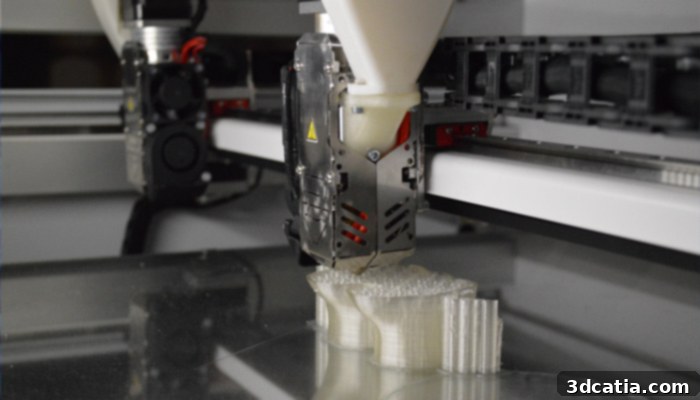
Pellet extruder developed by Tumaker (photo credits: 3Dnatives)
The Mechanics of Pellet 3D Printing: How it Works
Understanding the operational differences between filament and pellet 3D printing is crucial. A key distinction lies in the extrusion system itself. Unlike filament extruders, which feed a continuous strand of material, pellet extruders feature an integrated hopper or bowl. This hopper serves as a reservoir, gradually collecting and feeding the granular materials into a melting zone. Within this zone, typically comprising a heated barrel and a rotating screw, the pellets are subjected to controlled heat and pressure. As they move through the barrel, they progressively soften and melt into a viscous, extrudable consistency. Once the material reaches the desired melt viscosity, the molten plastic is precisely ejected through a nozzle and deposited onto the build platform, layer by layer, forming the final object. While this process may appear slightly more complex than the direct feeding of a filament, it unlocks a myriad of really compelling benefits that significantly enhance the capabilities of additive manufacturing.
Pellet vs. Filament Extrusion: A Closer Look
The design of a pellet extruder is fundamentally different from its filament counterpart. A traditional FDM extruder pulls a rigid filament through a hot end, where it melts and is pushed out through a nozzle. The consistency and diameter of the filament are critical for this process. Pellet extruders, on the other hand, manage loose, granular material. The integrated screw mechanism within a pellet extruder not only melts the plastic but also generates the necessary pressure to force the molten material through the nozzle. This robust design allows for a much wider range of materials, including those that are too brittle or too flexible to be processed into filament form. Furthermore, the ability to control the screw speed and heating elements independently offers greater precision in melt flow and temperature profiles, which can be advantageous for optimizing print quality and material characteristics.
Advantages of Pellet 3D Printing: Unlocking New Potentials
The adoption of pellet 3D printing brings forth a host of significant advantages that are reshaping the economics and capabilities of additive manufacturing. One of the most compelling benefits is a substantial reduction in the final cost of manufactured parts. This cost saving stems from two primary factors: the inherently lower price of raw plastic pellets compared to their filament counterparts, and a notable decrease in overall manufacturing time. Pellets are typically purchased in bulk, often at a fraction of the cost per kilogram of filament, which has undergone additional processing steps like extrusion and spooling. This makes pellet printing an exceptionally ideal technology for the cost-effective production of long series of parts or for manufacturing very large components that would otherwise be economically unfeasible with traditional filament methods.
Another crucial advantage is the significant reduction in printing issues, particularly material jams during the manufacturing process. Filament-based systems are susceptible to problems such as tangled spools, brittle filaments snapping, or inconsistent filament diameters leading to extruder blockages. Pellet extruders, by design, handle loose granular material, which inherently mitigates many of these common printing frustrations, leading to more reliable and uninterrupted print cycles. This enhanced reliability is particularly valuable for industrial applications where print failures can lead to considerable material waste and downtime.
Enhanced Material Properties and Performance
Perhaps one of the most exciting aspects of working with granular materials is the ability to achieve superior final part properties. When thermoplastics are processed into filaments, they undergo several heating and cooling cycles. Each heating cycle can induce a degree of thermal degradation, altering the polymer’s molecular structure and consequently diminishing its mechanical and chemical properties. To counteract this, filament manufacturers often incorporate additives, which, while beneficial, mean the filament no longer perfectly replicates the raw material’s original characteristics. In contrast, pellet 3D printing utilizes the raw material directly, minimizing these intermediate thermal transformations. This direct-to-print approach allows users to bypass significant material degradation, resulting in manufactured parts that retain properties much closer to the pristine chemical and physical characteristics of the plastic used in high-performance processes like injection molding. This means superior strength, better thermal resistance, and improved chemical stability for the final printed object.
Greater Material Variety and Customization
Beyond cost and integrity, pellet 3D printing opens doors to an unprecedented range of material possibilities. The market for plastic pellets is vast, encompassing everything from commodity plastics like ABS and PLA to high-performance engineering polymers such as PEEK, PEI, and carbon fiber-filled composites. Many of these materials are difficult or impossible to process into stable filaments. With pellet extruders, manufacturers can experiment with a broader spectrum of polymers, including recycled plastics, custom blends, and even novel material formulations tailored for specific applications. Furthermore, the ability to combine different colored plastic pellets within the same printing tray effortlessly facilitates the creation of vibrant, multicolored parts without the need for intricate multi-extrusion filament systems, offering greater aesthetic flexibility and functional integration.
Challenges and Considerations in Pellet 3D Printing
Despite its numerous benefits, pellet 3D printing is not without its challenges, primarily due to its relative novelty and the ongoing development of the technology. Currently, pellet 3D printing is not as widely democratized or accessible as filament-based systems. This means that finding off-the-shelf, affordable pellet extruders or compatible printers can be more difficult. The development and integration of extruders specifically adapted for these granular materials require specialized engineering and investment, which can limit immediate widespread adoption for hobbyists and smaller businesses.
Another significant challenge pertains to the control of material flow, particularly for parts requiring very intricate details or complex geometries. Unlike continuous filament, where a consistent diameter provides predictable extrusion, pellets are discrete units. When creating parts layer by layer, the individual pellets are melted and fused together, but their granular origin can make precise control over minute changes in flow rate more challenging. Achieving the fine resolution and surface finish often associated with advanced filament printers can be more difficult with current pellet systems, especially when navigating complex curves, overhangs, or thin walls. This aspect requires further technological refinement to broaden the scope of applications for pellet 3D printing to highly detailed and geometrically complex components.
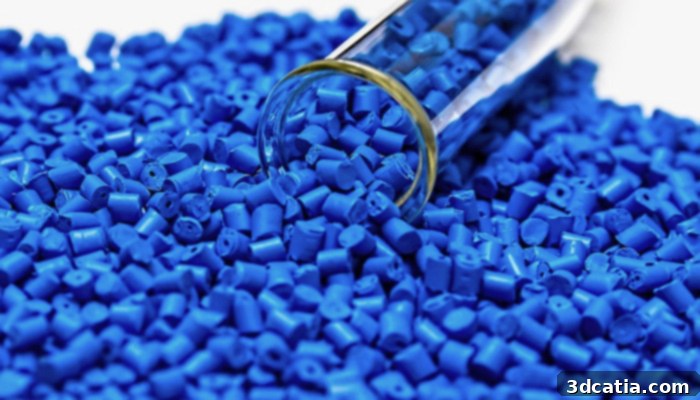
Pellets allow for the reduction of costs and manufacturing times
The Future of Pellet 3D Printing: A Glimpse Ahead
As we observe, the burgeoning popularity and undeniable advantages of pellet 3D printing are actively inspiring numerous companies to innovate and develop their proprietary manufacturing solutions. Pioneers in this field include the Spanish project Tumaker, renowned for its range of pellet 3D printers meticulously adapted to diverse user needs and industrial requirements. Similarly, the American company Titan Robotics has empowered its users by offering pellet printing capabilities on their robust Atlas series printers, demonstrating the scalability and industrial potential of this technology. These examples highlight a growing trend where manufacturers are recognizing the transformative power of direct pellet extrusion.
The trajectory of this new trend raises compelling questions: Will pellet 3D printing ultimately spell the end for traditional filament spools, or will both technologies coexist, each serving distinct market niches? What new innovators and industry players will emerge, betting on this groundbreaking additive manufacturing technology? The answers to these questions will undoubtedly unfold as the technology matures and becomes more accessible. What is certain is that pellet 3D printing represents a significant leap forward, promising greater material versatility, enhanced cost-effectiveness, and superior part performance for a wide array of industrial and creative applications. Its potential to unlock new dimensions in large-scale manufacturing, prototyping, and customized production is immense, making it a critical area of focus for the future of additive manufacturing.
If you’re eager to delve deeper into this transformative technology and understand how it’s breaking conventional boundaries, make sure to register for our upcoming exclusive webinar, “Breaking Boundaries With Pellet 3D Printing.” This insightful session is scheduled to take place on January 25th at 4 PM CET (10 AM EDT). Secure your free registration HERE and join industry experts to explore the latest advancements and applications in granular additive manufacturing.
We value your insights and would love to hear your perspective on the use of pellets in 3D printing! Share your thoughts in a comment below or engage with us on our social media platforms: LinkedIn, Facebook, and Twitter. Don’t miss out on the latest advancements and breaking news in the additive manufacturing world; sign up for our free weekly Newsletter here to receive direct updates in your inbox! You can also discover all our informative and engaging videos on our dedicated YouTube channel.