
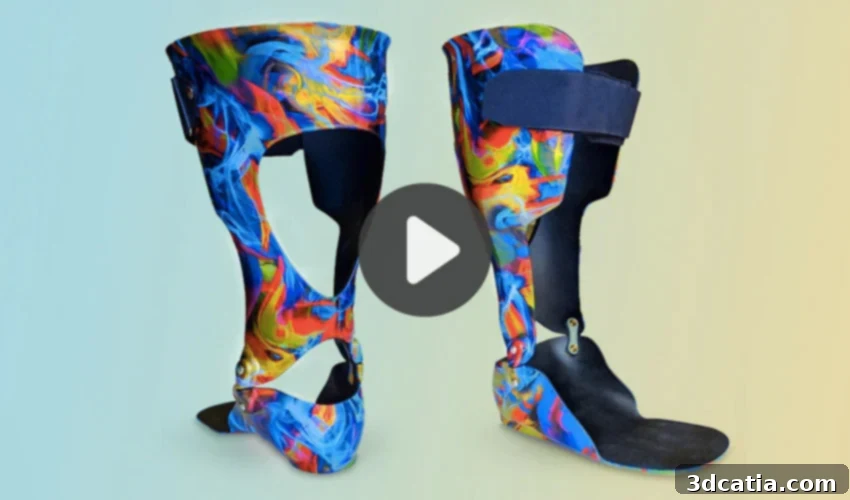
Revolutionizing Industries: A Deep Dive into 3D Printing’s Latest Breakthroughs in Orthotics, Aerospace, and Advanced Materials
Welcome to our weekly roundup of the most groundbreaking advancements and noteworthy happenings in the world of 3D printing! This week, we’re spotlighting a diverse array of innovations that underscore the transformative power of additive manufacturing across various sectors. From personalized healthcare solutions to the cutting edge of aerospace engineering and advanced material development, 3D printing continues to push the boundaries of what’s possible. We begin by exploring Korthotics, an Australian pioneer leveraging 3D technologies to deliver incredibly fast, reliable, and custom-fit orthotics. Following this, we bring you an urgent reminder about ADDITIV Aerospace, a premier event that’s just around the corner, promising deep insights into the future of flight and space exploration. Finally, prepare to be amazed by a significant material breakthrough from ExOne and Ford, as they unveil a revolutionary binder jetting process for 6061 aluminum, one of the most widely utilized aluminum alloys globally. Join us as we delve into these fascinating developments, each contributing to a future where manufacturing is more agile, efficient, and precise than ever before. We wish you all a good Sunday and an inspiring read!
Top 1: Korthotics Manufactures Custom Orthoses Using Advanced SLS Process
In the realm of personalized medicine, Korthotics, an innovative Australian company, stands out for its pioneering approach to creating custom orthotics. This week, we shine a spotlight on their exceptional use of 3D printing to produce tailor-made orthoses that significantly improve patient comfort and mobility. The traditional methods of creating orthotics often involve lengthy processes, including plaster casting and manual adjustments, which can be time-consuming and sometimes less precise. Korthotics, however, has embraced cutting-edge 3D technologies to streamline this process, making it faster, more accurate, and highly customizable to each patient’s unique needs.
The entire production workflow at Korthotics is a testament to the efficiency and precision that additive manufacturing brings to healthcare. It begins with a meticulous 3D scan of the patient’s foot. This digital capture provides an exact topographical map, far more detailed and less invasive than conventional casting methods. The high-resolution scan data is then seamlessly transmitted to sophisticated CAD software, where skilled technicians and designers create a precise digital model of the orthosis. This digital design phase allows for intricate adjustments and optimizations, ensuring the orthosis perfectly supports the foot’s biomechanics.
Once the digital design is finalized and approved, the orthosis moves into the production phase, where Korthotics harnesses the power of Selective Laser Sintering (SLS) technology. SLS is a powder bed fusion technique renowned for its ability to produce highly durable and geometrically complex parts from a wide range of thermoplastic materials. Specifically, Korthotics relies on the advanced 3D Systems ProX SLS 6100 3D printer for its production needs. This industrial-grade machine is celebrated for its large build volume, high precision, and consistent part quality, making it ideal for the batch production of custom medical devices like orthotics. The SLS process involves a laser selectively fusing powdered material layer by layer, building the orthosis from the bottom up without the need for support structures, which is a significant advantage for complex geometries and internal channels that can enhance comfort and ventilation. The result is a lightweight, strong, and perfectly contoured orthosis that dramatically improves the patient’s quality of life. The video below provides an insightful look into this entire production process, demonstrating how Korthotics is setting new standards in orthotic manufacturing.
Top 2: ADDITIV Aerospace – Exploring the Future of Flight with Additive Manufacturing
The countdown has begun! ADDITIV Aerospace, a must-attend event for anyone interested in the confluence of additive manufacturing and the aerospace sector, is scheduled to take place in just a few days. This pivotal conference is designed to bring together leading experts, innovators, and decision-makers to discuss how additive manufacturing (AM) is fundamentally transforming the aerospace industry. The applications of 3D printing in aerospace are vast and revolutionary, ranging from producing lightweight components with optimized geometries to reducing lead times for spare parts and enabling on-demand manufacturing in remote locations, including space itself.
If you are eager to delve deeper into how these cutting-edge technologies are reshaping the aerospace landscape, then ADDITIV Aerospace offers an unparalleled platform. The event features engaging panel discussions covering critical topics such as the primary challenges faced by additive manufacturing in aerospace – including material qualification, regulatory hurdles, process standardization, and the scaling of production – and innovative strategies being deployed to tackle them. Experts will share their insights on overcoming these barriers, detailing advancements in materials science, post-processing techniques, and quality assurance protocols that are paving the way for wider AM adoption.
Furthermore, the conference will explore the increasingly vital role of additive manufacturing in space exploration. From creating complex, high-performance rocket engine components to fabricating tools and spare parts directly in orbit or on celestial bodies, AM is crucial for making space missions more sustainable, cost-effective, and ambitious. Imagine the possibilities of manufacturing on Mars or the Moon, reducing the need to transport heavy equipment from Earth. Such visionary topics will be central to the discussions, offering a glimpse into the future of extraterrestrial manufacturing. The event boasts an impressive roster of speakers from prestigious organizations, including NASA, the European Space Agency, Eaton Aerospace, Rolls Royce, Airbus, Collins Aerospace, and many more industry giants. These luminaries will share their experiences, research findings, and strategic visions, providing invaluable perspectives on the current state and future trajectory of aerospace AM.
ADDITIV Aerospace is more than just a series of talks; it’s a vibrant hub for professionals to connect, collaborate, and innovate. Attendees will have ample opportunities to meet with peers and experts during dedicated networking sessions and participate in interactive workshops designed to foster practical knowledge and skills. Don’t miss this chance to engage with the brightest minds in the field, forge new partnerships, and stay abreast of the latest advancements that are propelling the aerospace industry forward. The event is scheduled for March 18th, running from 8 AM to 6 PM EDT (1 PM to 11 PM CET). To secure your spot and immerse yourself in this transformative discussion, register here. For additional information and a comprehensive agenda, you can also explore our website or watch the video below. Mark your calendars for an inspiring day of learning and networking!
Top 3: ExOne and Ford Unveil Breakthrough Binder Jetting Process for 6061 Aluminum
In a monumental stride for metal additive manufacturing, ExOne, a renowned manufacturer of industrial metal 3D printers, has joined forces with the iconic automobile manufacturer Ford to develop a revolutionary process. This groundbreaking collaboration has resulted in a binder jetting method specifically tailored for 6061 aluminum, a material that stands as one of the most widely used aluminum alloys across various industries due to its excellent strength-to-weight ratio, good weldability, and corrosion resistance. While the process is still awaiting patent approval, its implications for high-volume metal part production are profound.
The significance of this development cannot be overstated, particularly for sectors like automotive, aerospace, and general industrial manufacturing that heavily rely on aluminum components. Traditional 3D printing methods for metals, such as Selective Laser Melting (SLM) or Electron Beam Melting (EBM), can be very effective but often come with limitations in terms of build speed, cost, and the types of alloys that can be processed efficiently. Binder jetting, on the other hand, offers a fundamentally different approach. It works by using a liquid binding agent to selectively join powdered metal particles layer by layer, forming a “green” part that then undergoes a sintering process to achieve its final density and strength. This method is inherently faster and more scalable than fusion-based processes, making it particularly well-suited for industrial production volumes.
The new process developed by ExOne and Ford promises to significantly accelerate the production of aluminum parts, far surpassing the speed capabilities of many other metal 3D printing techniques. This enhanced speed is critical for the automotive industry, which demands high-volume output to meet production schedules. What makes this breakthrough even more impressive are the material properties of the printed parts: they achieve a remarkable density of 99%, with characteristics comparable to those of traditionally manufactured 6061 aluminum components. This means that parts produced via this binder jetting method are not merely prototypes but fully functional, end-use parts capable of withstanding the rigorous demands of automotive applications and beyond. The ability to produce high-density 6061 aluminum parts quickly and efficiently represents a substantial innovation for the industry, potentially unlocking new design freedoms, reducing waste, and shortening supply chains. This collaboration exemplifies how additive manufacturing continues to evolve, pushing the boundaries of material science and production methodologies to create tangible industrial advantages. The video below offers more details on this exciting innovation.
Top 4: Xometry Partners with Stratasys to Expand Access to High-Performance SLS Materials
In a move set to empower engineers and designers with broader access to advanced manufacturing capabilities, Xometry, a leading AI-powered marketplace for on-demand manufacturing, has announced a strategic partnership with Stratasys, a global leader in industrial 3D printing solutions. This collaboration is specifically designed to expand the range of high-performance materials available for Selective Laser Sintering (SLS) printing, directly accessible through Xometry’s expansive digital platform. For engineers constantly seeking innovative materials to meet stringent performance requirements, this partnership offers a streamlined pathway to prototyping and producing functional parts with superior properties.
The essence of this partnership lies in providing engineers with immediate access to Stratasys’s cutting-edge polymer materials optimized for SLS technology. SLS is celebrated for its ability to produce highly durable and geometrically complex parts without the need for support structures, making it a preferred choice for functional prototypes and end-use components across various industries, including aerospace, automotive, medical, and consumer goods. Through this collaboration, Xometry now proudly offers four distinct high-performance nylon materials, each engineered to address specific application needs and performance criteria.
The first material introduced is **Nylon 11 EX**, a robust polymer characterized by its exceptional impact resistance and presented in a clean white color. This material is ideal for applications where parts are subjected to sudden forces or require a high degree of toughness to prevent breakage. Next in the lineup is **Nylon 11 HST**, a mineral fiber-reinforced variant specifically designed for high-temperature resistance. This makes it an excellent choice for components that must maintain their structural integrity and mechanical properties in elevated thermal environments, such as under-the-hood automotive parts or industrial fixtures. Rounding out the new offerings are **Nylon 12 AF** and **Nylon 12 CF**, both distinguished by their outstanding strength and rigidity. Nylon 12 AF (Aluminum-Filled) typically incorporates aluminum particles to enhance stiffness and dimensional stability, while Nylon 12 CF (Carbon Fiber-Filled) leverages carbon fibers to provide an even higher strength-to-weight ratio and superior structural integrity. These materials are perfect for applications demanding lightweight yet incredibly strong and stiff components, such as jigs, fixtures, and performance-critical end-use parts.
By making these specialized Stratasys materials readily available on the Xometry platform, the partnership significantly lowers the barrier to entry for companies looking to leverage advanced additive manufacturing. Engineers can now easily upload their designs, select the appropriate high-performance nylon, and receive instant quotes and rapid production services, accelerating product development cycles and fostering innovation. This strategic alliance not only enhances Xometry’s extensive material portfolio but also reinforces its commitment to democratizing access to industrial 3D printing, ensuring that businesses of all sizes can tap into the potential of state-of-the-art additive manufacturing for their most demanding projects. The accompanying video offers a closer look at the benefits of these materials and the partnership.
Top 5: cDLM Printing with the EnvisionOne – Redefining Speed and Precision in Resin 3D Printing
This week, we also explore the fascinating world of Continuous Digital Light Manufacturing, or cDLM, a proprietary and patented generative manufacturing process developed by EnvisionTEC, a pioneer in high-precision 3D printing. cDLM represents a significant advancement over traditional Digital Light Processing (DLP) technology, pushing the boundaries of speed, accuracy, and surface finish in resin-based additive manufacturing. At its core, cDLM, much like stereolithography (SLA), utilizes a light-sensitive liquid plastic, or photopolymer resin, for printing. However, the ‘continuous’ aspect is where cDLM truly shines, differentiating itself by virtually eliminating the traditional layer-by-layer stop-and-go process that characterizes most vat photopolymerization methods.
In conventional DLP, each layer is cured, the build platform lifts, a new layer of resin flows underneath, and then the platform lowers before the next layer is cured. This cyclical motion, while effective, introduces delays and can sometimes affect surface quality. cDLM, conversely, employs a specialized oxygen-permeable optical window that creates a “dead zone” or non-stick interface between the projected light and the resin. This prevents the resin from adhering to the bottom of the vat, allowing the print to be pulled continuously from the resin bath without needing to separate and re-submerge for each layer. The result is a dramatically faster print speed, sometimes up to hundreds of millimeters per hour, while simultaneously achieving exceptional surface smoothness and intricate detail.
The unique advantages of cDLM printing make it particularly suitable for a wide array of demanding applications where speed, precision, and fine features are paramount. One of its most prominent uses is in the production of intricate **jewelry**, enabling designers to create highly detailed models for casting or direct-use pieces with complex geometries that would be challenging or impossible with other manufacturing techniques. In the **medical field**, cDLM technology from EnvisionTEC plays a crucial role in creating precise dental models, surgical guides, hearing aids, and other custom medical devices. The accuracy and biocompatibility of specific resins used with cDLM make it invaluable for patient-specific solutions. Furthermore, its ability to produce lightweight yet robust parts with excellent surface finish finds utility in **space travel applications**, where every gram counts, and components must withstand extreme conditions.
The EnvisionOne 3D printer, EnvisionTEC’s flagship cDLM machine, embodies these technological advancements, offering industrial-grade performance in a compact footprint. It provides users with unparalleled speed and accuracy, opening new avenues for rapid prototyping and high-volume additive manufacturing across various industries. The video below showcases the EnvisionOne in action, demonstrating how this cutting-edge technology operates and the superior quality of the parts it produces, further illustrating the transformative impact of continuous digital light manufacturing on modern production processes.
That wraps up this week’s exploration into the dynamic world of 3D printing! We hope you found these top 5 videos and their accompanying insights as captivating as we did. From Korthotics’ personalized orthotics revolutionizing patient care, to the vital discussions at ADDITIV Aerospace shaping the future of aviation, the industrial impact of ExOne and Ford’s binder jetting for 6061 aluminum, the enhanced material access through Xometry and Stratasys’s partnership, and the unparalleled speed and precision of cDLM printing with the EnvisionOne – it’s clear that additive manufacturing continues to drive unprecedented innovation across diverse sectors. Each development highlighted here represents not just a technological advancement but a step towards a more efficient, customized, and sustainable future.
Which of these groundbreaking innovations captured your imagination the most? We’d love to hear your thoughts and insights! Share your favorite video and what you found most interesting in a comment below, or engage with us on our social media channels: Facebook, Twitter, and LinkedIn. Your feedback is invaluable in understanding the pulse of the 3D printing community. And don’t forget, to ensure you never miss out on the latest news, breakthrough technologies, and key events in the additive manufacturing industry, sign up for our free weekly Newsletter. Get all the essential updates delivered straight to your inbox, keeping you at the forefront of this rapidly evolving field!