
Revolutionizing Metal 3D Printing: AMGTA Unveils Sustainable Waste Recycling Process
The landscape of advanced manufacturing is constantly evolving, with a growing emphasis on sustainable practices. In a significant leap forward for environmental responsibility within the additive manufacturing sector, the Additive Manufacturer Green Trade Association (AMGTA) has released a pivotal new report. This report details a groundbreaking process designed to safely passivate metal condensate waste, making it suitable for transport and recycling. Developed collaboratively by Sintavia, a prominent member of the AMGTA, and KBM Advanced Materials, this innovative procedure offers a viable solution to one of the industry’s most pressing environmental challenges. By mixing hazardous powder condensate waste with a special, removable resin, the material is rendered non-hazardous, ensuring it can be safely transported to recycling facilities. Given the persistent concerns surrounding the proper disposal and recycling of metal powders in 3D printing, this development represents a monumental step toward achieving greater sustainability across the industry.
Additive manufacturing, particularly Powder Bed Fusion (PBF), has emerged as a cornerstone technology for various high-demand industries. PBF processes are especially favored by sectors requiring the ability to design and produce highly complex, intricate parts that are often impossible to achieve with traditional manufacturing methods. The aerospace, automotive, and medical fields, for instance, rely heavily on metal PBF to create lightweight components, custom implants, and performance-optimized parts. These technologies offer unparalleled opportunities for innovation, reducing material waste during production compared to subtractive methods, and enabling rapid prototyping and iterative design cycles. However, despite its myriad benefits and efficiencies in material usage during the build phase, metal PBF does present unique challenges, particularly concerning the disposal of condensate created during the printing process.
This specialized powder condensate is a unique waste stream generated from the fine splatter, agglomerated particles, and unused powder that is sieved out of a reused batch of metal powder. Due to its fine particulate nature, and sometimes its reactivity or specific material properties (e.g., titanium, aluminum alloys), this waste is often classified as hazardous. From both an environmental stewardship perspective and a commercial operational standpoint, the management and disposal of this hazardous waste have historically posed a significant dilemma. Current disposal methods often involve expensive hazardous waste transportation and landfilling, which not only incurs substantial costs for manufacturers but also carries a heavy environmental burden. This complex issue has long underscored the urgent need for an innovative, sustainable, and economically viable solution to manage the byproducts of advanced metal additive manufacturing.
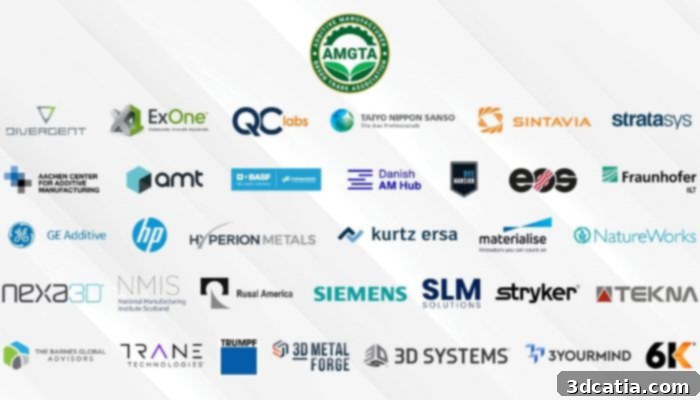
Members of AMGTA (photo credits: Business Wire)
A Revolutionary New Solution for Metal AM Waste
Responding directly to the critical need for improved hazardous waste management in metal additive manufacturing, Sintavia undertook extensive research and development to devise a truly promising solution. Previously, common practice might have involved mixing such hazardous waste with substances like silicon oil and sand, which renders the material inert but also practically unrecyclable. The new, innovative procedure fundamentally changes this approach: it involves mixing the powder condensate waste with a specialized, removable resin. This resin effectively encapsulates the hazardous particles, preventing their release and stabilizing the material, thus rendering it non-hazardous for transportation purposes.
During the rigorous testing phase of this novel method, comprehensive safety protocols were observed, and no hazardous situations were reported. Crucially, air quality monitoring remained consistently within acceptable safety limits, underscoring the procedure’s efficacy and safety for industrial implementation. This marks a significant departure from previous concerns related to handling and transporting such materials. Sherri Monroe, the Executive Director of the AMGTA, has expressed strong confidence in the profound impact of this new process. She explains, “Today’s report is a must-read for any company involved in laser powder bed fusion metal additive manufacturing. Not only does this new process reduce transportation costs, but it is also reversible, meaning that metal recycling companies can have unsoiled access to the underlying powder once it is received—thus allowing for the potential to recycle waste material that previously had to be put in a hazardous waste landfill.”
The reversibility aspect highlighted by Monroe is a game-changer. It means that once the treated waste reaches a recycling facility, the resin can be efficiently separated, liberating the valuable metal powder for reprocessing. This not only diverts substantial quantities of material from landfills but also helps conserve virgin raw materials, aligning perfectly with the principles of a circular economy. The ability to reclaim these precious metals translates directly into environmental benefits, reducing the energy and resource intensity associated with mining and processing new metals. Furthermore, by reclassifying the material from hazardous to non-hazardous, companies can realize significant savings on transportation, storage, and disposal costs, making sustainable practices more economically attractive.
Shaping the Future of Sustainable Additive Manufacturing
While initial tests have unequivocally proven the process’s effectiveness and safety with specific types of metal powder condensate, further trials are planned. These upcoming studies will involve other diverse types of powder condensate to meticulously ensure its broad functionality and adaptability across the wide range of materials used in metal PBF. This meticulous approach guarantees that the solution is robust and applicable to the varied needs of the additive manufacturing industry. Even at this early stage, it is undeniably safe to assert that this new procedure represents a profoundly sustainable solution poised to revolutionize how hazardous powder waste is managed and mitigated in the future.
The implications for the metal additive manufacturing sector are far-reaching. By providing a clear, safe, and economically advantageous pathway for waste recycling, this innovation removes a significant barrier to the widespread adoption of sustainable practices. It fosters a more responsible approach to resource management and strengthens the industry’s environmental credentials. Brian Neff, the AMGTA’s Board Chair and CEO of Sintavia, underscores the importance of this development, stating, “I hope that other companies adopt this new process, as it will reduce their transportation costs since the underlying material is no longer hazardous. This report is an excellent example of the AMGTA taking a leadership role in developing sustainable use practices for additive manufacturing.” His call to action emphasizes the collective responsibility of the industry to embrace such advancements for mutual benefit and the greater good of the planet.
This report from the AMGTA is more than just a technical document; it is a blueprint for a greener future in metal 3D printing. It demonstrates how collaboration between industry associations and innovative companies can lead to practical solutions that address complex environmental challenges head-on. By converting what was once an expensive and environmentally damaging waste stream into a valuable, recyclable resource, the industry moves closer to realizing a true circular economy for advanced manufacturing materials. This not only benefits individual companies through cost reductions but also enhances the overall sustainability profile of additive manufacturing, making it an even more attractive and responsible choice for global industries.
The full report, offering detailed insights into the process and its implications, is available for download on the AMGTA’s resources page. You can access it HERE. We encourage all stakeholders in the additive manufacturing ecosystem – from material suppliers and machine manufacturers to end-users and policymakers – to review this vital information and consider how these sustainable practices can be integrated into their own operations. This is a critical step towards fostering a more environmentally conscious and resource-efficient future for advanced manufacturing worldwide.
What are your thoughts on this innovative new process for metal AM waste? We invite you to share your perspective in a comment below or join the conversation on our LinkedIn, Facebook, and Twitter pages! Don’t forget to sign up for our free weekly Newsletter here to receive the latest 3D printing news straight to your inbox. You can also find all our compelling videos and interviews on our YouTube channel, offering deeper dives into the world of additive manufacturing.