
Parastruct: Pioneering Sustainable 3D Printing and Circular Construction with Georg Breitenberger
The innovative startup Parastruct has rapidly gained prominence, notably after securing a win in the highly competitive “Waste Management and Recycling” category from Kurier magazine. This accolade highlights the company’s commitment to spearheading a sustainable revolution within the construction sector. Parastruct achieves this through groundbreaking solutions that meticulously adhere to the core principles of circular production, transforming how we think about building materials and processes. But their vision extends far beyond current industry standards.
In an exclusive interview, Parastruct’s visionary founder, Georg Breitenberger, offers an insightful look into the philosophical underpinnings of circular production, elucidates the ambitious goals driving his young company, and provides a comprehensive overview of the cutting-edge technologies Parastruct employs. Breitenberger, a former master bricklayer, draws upon a rich tapestry of experience, from his foundational artisanal training to transformative study trips in Taiwan, all of which have profoundly shaped Parastruct’s unique operational ethos. Join us as we delve into this captivating interview to discover the inner workings and future aspirations of Parastruct.
3DN: Could you briefly introduce yourself and tell us how you first got involved with 3D printing?
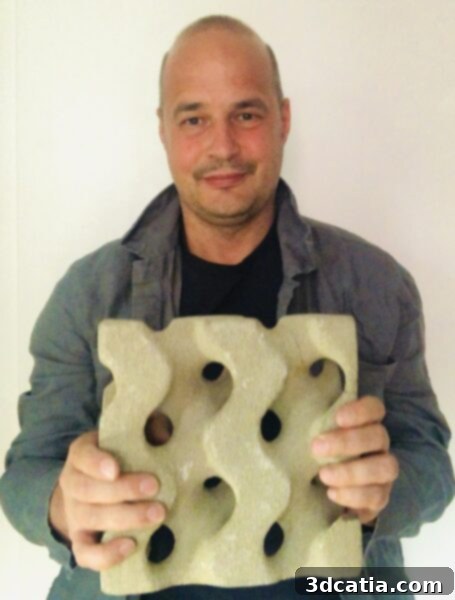
Georg Breitenberger founded Parastruct in 2021.
My name is Georg Breitenberger, and my professional journey began as a master bricklayer by trade, which provided me with a deep, practical understanding of construction. Following this, I pursued higher education, studying civil engineering and business administration, which broadened my perspective on the structural and economic aspects of the industry. My early career saw me working in real estate development and the precast concrete industry, sectors where I witnessed firsthand the significant material consumption and waste generation inherent in traditional construction. It was in 2021 that I made the pivotal decision to found Parastruct, driven by a desire to address these challenges head-on.
At Parastruct, our core mission is to develop highly sustainable materials derived from biogenic and mineral waste streams. We meticulously transform these discarded resources into advanced materials specifically engineered for 3D printing applications within the construction industry. Furthermore, we actively foster collaborative projects, bridging the gap between machinery manufacturers and innovative 3D printing solution providers to accelerate the adoption of these transformative technologies.
My initial foray into 3D printing occurred about ten years ago, almost by chance, during a period of what I would describe as rather dull academic studies. I’ve always harbored a keen interest in new and disruptive technologies, and it was through a friend that I first learned about 3D concrete printing. The timing was fortuitous, as I was concurrently working at a technical testing and research institute’s laboratory. This confluence of circumstances eventually led to a more extensive research project at a university in Taiwan, which at that time, surprisingly, represented the sole source of funding willing to support our pioneering work. The potential of 3D printing soon caught the attention of the precast concrete industry, and following this, I dedicated myself to developing specialized 3D printers and bespoke materials for various companies, solidifying my expertise in this emerging field.
3DN: How was Parastruct founded, and what is its mission?
I founded Parastruct with the explicit purpose of bringing my own vision to fruition within the burgeoning field of 3D printing for the construction industry. I recognized the immense, untapped potential that 3D printing processes held, particularly in powder-based printing methods. I firmly believe that binder jetting is poised to revolutionize component production, offering the most powerful tool the construction industry has at its disposal to navigate and effectively address future challenges. These challenges include critical issues such as fostering greater sustainability, mitigating the growing skilled labor shortages, enhancing overall productivity, and achieving crucial price stability in an increasingly volatile market.
What we meticulously pursue at Parastruct is encapsulated by our unique approach, which we term Circular Advanced Manufacturing. Through the strategic integration of our sustainable materials and advanced 3D printing methodologies, our overarching aim is to make construction inherently more functional, environmentally responsible, highly customizable, and ultimately, more affordable. It’s an undeniable fact that the construction industry currently stands as one of the largest emitters of CO2 globally and simultaneously the biggest producer of waste. To counter this, we proactively utilize both biogenic and mineral waste materials, skillfully combining them with our innovative low-carbon binders. This process allows us to produce highly sustainable and exceptionally cost-effective 3D printing materials, thereby transforming waste into valuable resources and drastically reducing the environmental footprint of construction.
3DN: What technologies and materials do you use, and why?
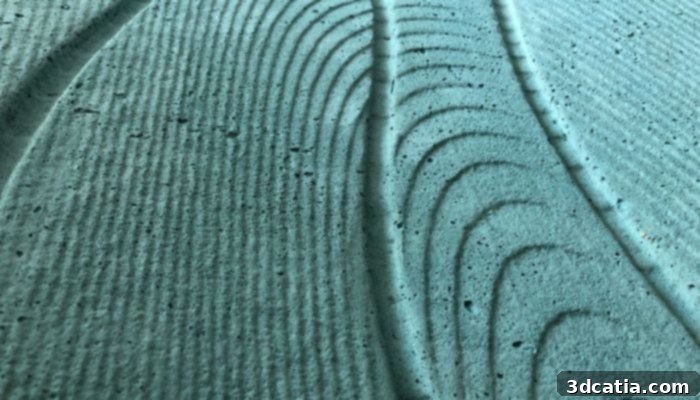
At Parastruct, we employ specific in-house recycling methods, expertly designed to extract and reactivate valuable mineral binders from various waste streams and industrial byproducts. These reclaimed binders are then meticulously utilized to formulate sustainable materials for the conventional construction industry, with a particular focus on the precast concrete sector where their impact can be significant. Concurrently, we are deeply invested in developing advanced materials specifically tailored for a range of 3D printing processes. Our technological portfolio includes working with Contour Crafting, a well-known extrusion process, as well as Selective Binder Activation and Paste Intrusion, both robust powder-based printing processes. Furthermore, we are proud to incorporate Mineral Binder Lithography, an innovative new process developed entirely in-house by Parastruct.
Each of these distinct 3D printing technologies possesses its own unique set of advantages, disadvantages, and optimal applications. It is absolutely essential to thoroughly understand these nuances to create truly meaningful and impactful products. For instance, while the concept of 3D printing an entire house might capture headlines, it is often not economically viable or practical for widespread application. Our focus remains on optimizing specific components and applications where additive manufacturing delivers tangible benefits in sustainability, efficiency, and design flexibility.
Crucially, our material selection is strictly limited to biogenic and mineral materials. In the vast majority of cases, these are waste materials and byproducts that would otherwise be discarded, contributing to landfill and environmental burden. We ingeniously convert these into high-performance 3D printing materials that are not only sustainable but also non-toxic. A key differentiator, thanks to our advanced binder recycling processes, is that these materials retain their value and can be effectively reused after their initial lifecycle, establishing a truly closed-loop system and further enhancing their environmental credentials.
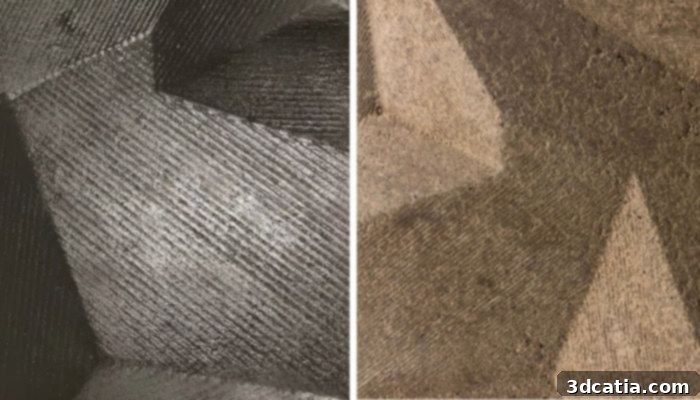
Parastruct processes various waste materials into new 3D printing materials.
3DN: We understand that you focus on circular production. How do you implement this circularity?
For us at Parastruct, circularity transcends being merely an ecological principle; it fundamentally serves as a sophisticated technological design framework that guides every aspect of our operations. We meticulously implement this circularity across multiple integrated levels, leveraging innovative materials, pioneering circular processes, and cutting-edge digital manufacturing technologies such as 3D printing. Our entire company concept is strategically built upon four main, interconnected pillars, each designed to reinforce our commitment to a truly sustainable future in construction:
- Use of Circular Raw Materials: Our sustainable construction materials are predominantly manufactured from industry byproducts that would otherwise be considered waste. This includes materials such as steel mill slag or various forms of biogenic waste, like wood flour, hemp fibers, or rice husks. By diverting these materials from landfills or energy-intensive disposal processes, we effectively transform them into the essential basis for our next-generation sustainable construction materials, drastically reducing virgin resource consumption.
- Recovery and Recycling of Mineral Binders: A cornerstone of our technological priorities is advanced cement recycling. We possess proprietary methods to efficiently recover active binders from demolished concrete and subsequently reactivate them for reuse in new construction applications. This breakthrough allows, for the very first time, the realization of true circulation for mineral construction materials that have historically been simply dumped or downcycled into lower-value applications at the end of their service life, creating a genuine closed loop.
- Additive Manufacturing: Our specifically engineered circular materials are optimally developed for various 3D printing processes. Additive manufacturing not only facilitates highly optimized and remarkably material-efficient construction, significantly reducing waste and material usage, but it also enables locally adapted production. This localized approach drastically shortens supply chains, minimizing transportation emissions and fostering regional economic development, while providing unprecedented design freedom.
- Reuse and Modular Design: Our materials and designed components are conceived from the outset to strictly adhere to the principle of disassemblability. This means that printed components are engineered to be easily separated, meticulously disassembled, and subsequently either directly reused in new structures or efficiently recycled without any significant loss of quality or performance. This modularity ensures a longer lifecycle for materials and components, reducing the need for new production and minimizing waste generation.
3DN: What are your biggest current challenges?
The biggest challenges we currently face, particularly within Europe, revolve significantly around securing adequate funding for promising, truly disruptive technologies. There’s a persistent reluctance to invest in innovations that challenge the status quo, which often hinders the growth of pioneering solutions like ours. Furthermore, we encounter substantial gaps in mindset when it comes to embracing new technologies. I vividly recall that when I first began working with 3D concrete printing in Austria a decade ago, my efforts were met with skepticism and even ridicule. Especially within German-speaking countries, there appears to be a deeply entrenched focus on preserving established processes and conventional technologies. While this approach might offer a sense of stability in the short term, it simultaneously leads to a critical loss of competitiveness on the global stage, as other regions rapidly adopt and develop advanced manufacturing techniques.
To overcome these hurdles and truly advance 3D printing in Europe, I strongly encourage the entire 3D printing community to forge robust partnerships. In these collaborations, each participant should contribute their core competencies, fostering an environment where synergistic efforts can achieve the greatest possible leverage. Only through such strategic alliances and a collective shift in mindset can we unlock the full potential of additive manufacturing and position Europe as a leader in sustainable and innovative construction.
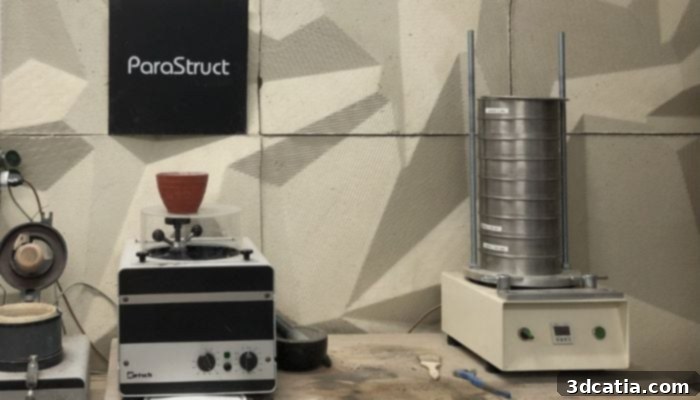
A behind-the-scenes look at Parastruct
3DN: Can you give us a preview of your upcoming projects?
We have an exciting array of projects currently underway and in development, showcasing the diverse applications of our circular production and 3D printing expertise. In collaboration with a specialized Spanish company focusing on coastal protection, we are actively developing highly sustainable 3D-printed construction elements. These elements, crafted from recycled materials, are specifically engineered to exhibit exceptional resilience and durability against harsh marine conditions, offering an eco-friendly solution to erosion and habitat creation. For a prominent French fashion company, we are meticulously creating an innovative concept for fully recyclable 3D-printed commercial fixtures. This project aims to demonstrate how additive manufacturing can enable rapid, customizable, and environmentally responsible retail design. Additionally, we are working closely with a construction waste recycling company to design and implement a novel powder-based 3D printing process specifically tailored to efficiently process and utilize construction waste as a primary feedstock. In Germany, our partnership with the Technical University of Darmstadt is focused on pioneering the development of advanced 3D-printed cellulose acoustic panels, aiming to deliver sustainable and high-performing sound management solutions for various architectural applications.
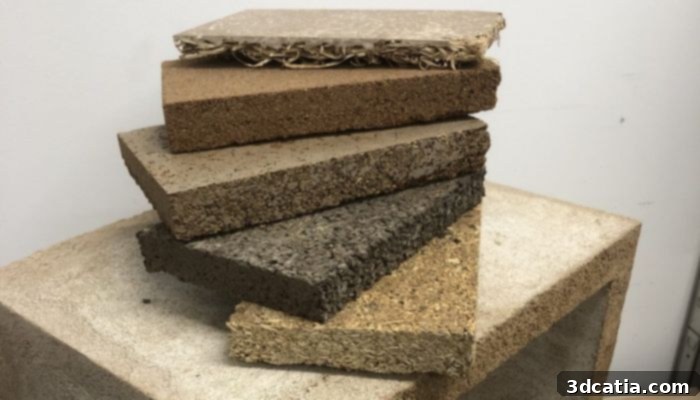
Different materials that Parastruct reprocesses through 3D printing
3DN: Any final words for our readers?
We are undeniably standing at a critical turning point for the construction industry and, indeed, for our planet. The escalating raw material crises, urgent need to reduce CO₂ emissions, and persistent waste problems collectively demand a radical rethinking of how we build. However, this profound challenge simultaneously presents an extraordinary opportunity. By strategically harnessing the power of new technologies—such as advanced 3D printing, innovative circular materials, and sophisticated data-driven planning—we have the unprecedented chance to create a construction sector that is not only climate-positive but also exceptionally efficient, and offers unparalleled freedom in design. Parastruct is dedicated to leading this transformation, building a future where construction actively regenerates rather than depletes resources.
You can find more detailed information about Parastruct and our pioneering work HERE. What are your thoughts on Parastruct’s vision and innovations? We encourage you to share your insights in a comment below or engage with us on our LinkedIn or Facebook pages! Additionally, don’t forget to sign up for our free weekly Newsletter to receive the very latest 3D printing news directly in your inbox. You can also explore all our informative videos and content on our YouTube channel. Stay connected with the future of additive manufacturing!
*All Photo Credits: Parastruct