
Michelangelo’s David Reimagined: How 3D Printing Created a Masterpiece for Dubai Expo 2020
The intersection of ancient artistry and modern innovation is continuously reshaping how we interact with, interpret, and preserve invaluable cultural heritage. Across the diverse realms of architecture, design, and fine art, 3D printing has consistently proven its transformative utility and immense potential. From visionary artists like Jakub Pastuszak, who expertly employs additive manufacturing techniques to craft intricate artworks for the Amber Museum in Gdansk, Poland, to ambitious global initiatives such as Scan the World, which leverages advanced 3D technologies to reproduce and democratize access to countless cultural artifacts, the applications are as varied as they are impactful. This revolutionary technology recently commanded significant attention at one of the world’s most anticipated cultural exhibitions: the World Expo 2020 in Dubai. Postponed from its original 2020 schedule due to the global health crisis, the Expo officially opened its doors on October 1st and welcomed visitors until March 31st. This grand international event provided an extraordinary platform for each participating nation to showcase its unique contributions and innovations within its dedicated pavilion over a six-month period. The overarching goal was to address critical global topics related to “connecting minds” and “building the future,” with a profound emphasis on the interconnected principles of sustainability and mobility. The Expo truly embodied a spirit of global collaboration, inviting attendees to imagine and build a better tomorrow.
Among the myriad of compelling national presentations, the Italian pavilion stood out for its ingenious and captivating integration of the exhibition’s core themes. Italy achieved a remarkable feat by harnessing advanced 3D technologies to create an astonishingly accurate reproduction of Michelangelo’s universally celebrated masterpiece: the statue of David. This iconic sculpture, which depicts the biblical hero in the legendary moments leading up to his confrontation with the giant Goliath, became a powerful symbol of human spirit and technological prowess within the Italian exhibit. The meticulous project, a testament to both artistic dedication and scientific precision, unfolded over an intensive four-month period. According to Grazia Tucci, a distinguished professor of geometry at the University of Florence and the coordinating mind behind this ambitious endeavor, the engineering department of the University of Florence played a pivotal role. They collaborated strategically with the Swedish industrial technology group Hexagon, a global leader renowned for its specialization in cutting-edge sensing, software, and autonomous solutions. This symbiotic partnership proved invaluable, blending academic rigor with industrial expertise. The result was a replica of such unparalleled fidelity that Ms. Tucci confidently declared, “we’ve got now essentially the most trustworthy replica of the David.” This statement not only highlights the exceptional accuracy achieved but also underscores the potential of 3D technology to set new standards in cultural artifact reproduction and preservation.
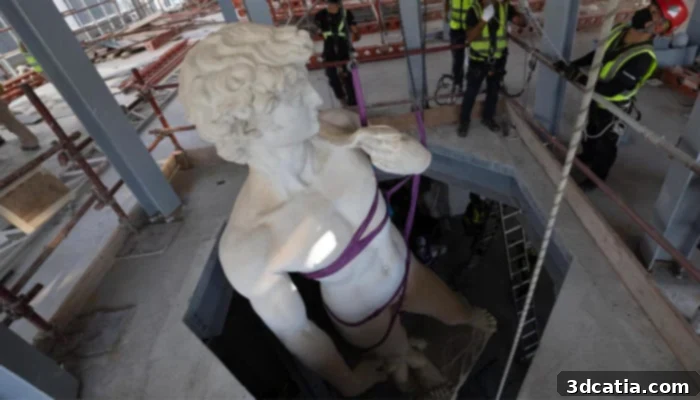
The 3D printed replica of Michelangelo’s David is a marvel of modern technology, weighing ten times less than the original marble sculpture. (Photo credits: Massimo Sestini for ItalyExpo2020)
Crafting a “Digital Twin”: The Intricate Journey from Scan to Sculpture
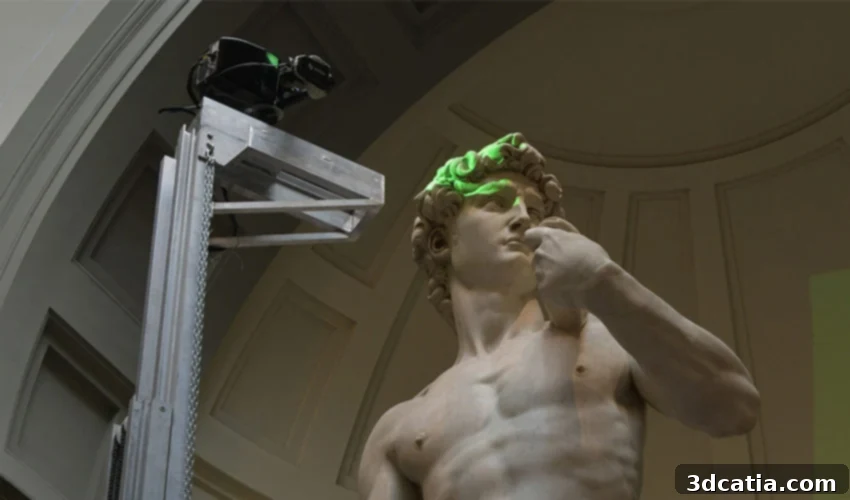
The ambitious undertaking of creating a faithful “digital twin” of Michelangelo’s David was a monumental engineering challenge, rivaling the scale and precision of the original artwork itself. Given the statue’s imposing height of 5 meters (approximately 17 feet), the initial phase involved an extraordinarily detailed digital capture. A specially designed, robust tripod system was engineered and deployed to meticulously navigate around the colossal sculpture. This setup enabled the capture of thousands of high-resolution scans from every conceivable angle, generating an intricate point cloud data set that precisely mapped every contour, texture, and minute detail of David’s form. This exhaustive scanning process was crucial to ensuring that the digital model, and subsequently the physical replica, would possess an unprecedented level of accuracy and authenticity. Once the digital model was perfected, the next significant hurdle was the actual fabrication. As might be anticipated, the sheer scale of David made it impossible to print the entire replica as a single, monolithic piece with current 3D printing capabilities. Resourceful and innovative, the project organizers devised a pragmatic solution: the digital model was intelligently segmented into 14 individual, printable sections. Each of these sections was then expertly produced using a high-quality acrylic resin, a material chosen for its excellent dimensional stability, ability to capture fine details, and relative lightness compared to marble. Upon completion of the printing phase, a dedicated team of skilled art restorers meticulously assembled the various printed components. They employed specialized adhesives and, in a nod to traditional restoration artistry, incorporated finely ground marble dust to seamlessly join the parts, ensuring a cohesive and visually stunning final structure. This intricate process culminated in a breathtaking reproduction, hailed by Grazia Tucci as a true “digital twin.” Her long-term vision emphasizes the critical role 3D technologies will play in safeguarding, preserving, and making accessible our global cultural heritage for future generations, ensuring these masterpieces transcend time and remain universally appreciated.
Beyond Replication: Revitalizing Florence’s Cultural and Economic Landscape
The profound significance of this trailblazing initiative extends far beyond its technological marvel, carrying deep cultural and economic resonance, especially for the city of Florence—the historic heart of the Renaissance. The project’s organizers, in close collaboration with the passionate Florentine mayor Dario Nardella, harbored a clear and compelling vision: to provide Florence with a powerful means to re-engage with international tourists and reaffirm its status as a vibrant global cultural destination. The recent global health crisis had inflicted a severe blow upon the city’s vital tourism sector, a cornerstone of its economy and identity. Pertinent studies revealed that Florence had endured a devastating loss of no less than 81% of its annual visitors since the pandemic’s onset. In this context, the 3D printed David replica emerges not merely as an artistic reproduction, but as a potent symbol of hope, innovative resilience, and impending recovery. Mayor Nardella eloquently articulated this sentiment, emphasizing, “The David is a logo of prosperity, a logo of power, of freedom, and particularly a logo of peace.” He further stressed the importance of this endeavor, stating, “So, this occasion is a giant opportunity for our spirit and to get better our metropolis and outdated arts in Italy.” This ambitious project brilliantly bridges the chasm between time-honored artistic traditions and contemporary technological advancements, vividly demonstrating how cutting-edge innovations can powerfully revitalize and safeguard cherished historical legacies. By proudly presenting this modern masterpiece at an internationally acclaimed event like the Dubai Expo, Italy strategically aimed to project an image of unwavering resilience, innovative spirit, and forward-thinking cultural stewardship, extending an open invitation to the world to rediscover the timeless beauty and profound heritage that Florence so richly offers. The replica thus not only pays homage to Michelangelo’s unparalleled genius but also ingeniously leverages modern methodologies to ensure his enduring message resonates profoundly with new generations and a truly global audience.
The Future of Art Preservation and Accessibility Through 3D Printing
The successful creation and exhibition of the 3D printed David replica at the Dubai Expo 2020 offers a compelling and tangible glimpse into the future trajectory of art preservation, restoration, and accessibility. The concept of creating highly accurate “digital twins” of invaluable cultural artifacts holds immense promise, revolutionizing how we safeguard and interact with our shared heritage. These precise digital models serve as indispensable resources for a wide array of professionals, including researchers, conservators, and educators. They provide an unalterable, high-fidelity record of an artwork’s condition at any given point in time, which is critically important for meticulously monitoring decay, detecting damage, and even facilitating intricate virtual restoration efforts without ever touching the original. Furthermore, the ability of 3D printing to create physical replicas that are not only visually identical but also considerably lighter—in this case, ten times lighter than the original marble sculpture—significantly simplifies logistics for transportation and global exhibition. This innovation unlocks unprecedented opportunities for traveling exhibitions, enabling masterpieces to reach far wider audiences across continents without subjecting the priceless, irreplaceable original artwork to potential risks or environmental stressors. Beyond conservation, additive manufacturing inherently democratizes access to art. Replicas can be specifically designed for tactile exploration, offering a profound sensory experience for visually impaired individuals, or utilized in dynamic educational settings where students can physically interact with and study historical objects in a hands-on manner. The David project stands as a powerful testament to how technology can bridge historical divides, broaden access to art, and foster a deeper, more inclusive appreciation for cultural heritage across diverse communities worldwide. This seamless blend of traditional craftsmanship with digital precision exemplifies a harmonious path forward, ensuring that the narratives, aesthetic beauty, and profound lessons encapsulated in our shared heritage continue to inspire, educate, and resonate for countless centuries to come. For those eager to delve deeper into Italy’s innovative contributions at the Dubai Expo, further information about the impressive Italian pavilion is available HERE.
Join the Conversation
What are your reflections on this groundbreaking 3D printed Statue of David and its profound implications for the future landscape of art, cultural heritage, and global exhibitions? We warmly invite you to share your insightful thoughts, opinions, and perspectives in the comment section provided below. Engage with us and stay at the forefront of the latest advancements and pioneering innovations in additive manufacturing by connecting with our vibrant communities on Facebook and Twitter. To ensure you never miss out on critical news, exciting developments, and exclusive insights, remember to sign up for our complimentary weekly newsletter, which delivers all the essential updates from the dynamic world of 3D printing directly to your inbox!
*Cover Photo Credits: Antonio Quattrone