

Revolutionizing Healthcare: Rutgers Engineers Unveil 4D Printed Micro-Needles for Painless Injections and Advanced Medical Applications
The landscape of modern medicine is constantly evolving, driven by innovations that seek to improve patient outcomes, enhance treatment efficacy, and minimize discomfort. In a significant leap forward, engineers at Rutgers University have harnessed the power of additive manufacturing to develop an groundbreaking alternative to conventional hypodermic needles: tiny, intelligently designed micro-needles. This pioneering work leverages the advanced capabilities of 4D printing, a revolutionary technology that integrates smart materials programmed to dynamically change shape or function once printed. By taking full advantage of these adaptive properties, this group of visionary engineers has engineered a sophisticated solution to address the pain, anxiety, and potential complications associated with traditional needles used for drug administration and blood sample collection.
Conventional hypodermic needles, despite their widespread use in hospitals, clinics, and laboratories worldwide, present several well-documented drawbacks. Beyond the immediate sting, they can cause lingering pain, localized scarring, and, critically, pose a risk of infection if not handled or sterilized meticulously. For millions of individuals globally, particularly those managing chronic conditions like diabetes, these issues are compounded by the necessity of frequent self-injections or blood glucose monitoring. Diabetics often endure multiple finger pricks or injections daily to maintain their health, making the experience of needle-related discomfort a pervasive part of their lives. However, promising research published in the prestigious journal Advanced Functional Materials suggests that these innovative micro-needles could fundamentally transform medical procedures, potentially replacing their conventional counterparts in the near future. This development once again underscores the profound and accelerating impact of 3D printing and its advanced iterations in reshaping the medical sector.
The advent of 4D printing introduces a new dimension to additive manufacturing, moving beyond static, predefined shapes to create objects that can reconfigure themselves over time in response to external stimuli such as temperature, light, or moisture. This dynamic capability is central to the design and function of the Rutgers micro-needles, enabling them to offer superior performance compared to rigid, passive conventional needles. This paradigm shift in material science and manufacturing promises not just less invasive procedures but also opens doors to entirely new therapeutic and diagnostic possibilities, making healthcare more efficient, safer, and significantly more patient-friendly.
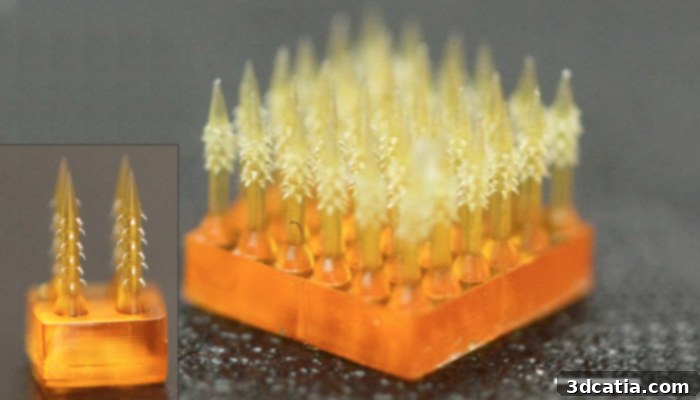
Credits: Riddish Morde
The Ingenious Design and Superior Properties of 4D Printed Micro-Needles
The brilliance behind Rutgers’ 4D printed micro-needles lies in their biomimetic design. Drawing inspiration from nature’s most effective adhering mechanisms, specifically how certain parasites and bees securely attach to tissue, these engineers meticulously developed micro-needles featuring backward-facing barbs. This seemingly simple yet highly effective design element fundamentally alters the interaction between the needle and human tissue, significantly improving fixation and stability once inserted into the skin. This enhanced adhesion is critical for reliable drug delivery and efficient sample collection, preventing slippage or dislodgement that can occur with smooth conventional needles.
The primary advantages of these innovatively designed micro-needles are multifaceted and directly address the shortcomings of existing technology. They are characterized by their ease of use, diminutive size (being both short and incredibly thin), and their minimally invasive nature. These qualities collectively work to dramatically reduce both the risk of infection and the pain typically associated with injections. The potential for a truly painless and infection-free injection experience marks a monumental step forward for patient comfort and safety. According to Howon Lee, the lead author of this groundbreaking project, the implications are far-reaching. He stated, “We believe that our 4D printed micro-needle matrix will enable a more robust and sustained use of minimally invasive, painless and easy-to-use micro-needles for drug delivery, wound healing, bio-scanning and other soft tissue applications.” This vision highlights a future where medical interventions are not just effective but also far more humane.
The barbs, inspired by the natural world, serve a crucial functional purpose. Once the micro-needle penetrates the skin, these tiny, backward-facing structures engage with the tissue, creating a secure anchor. This mechanism ensures that the needle remains firmly in place, optimizing the efficiency of drug diffusion into the bloodstream or the collection of biofluids. This enhanced stability is particularly beneficial for long-duration applications or when precise and consistent fluid exchange is required. Moreover, the reduced diameter of the needles, combined with their dynamic properties, minimizes tissue damage upon insertion and withdrawal, contributing significantly to the overall reduction in pain and the potential for scarring.
Advanced Manufacturing: Combining Micro 3D Printing and 4D Printing
The creation of these sophisticated micro-needles was an intricate process, necessitating the synergistic application of two cutting-edge additive manufacturing techniques: micro 3D printing and 4D printing. Micro 3D printing allowed the Rutgers engineers to fabricate structures with incredibly fine details and at scales previously unimaginable, crucial for creating the tiny, precise barbs and the overall minute dimensions of the needles. This technology enables the production of objects with features in the micron range, which is essential for medical devices designed for minimally invasive interaction with biological tissues.
Subsequently, the principles of 4D printing were applied, where smart materials were incorporated into the design. These materials are intrinsically programmed to respond to specific stimuli, enabling the micro-needles to dynamically interact with their environment. While the article doesn’t specify the exact smart material used, common examples in 4D printing include hydrogels that swell in response to water, shape memory polymers that alter their form with temperature changes, or liquid crystal elastomers. The ability of these materials to change shape or mechanical properties post-manufacturing is what differentiates 4D printing from traditional 3D printing and makes these micro-needles uniquely adaptable and effective for their intended biomedical applications.
Following their meticulous manufacturing, the micro-needles underwent rigorous testing. Researchers conducted trials on a sample of chicken muscle tissue, an excellent biological proxy for human tissue due to its similar mechanical properties and accessibility. The results were remarkably promising, demonstrating a significant leap in performance: the printed micro-needle exhibited an astounding 18 times stronger adhesion compared to previously reported samples. This quantitative improvement is a critical indicator of the technology’s potential. Such enhanced adhesion translates directly into a more stable and robust platform for drug supply, ensuring that medication is delivered consistently and effectively. Furthermore, it promises substantially improved biofluidic collection, allowing for more accurate and comprehensive diagnostic sampling, as well as enhanced bio-detection capabilities, all vital for precise medical assessments.
This exceptional adhesion strength, coupled with the minimally invasive nature of the design, addresses key challenges in medical procedures. For instance, in applications requiring sustained drug release, a needle that remains securely in place for an extended period ensures optimal therapeutic effect. Similarly, for continuous monitoring or complex diagnostic sampling, the stability offered by these 4D printed micro-needles minimizes the risk of erroneous readings or incomplete sample collection. The combination of precision manufacturing and intelligent material response truly sets this innovation apart, paving the way for a new generation of medical devices that are both highly effective and gentle on the patient.

The micro-needle barbs allow for better tissue adhesion, improving stability for medical applications.
Transformative Applications in Healthcare and Beyond
The implications of these micro-needles, meticulously crafted through advanced additive manufacturing techniques, extend far beyond simple injections. Their unique properties position them to play a pivotal role in a multitude of biodegradation and biomedical applications. The ability to achieve robust tissue adhesion with minimal invasiveness makes them ideal for intricate biological interactions. Specifically, these tiny needles could revolutionize diagnostic processes by enabling the detection of a wide array of critical health indicators, including DNA, various enzymes, specific antibodies, and other vital biomarkers with unprecedented precision and comfort.
For individuals managing chronic conditions, the impact could be particularly profound. Patients with diabetes, for example, currently face the burden of frequent, often painful, blood sugar checks and insulin injections. These 4D printed micro-needles could offer a dramatically less invasive, virtually painless technique for both continuous glucose monitoring and targeted drug delivery. Imagine a future where daily glucose monitoring is as simple and discomfort-free as applying a small patch, or where insulin can be delivered reliably and painlessly throughout the day, significantly improving quality of life and adherence to treatment regimens.
Beyond diabetes, the potential applications are vast. In the realm of wound healing, the precise and sustained delivery of growth factors or antimicrobial agents directly to the affected tissue could accelerate recovery and prevent complications. For advanced bio-scanning and continuous health monitoring, these micro-needles could serve as discreet, long-term interfaces that collect vital physiological data without requiring repeated, uncomfortable procedures. Their capacity for stable and controlled interaction with soft tissues also opens avenues for applications in localized cancer therapies, vaccine delivery, and even cosmetic procedures seeking minimally invasive solutions.
The integration of smart materials via 4D printing allows for functionalities that go beyond simple drug delivery or sample collection. These micro-needles could potentially be designed to release medication only when certain physiological conditions are met, or to provide real-time feedback on tissue health. Such intelligent capabilities herald a new era of personalized medicine, where treatments are not only tailored to the individual but also dynamically adapt to their body’s changing needs, optimizing therapeutic outcomes and minimizing side effects.
This innovative research from Rutgers University exemplifies the transformative potential of additive manufacturing in healthcare. By addressing fundamental challenges with ingenuity and advanced technology, engineers are paving the way for a future where medical procedures are not just more effective, but also universally more comfortable and accessible. The transition from conventional needles to these advanced 4D printed micro-needles represents more than just a technological upgrade; it signifies a compassionate step forward in patient care.
You can find more detailed information about the comprehensive study that outlines these findings and methodologies HERE, offering deeper insights into the scientific principles and experimental validation behind this remarkable medical breakthrough.
What are your thoughts on these revolutionary 4D printed micro-needles and their potential to redefine medical treatments? We invite you to share your perspectives and comments below, or engage with us on our social media platforms, including our Facebook and Twitter pages. Stay informed about the latest advancements in additive manufacturing by signing up for our free weekly Newsletter, which delivers all the essential news and updates in 3D printing directly to your inbox!