
Unveiling 4D Printing: The Next Dimension in Smart Manufacturing
In recent years, the concept of 3D printing has transitioned from a niche engineering marvel to a widely recognized technological advancement. Mentioning it at a social gathering often sparks discussions about its various applications, from rapid prototyping to personalized consumer goods. However, introduce the term “4D printing,” and you are likely to be met with intrigued, if not slightly confused, expressions. While innovations like CASIO’s 2.5D printer represented incremental steps in adding dimensionality to printing, 4D printing introduces a fundamentally different paradigm. It is an emerging form of additive manufacturing that imbues objects with the ability to transform and adapt over time, extending its effects far beyond the initial fabrication process. This goes beyond merely creating a three-dimensional object; it’s about programming its future behavior.
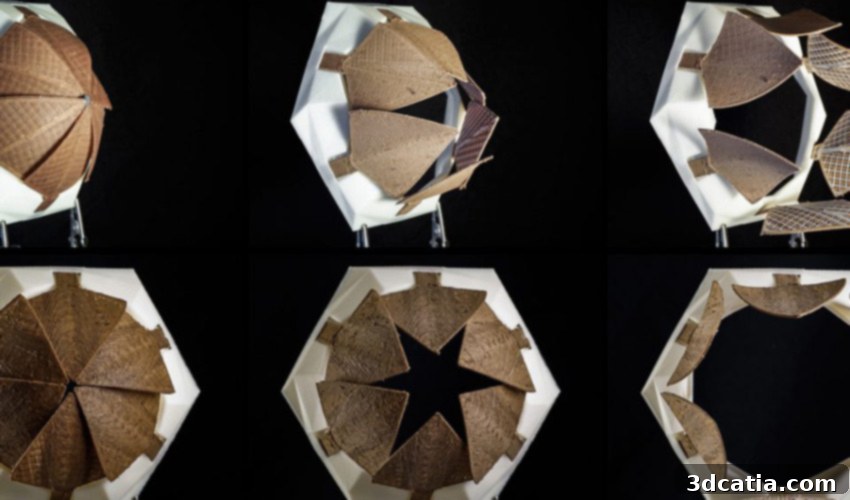
At its core, 4D printing is about crafting dynamic, intelligent objects. As pioneering researcher Skylar Tibbits succinctly puts it, 4D printing is “the programming of physical and biological materials,” essentially describing it as “robotics, but without the cables and drives.” This definition highlights the critical distinction: objects become self-actuating. The process begins similarly to 3D printing, where an object is meticulously built layer-by-layer. However, the true innovation lies in the materials used. These 3D objects are printed with specialized materials that are meticulously programmed to change their shape, properties, or function when exposed to specific external stimuli. This transformation over time constitutes the “fourth dimension” – allowing the printed object to evolve and react post-production. These stimuli can range from changes in temperature, exposure to water or light, magnetic fields, or other environmental energy sources, opening up a universe of possibilities for adaptive structures.
A 4D print in progress showcasing a transforming structure.
How 4D Printing Works: The Science Behind Transformation
The magic of 4D printing stems from the careful selection and integration of “smart materials” or “programmable materials” during the additive manufacturing process. Unlike conventional 3D printing, which uses inert plastics or metals, 4D printing leverages materials engineered to exhibit specific behaviors when subjected to external cues. These materials are designed to store energy in their internal structure, which can then be released in a controlled manner upon stimulation, causing a pre-programmed deformation, expansion, contraction, or even self-assembly.
Common types of smart materials include shape memory polymers (SMPs), which can be deformed and then return to their original shape when heated; hydrogels, which swell or shrink in response to water or changes in pH; and liquid crystal elastomers (LCEs), which can undergo large, reversible shape changes when heated or exposed to light. Multi-material printing plays a crucial role here, as different materials with varying responses can be strategically placed within an object. For instance, combining a rigid, non-responsive material with a flexible, responsive one can create hinge-like structures that fold or unfold when activated. The design process often involves sophisticated computational modeling to predict and control the complex transformations, ensuring the object achieves its desired final form or function.
The stimuli that trigger these transformations are diverse and can be tailored to specific applications. Temperature changes are widely used, but researchers are also exploring activation through light (e.g., UV light), magnetic fields, electric fields, acoustic waves, and even biochemical signals. This ability to react and adapt makes 4D-printed objects fundamentally different from static 3D prints, bridging the gap between passive structures and active, robotic systems without the need for intricate electronics or moving parts post-fabrication. The goal is to create systems that are intrinsically dynamic and responsive, simplifying design, reducing component count, and enabling functionalities previously impossible.
Diverse Applications: Transforming Industries and Daily Life
The potential applications of 4D printing are truly expansive, touching upon numerous sectors from consumer goods to advanced industrial and biomedical fields. While many are still in the research and development stage, the promise of self-transforming materials is already sparking innovative concepts across various domains.
Consumer and Lifestyle Products
Imagine clothing that can adapt to environmental conditions. For example, fabrics could contract or expand based on temperature fluctuations, providing better insulation when it’s cold and becoming more breathable in warmer weather. Footwear could similarly adjust to the wearer’s foot shape or respond to different terrains for optimized comfort and performance. Beyond apparel, 4D printing could revolutionize packaging, allowing boxes to self-collapse for easier recycling or self-assemble into complex structures. Toys could transform and interact in novel ways, offering dynamic play experiences. These adaptive consumer products promise greater personalization, comfort, and sustainability.
Aerospace and Defense
In environments where human intervention is challenging or impossible, such as deep space, 4D printing offers remarkable solutions. Self-assembling models could revolutionize construction in space. For example, large antennas, solar panels, or even entire habitats could be printed as compact structures on Earth, transported to space, and then self-deploy or self-assemble upon activation, significantly reducing payload volume and eliminating complex manual assembly processes. This has profound implications for space exploration, satellite deployment, and in-situ manufacturing off-Earth. Furthermore, adaptive aircraft wings could change shape during flight to optimize aerodynamics for varying speeds and altitudes, leading to increased fuel efficiency and performance. Military applications could include camouflage materials that adapt to surroundings or deployable shelters.
Biomedical and Healthcare
The medical field stands to be profoundly transformed by 4D printing. Imagine smart drug delivery systems where capsules are programmed to release medication only when they reach a specific pH level in the body or at a particular temperature, ensuring targeted treatment and minimizing side effects. Tissue engineering could benefit from dynamic scaffolds that adapt and remodel as cells grow, promoting better tissue regeneration. Smart implants, such as stents, could expand or contract within the body in response to biological signals. Surgical instruments could be designed to change their shape minimally invasively, reaching difficult areas with greater precision. Adaptive prosthetics that conform to changes in a patient’s limb over time could also significantly improve quality of life.
Automotive and Robotics
In the automotive industry, 4D printing could lead to self-repairing components that heal minor cracks or damage, extending the lifespan of vehicles. Interiors could feature adaptive materials for seats that adjust to an occupant’s posture or environmental conditions, enhancing comfort and safety. Beyond cars, 4D printing is a cornerstone of soft robotics, enabling the creation of robots that move and interact with their environment without rigid motors or complex wiring. These soft robots can navigate confined spaces, handle delicate objects, and perform tasks that traditional rigid robots cannot, opening doors for new forms of human-robot interaction and exploration.
Construction and Environmental Management
Buildings could incorporate 4D-printed elements that respond to environmental changes. For example, building facades could automatically adjust to sunlight or temperature to optimize energy efficiency. Self-healing concrete, capable of repairing its own cracks when exposed to moisture, could dramatically increase the longevity and safety of infrastructure. Environmentally, 4D-printed smart filters could adapt to various contaminants in water purification systems, becoming more efficient and versatile. Materials could even be designed to capture pollutants or respond to hazardous substances in real-time.
Advantages and Challenges of 4D Printing
The advantages offered by 4D printing are compelling. It promises to create objects that are inherently more flexible, adaptable, and functional than their static counterparts. By eliminating the need for complex assembly of multiple components, it can drastically reduce manufacturing time and waste. The ability to create dynamic structures simplifies design, reduces part count, and enables miniaturization, leading to more efficient and sophisticated products across various industries. Objects can achieve functionalities previously thought impossible for passive materials, opening up entirely new product categories and capabilities.
However, 4D printing is not without its significant challenges. One of the primary hurdles is the development and reliable production of advanced smart materials. These materials need to be precisely controllable, durable, and cost-effective for widespread adoption. Achieving accurate and predictable transformations, especially for complex designs, requires sophisticated computational modeling and advanced manufacturing techniques. The scalability of 4D printing processes, particularly for large-scale industrial applications, is another area of ongoing research. Furthermore, understanding the long-term stability and durability of these transforming materials under repeated cycles of activation remains crucial for real-world deployment. The current costs associated with specialized materials and high-precision multi-material printers also present a barrier to entry. Finally, the ethical implications of creating self-transforming, almost “living” materials will need careful consideration as the technology matures.
A detailed explanation of the 4D printing process by researcher Skylar Tibbits and its applications can be found in the following video, offering a deeper dive into the technological principles and potential:
The Future Landscape of 4D Printing
As research continues to advance, the future of 4D printing looks incredibly promising. We can anticipate further integration with artificial intelligence and machine learning, allowing objects to learn and adapt to their environment with even greater autonomy and precision. The development of new, more versatile smart materials, capable of responding to multiple stimuli simultaneously, will unlock unprecedented design possibilities. As manufacturing costs decrease and the technology becomes more accessible, 4D printing is poised to move beyond niche applications into mainstream industrial and consumer markets. The vision is a world where objects are not static entities but dynamic, adaptive components that can self-repair, reconfigure, and evolve, seamlessly integrating into our lives and infrastructure. From adaptive architectural elements to self-regulating medical devices, 4D printing promises to redefine what is possible in design and manufacturing, creating a truly responsive and intelligent built environment.
What are your thoughts on the revolutionary potential of 4D printing? Do you envision its widespread adoption in the near future, or do you believe significant hurdles still need to be overcome? We’d love to hear your insights and predictions! Let us know in a comment below or join the discussion on our Facebook and Twitter pages! Don’t miss out on the latest advancements and news in the world of additive manufacturing; sign up for our free weekly Newsletter to get all the cutting-edge updates delivered straight to your inbox.