
Ohmie Lamp: Illuminating the Future with 3D Printed Orange Peels and Sustainable Design
Imagine a world where everyday objects, like the lamp on your bedside table, are not only functional but also actively contribute to a healthier planet. This vision is rapidly becoming a reality thanks to groundbreaking innovations in sustainable product design and additive manufacturing. At the forefront of this movement is the Italian agency Krill Design, creators of the remarkable Ohmie lamp project. This innovative venture reimagines waste, transforming humble orange peels into beautiful, functional, and eco-friendly household items through the power of 3D printing.
The Ohmie lamp is more than just a lighting fixture; it’s a statement about the potential of a circular economy. In just two hours, this unique lamp can be 3D printed from a revolutionary material derived entirely from the skins of oranges. Currently available for purchase from €59 through the company’s Kickstarter campaign, the Ohmie lamp serves as a compelling testament to the pivotal role that additive manufacturing, or 3D printing, can play in fostering closed-loop production systems. This application of 3D printing presents a tangible and appealing alternative to the environmentally damaging pollution often generated by traditional manufacturing methods, which have long contributed to our planet’s ecological challenges.
For those closely following advancements in 3D printing news and sustainable innovations, the concept of transforming organic waste into usable products might sound familiar. You may recall the intriguing Feel the Peel machine, a smart juice bar designed by Carlo Ratti Associati that captivated audiences with its ability to turn discarded orange peels into 3D printed cups right before your eyes. In the case of Krill Design, the underlying philosophy is remarkably similar yet distinct in its application: to recover natural waste materials and leverage them in a manufacturing process that is inherently more respectful of our environment. Their innovative approach led them to develop a unique, natural, and fully compostable biopolymer using Sicilian orange peels – a material the agency has dedicated significant research and development to over time. This sustainable material was not only perfected for the Ohmie lamp but also successfully utilized in another notable project with Autogrill, underscoring its versatility and commercial viability in various product applications.

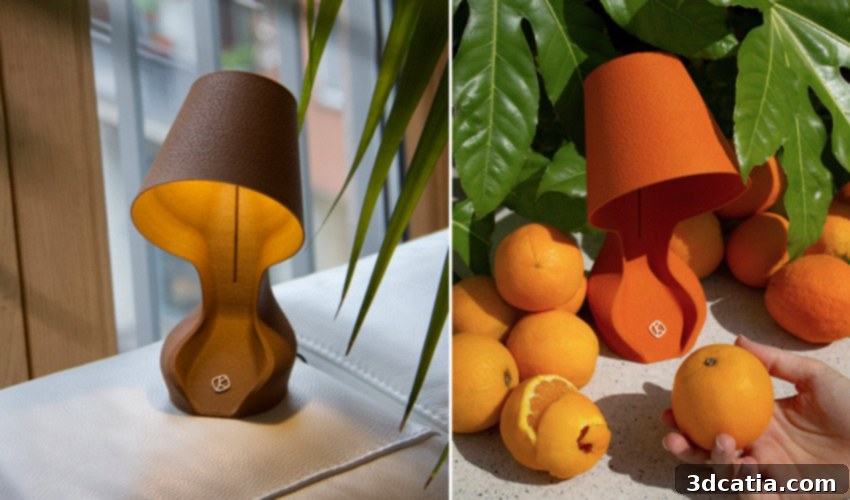
The innovative Ohmie lamp, showcasing elegant design crafted from sustainable orange peel biopolymer. (Photo Credit: Krill Design)
The Innovative Manufacturing Process of the Ohmie Lamp: From Waste to Wonder
The selection of orange peels as the primary manufacturing material for the Ohmie lamp was a strategic decision by Krill Design, driven by several compelling factors. Firstly, their sheer abundance in regions like Sicily, a major orange producer, ensures a consistent and readily available waste stream. This addresses a critical challenge in sustainable manufacturing: sourcing raw materials without depleting natural resources. Secondly, and perhaps more fascinatingly, the intrinsic properties within the organic chemistry of orange peels make them an ideal candidate for biopolymer development. Domiziana Illengo, Krill Design’s insightful marketing manager, eloquently explains the scientific rationale: “The link between the basic biopolymer from the fermentation of plant starches and the added material from organic crops is that they need sugars to bind together. Oranges are particularly high in carbohydrates, which chemically is basically the same as sugar. And so that helps us to develop a robust material.” This natural carbohydrate content acts as a crucial binding agent, facilitating the creation of a strong and durable bioplastic filament suitable for 3D printing. The meticulous process begins with the careful drying of the orange skins, followed by grinding them into a fine powder. This powder is then expertly processed into granules, which form the foundational material for the 3D printing filament. This transformation from discarded fruit waste to a high-quality manufacturing material epitomizes the ingenuity behind the Ohmie lamp.
Developing the perfect structural integrity for the Ohmie lamp presented a unique engineering challenge. The Krill Design team needed to formulate a solid material robust enough to support the weight of the lamp’s upper portion, where the light bulb is securely nestled, while maintaining its aesthetic appeal and functionality. This rigorous development phase involved extensive experimentation and prototyping. The agency candidly shares that they went through several prototypes, precisely seven distinct iterations, before finally arriving at the optimal design and material composition. The dedication to this iterative design process ensured that the Ohmie lamp would not only be eco-friendly but also a practical and enduring product. The final design of the Ohmie lamp boasts an ingenious feature: its head can gracefully tilt, offering adjustable lighting, while its body maintains a steadfast upright posture. Each individual Ohmie lamp is a testament to sustainable efficiency, crafted from the peels of approximately two Sicilian oranges and weighing a mere 153 grams – a truly lightweight marvel of bio-design and advanced manufacturing.
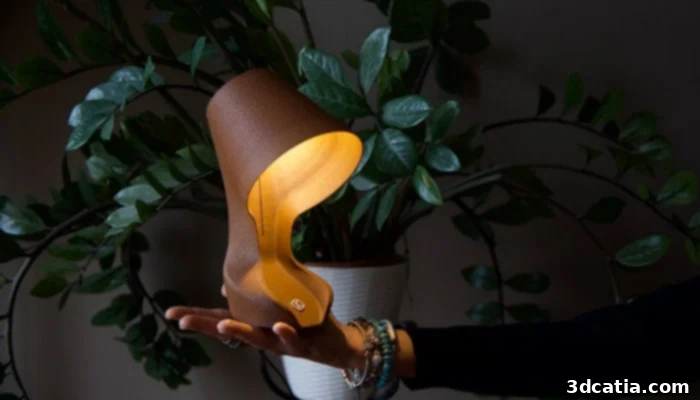
Each Ohmie lamp is a lightweight marvel, crafted from the peels of two Sicilian oranges, weighing only 153 grams. (Photo Credit: Krill Design)
The manufacturing versatility of the orange peel-enriched material is another key aspect of its innovation. This unique biopolymer can be efficiently extruded on virtually any standard desktop FDM (Fused Deposition Modeling) 3D printer, allowing for accessible and relatively fast production. The entire printing process for one Ohmie lamp takes approximately two hours, showcasing the efficiency of additive manufacturing for bespoke sustainable products. However, Krill Design emphasizes a critical point for potential manufacturers: achieving optimal quality can sometimes be challenging due to thermal management issues. Many commercial 3D printers are not specifically engineered or optimized to work with the delicate thermal properties of organic and bioplastic materials, which require precise temperature control to prevent warping or inconsistencies. Despite these technical nuances, the final product offers a delightful surprise. Once printed, the Ohmie lamp emits a subtle, natural aroma reminiscent of an orange cookie – a truly astonishing and unexpected sensory bonus that further enhances its unique appeal and connection to its organic origins.
Beyond its eco-friendly origins and innovative material, the Ohmie lamp is designed for modern living. Each lamp comes equipped with an energy-efficient LED bulb, known for its longevity and low power consumption, aligning perfectly with its sustainable ethos. Furthermore, it features a convenient dimmer function, allowing users to effortlessly adapt the light intensity to suit any environment or personal need, from bright task lighting to a soft, ambient glow. All these thoughtful features are offered at an accessible price point of 59 euros, making sustainable design attainable for a wider audience. To learn more about this revolutionary product and contribute to the ongoing success of this eco-conscious initiative, you can find further details and support the crowdfunding campaign HERE. The vision of Krill Design extends far beyond the Ohmie lamp; they are committed to pioneering a new era of eco-conscious product development. The agency plans to launch an entire range of organic products, continually exploring and harnessing the potential of natural waste streams. Their next ambitious project aims to develop a coffee table constructed from recycled coffee grounds, underscoring their dedication to closed-loop production. While the specific manufacturing method for the coffee table is yet to be confirmed, the prospect of another innovative, waste-derived product is undeniably exciting and demonstrates Krill Design’s enduring commitment to sustainability.

The material is meticulously deposited layer by layer, showcasing the precision of 3D printing with biopolymers. (Photo Credit: Krill Design)
The Ohmie lamp by Krill Design represents a significant leap forward in the integration of sustainable practices with cutting-edge technology. It’s a compelling example of how discarded resources can be transformed into valuable, desirable, and environmentally responsible products. This innovation not only addresses the pressing issue of waste but also inspires a new generation of designers and consumers to think differently about the objects we bring into our homes. By embracing biopolymers and additive manufacturing, companies like Krill Design are paving the way for a future where design is intrinsically linked to ecological responsibility. This shift towards a circular economy, powered by ingenious solutions like the Ohmie lamp, is crucial for mitigating environmental degradation and fostering a more sustainable global industry. The journey from orange peel to a beautifully designed, functional lamp illustrates the immense potential for creativity and sustainability to converge, offering hope for a greener tomorrow.
What are your thoughts on Ohmie’s pioneering 3D printed lamp made from humble orange peels? Do you believe this represents the future of sustainable product design and manufacturing? We encourage you to share your insights and opinions in a comment below or join the conversation on our vibrant Facebook and Twitter pages. Stay informed about the latest breakthroughs in additive manufacturing and eco-friendly innovations by signing up for our free weekly newsletter, delivering all the essential 3D printing news directly to your inbox!
Cover Photo Credit: Krill Design