
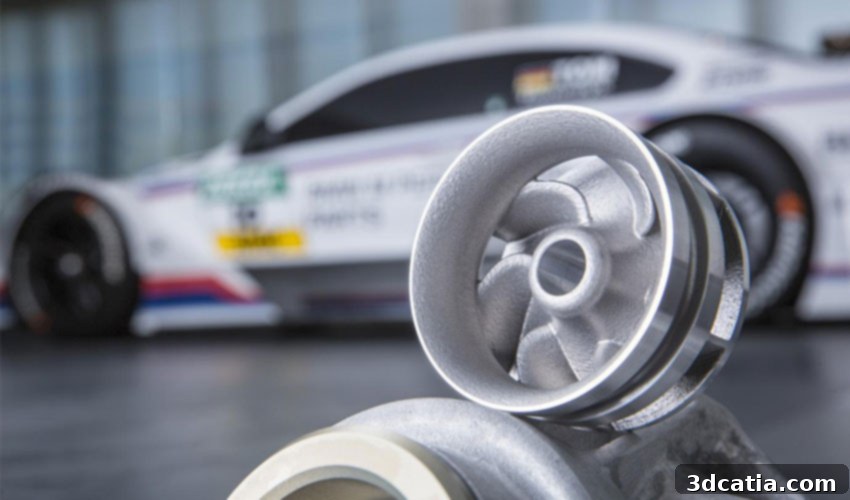
BMW’s Pioneering Journey in 3D Printing: Revolutionizing Automotive Manufacturing with Additive Technologies
Leading industrial conglomerates are at the forefront of embracing additive manufacturing, recognizing the immense strategic advantages this technology offers today. The German automotive giant, BMW Group, stands as a prime example of this progressive adoption. Having announced the establishment of a state-of-the-art additive manufacturing center in 2019, BMW has consistently pushed the boundaries of design and engineering. A notable achievement includes the unveiling of their 3D printed motorcycle chassis prototype, a testament to their innovative spirit. For over two and a half decades, BMW has seamlessly integrated additive manufacturing solutions into its production cycles, a commitment that continues to drive the development of more innovative, efficient, and personalized vehicles. To delve deeper into BMW’s ambitious projects and strategic vision, we had the privilege of speaking with Dr. Jens Ertel, Manager of the BMW Additive Manufacturing Center. Dr. Ertel provided invaluable insights into why BMW views 3D printing not as a speculative gamble, but as a crucial, long-term investment in the future of automotive excellence.
Driving Innovation: Dr. Jens Ertel on BMW’s Enduring Relationship with 3D Printing
“My name is Dr. Jens Ertel,” he begins, introducing himself. “I pursued my physics studies at the University of Göttingen, specializing in materials, and successfully completed my doctorate in 1993. My journey in the industry commenced two years later when I proudly joined the BMW Group. Over the years, I’ve had the opportunity to hold diverse management roles within the critical domains of laboratory technology and quality assurance. In 2012, I took on the leadership of the BMW Group’s Additive Manufacturing Center, a role that encompasses the vital responsibilities of developing advanced 3D technologies, overseeing rapid prototyping initiatives, and expanding into large-scale mass production applications. Looking ahead, 2019 marks another significant milestone as I prepare to manage the new Additive Manufacturing Campus of the BMW Group, a facility poised to redefine our capabilities.”

Dr. Jens Ertel
Dr. Ertel elaborates on BMW’s deep roots in the technology: “At BMW, our engagement with additive manufacturing dates back to 1991, meaning we have been actively utilizing this groundbreaking technology for well over 25 years. Our initial foray involved producing prototypes primarily for our groundbreaking concept cars. This foresight and early adoption of 3D technologies provided us with an unparalleled head start, conferring a substantial advantage in the realm of 3D printing over the subsequent decades. This extensive experience has been foundational, allowing us to build a robust internal expertise and continually refine our processes, positioning BMW as a true pioneer in the industrial application of additive manufacturing.”
Revolutionizing Automotive Production: The Diverse Benefits and Applications of BMW 3D Printing
“Today, the scope of our additive manufacturing capabilities at BMW has expanded dramatically, becoming far more diversified and integrated into various stages of our production cycle,” Dr. Ertel explains. “What began with mere prototypes has evolved into a sophisticated operation spanning the production of essential spare parts for our classic vehicles, the creation of specialized tools and fixtures for manufacturing lines, and increasingly, the direct fabrication of functional components for the mass production of our modern vehicles. The inherent strength of additive manufacturing lies in its unparalleled ability to offer significantly greater freedom in design and geometry. This liberation from traditional manufacturing constraints has empowered our engineers and designers to develop entirely new approaches in terms of both functionality and aesthetic design, leading to superior product performance and unique customer experiences.
A prime example of this innovative application is our recent initiative for MINI customers. Through this pioneering program, MINI enthusiasts now have the exciting opportunity to customize their vehicles with truly personal touches. Customers can actively participate in designing bespoke elements such as the passenger-side sideband within the cockpit and personalized side inserts. These custom-designed pieces are then individually 3D printed by us with precision and efficiency. The beauty of this process is that these highly personalized components become available to the customer in just a few days, a stark contrast to conventional production methods. Traditional manufacturing often necessitates lengthy tooling times and significant upfront investments, making such individualized customization economically prohibitive. BMW’s commitment to additive manufacturing therefore not only enhances product quality and design but also fundamentally transforms the customer’interaction with their vehicle, moving towards a truly personalized driving experience.”
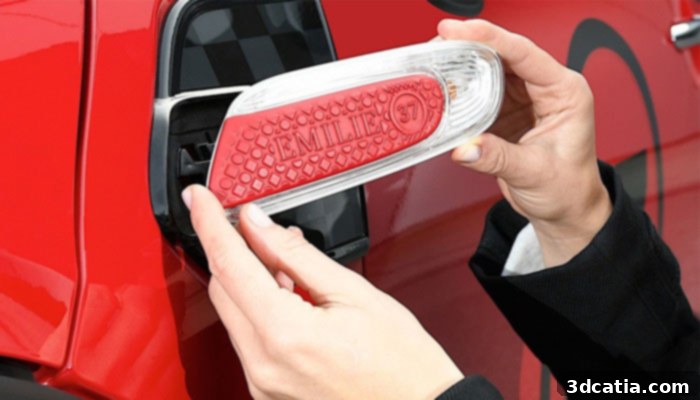
MINI customers will be able to customize their car
“Our dedicated additive manufacturing center is a hive of activity, processing an impressive volume of work each year,” Dr. Ertel continues. “Annually, we manage approximately 30,000 distinct prototyping projects, which collectively yield more than 140,000 individual components. This high throughput underscores the critical role 3D printing plays in our rapid iteration and development cycles. To achieve this, we leverage a dual strategy: on one hand, we deploy a comprehensive array of the most advanced, cutting-edge 3D printing technologies available in-house. This ensures we have the right tool for every specific application, from intricate plastic parts to high-performance metal components. On the other hand, we proactively foster collaborations with external partners, including innovative startups and established technology providers, to explore and integrate new and emerging additive manufacturing solutions. This collaborative approach allows us to stay at the vanguard of technological advancements, continually expanding our capabilities and pushing the boundaries of what’s possible in automotive production. The benefits are multifold: from accelerated product development and enhanced design possibilities to more efficient production of complex geometries and reduced material waste, BMW’s strategic embrace of additive manufacturing delivers tangible advantages across the entire value chain.”
Engineering the Future: The Groundbreaking 3D Printed Motorcycle Chassis Project
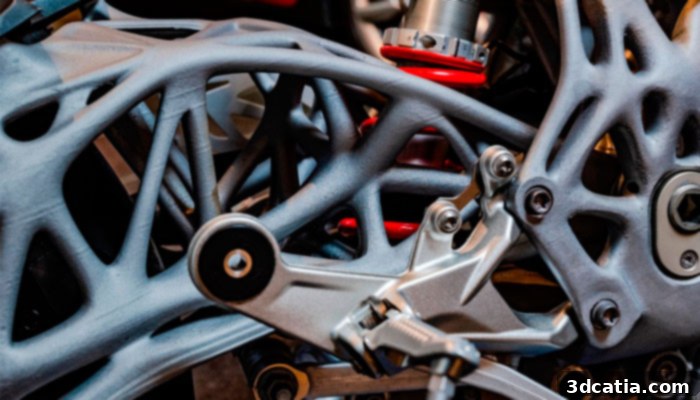
“The 3D printed motorcycle chassis project represents a pinnacle of our innovative efforts and collaborative spirit within the BMW Group,” Dr. Ertel proudly explains. “Our team of experts at BMW Motorrad, working in close synergy with our dedicated additive manufacturing and generative design departments, embarked on a conceptual study. Together, they meticulously developed groundbreaking ideas on how motorcycle frames, and indeed vehicle architectures, could be fundamentally reimagined and created in the future. The core challenge was to meet stringent requirements for stiffness and weight reduction in the component, which led us to explore advanced computational design methodologies.
Utilizing sophisticated generative design algorithms, our teams were able to develop a highly complex, optimized structure that would be virtually impossible to produce using conventional manufacturing techniques. Generative design, in essence, allows software to autonomously explore thousands of design permutations based on predefined parameters (like load, weight, and material properties), arriving at an optimal geometry that often mimics organic, biological structures for maximum efficiency. The resulting geometry for the motorcycle chassis was inherently intricate and complex, making additive manufacturing not just an option, but the *only* viable production method. For this specific research project, we turned to Selective Laser Sintering (SLS) technology, specifically opting for aluminum as the material of choice. Aluminum’s excellent strength-to-weight ratio makes it ideal for performance-critical automotive components. It’s important to emphasize that this project is currently a pure research and development endeavor; the motorcycle, while fully functional as a prototype, is not intended for commercial marketing today. However, the insights gained and the design principles established through this project will undoubtedly inform and inspire the next generation of BMW vehicles, demonstrating the profound potential of additive manufacturing to redefine vehicle performance, safety, and aesthetics.”
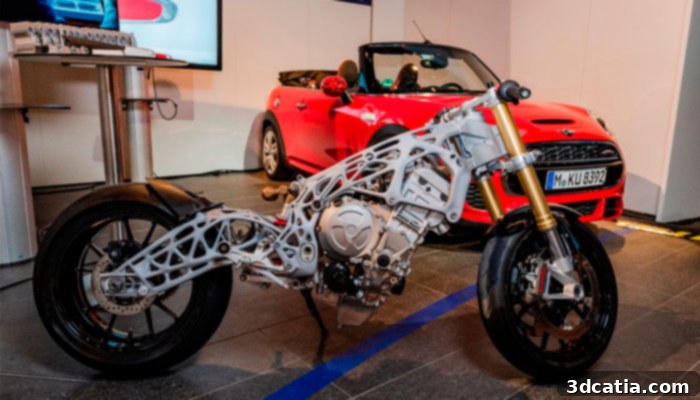
The BMW chassis
Pioneering the Future: The Visionary BMW Additive Manufacturing Campus
“The establishment of our new Additive Manufacturing Campus represents a significant leap forward in BMW’s long-term strategy and commitment to industrial 3D printing,” Dr. Ertel highlights. “This cutting-edge facility is designed to serve as the central hub where we will continue to consolidate and significantly advance our deep expertise in all facets of additive manufacturing. The campus will operate with a multi-pronged focus, encompassing the critical areas of rapid prototyping for future vehicle concepts, the scalable production of serial parts for existing models, and the creation of highly customized, bespoke components for specialized vehicles. This integrated approach ensures that 3D printing solutions can be deployed across the entire product lifecycle, from initial concept to final production.
A key aspect of the campus’s mission is its role in pre-development and technological scouting. Within dedicated pre-development areas, new and disruptive technologies from innovative startups, such as Desktop Metal or Carbon, will be rigorously tested and validated for their potential application within BMW’s demanding production environment. This proactive engagement with external innovators ensures that BMW remains at the cutting edge of additive technology. Furthermore, the campus will be instrumental in introducing novel automation concepts specifically tailored for additive manufacturing. These advancements in automation are crucial; they will enable the cost-effective and highly efficient production of mass-produced components, thereby addressing one of the traditional barriers to widespread 3D printing adoption in automotive. By streamlining processes and reducing manual intervention, we aim to accelerate the overall development cycles of our cars significantly, bringing innovations to market faster and more efficiently.
“We anticipate profound synergies emerging from the common projects undertaken within the campus, spanning the entire process chain,” Dr. Ertel explains with optimism. “This includes everything from the development of advanced materials to the refinement of sophisticated additive technologies and the seamless integration with our existing IT systems. By fostering such close collaboration and integrated development, our partners gain invaluable insights into the stringent demands and specific requirements of automotive production at an accelerated pace. Simultaneously, thanks to our rapid access to these cutting-edge new technologies and processes, we are able to factor in process-specific nuances and optimize designs right from the very initial stages of development. This holistic approach minimizes costly rework, maximizes efficiency, and ultimately leads to superior product outcomes.
Within BMW’s extensive global production network, the new Additive Manufacturing Campus is strategically positioned to act as a vital pilot plant. Its primary role will be to drive forward the development and maturation of new additive manufacturing technologies, serving as a proving ground for innovations before they are scaled and disseminated across our entire production network. This ensures that all BMW facilities can benefit from the latest advancements, maintaining our competitive edge and fostering a culture of continuous innovation throughout the company. For those interested in delving deeper into BMW’s groundbreaking work in 3D printing and advanced manufacturing, we encourage you to visit our official website for more comprehensive information!”
Photo credits: BMW
BMW’s steadfast commitment to additive manufacturing clearly demonstrates its vision for the future of automotive production. By integrating 3D printing from prototyping to mass production and customization, BMW is not merely adapting to technological shifts but actively shaping them. This strategic investment in innovation, exemplified by the new Additive Manufacturing Campus and visionary projects like the 3D printed motorcycle chassis, solidifies BMW’s position as a leader in leveraging advanced manufacturing to deliver superior, more personalized, and sustainable vehicles for tomorrow. The journey of BMW 3D printing is a clear testament to how foresight, strategic investment, and continuous innovation can transform an entire industry.
What are your thoughts on BMW’s extensive use of 3D printing in the automotive sector? We invite you to share your perspectives and comments below, or engage with us on our Facebook and Twitter pages! Don’t miss out on the latest advancements and news in the world of 3D printing – be sure to sign up for our free weekly Newsletter, delivered straight to your inbox!