
Ultimaker Material Alliance Program: Revolutionizing Industrial FDM 3D Printing with Advanced Materials
Ultimaker, a global leader and innovator in Fused Deposition Modeling (FDM) 3D printers, marked a significant milestone with its ‘Ultimaker Material Alliance Program.’ Launched just over a year ago, the initiative has rapidly grown into a formidable ecosystem, now boasting partnerships with more than 80 contributing companies worldwide. This remarkable expansion was proudly announced at the prestigious Hannover Messe event, underscoring the program’s profound impact on the landscape of FDM 3D printing. The alliance has successfully galvanized material developers and manufacturers globally, leading to the creation of a vast library of optimized material print profiles specifically designed for Ultimaker’s cutting-edge FDM 3D printers, thereby addressing the increasing demands for industrial-grade additive manufacturing solutions.
The inception of the Ultimaker Material Alliance Program dates back to April 2018. Its fundamental objective was clear: to cultivate and develop high-performance materials capable of meeting the rigorous and evolving requirements of industrial 3D printing applications. In a market where traditional manufacturing methods often fall short in flexibility and customization, FDM technology, when coupled with advanced materials, offers unparalleled advantages. The program was designed to bridge this gap, ensuring that Ultimaker users could leverage their machines for more than just prototyping, pushing into functional parts, tooling, and even end-use production. Soon after its initial launch, the program garnered immense attention, attracting industry giants such as BASF, DSM, DuPont, Solvay, and Clariant, who were publicly announced as foundational partners. Their involvement brought invaluable material science expertise and established credibility. This strong foundation was further bolstered by the subsequent inclusion of other prominent names like Arkema, Essentium, Jabil, and Polymaker, expanding the breadth and depth of material offerings available to Ultimaker users.
Through this innovative program, Ultimaker is committed to providing its extensive user base with access to a diverse array of materials, significantly expanding capabilities beyond the conventional and often limiting standard ABS and PLA grades. For engineers and designers, the choice of material is not merely a preference but a critical factor that dictates the feasibility, performance, and ultimate success of a manufactured component. When selecting a manufacturing method, particularly for demanding industrial applications, engineers meticulously consider material properties such as strength, durability, heat resistance, chemical inertness, and electrical conductivity. The Material Alliance Program directly addresses these complex considerations by making advanced, engineering-grade materials readily available. For instance, the program offers access to flame-retardant nylons, crucial for safety-critical applications in sectors like aerospace and automotive; chemically resistant polypropylenes, ideal for medical devices, laboratory equipment, and fluid handling systems; and filaments reinforced with glass fibers, providing exceptional stiffness and mechanical strength for jigs, fixtures, and structural components. These specialized materials empower users to produce parts that were previously unattainable with desktop FDM 3D printers, thereby unlocking new applications and vastly expanding the potential of additive manufacturing.
Commenting on the program’s remarkable trajectory, Paul Heiden, Senior Vice President of Product Management at Ultimaker, expressed immense satisfaction: “We’ve seen an overwhelming amount of interest in the Ultimaker Material Alliance Program since its launch. In just twelve short months, we’ve worked with many global companies to unlock new applications and have produced some amazing results.” This enthusiasm is a testament to the program’s success in addressing a genuine market need. The collaborative model brings together Ultimaker’s hardware and software expertise with the deep material science knowledge of its partners. This synergy accelerates the development and qualification of new materials, ensuring that users can confidently print parts with predictable and repeatable results. The ‘amazing results’ Heiden refers to are not just about new materials, but about the thousands of new, high-value applications now accessible to businesses and individuals through desktop 3D printing. From functional prototypes that withstand harsh environments to custom tools and fixtures that optimize production lines, the alliance is fundamentally changing how companies approach design and manufacturing.
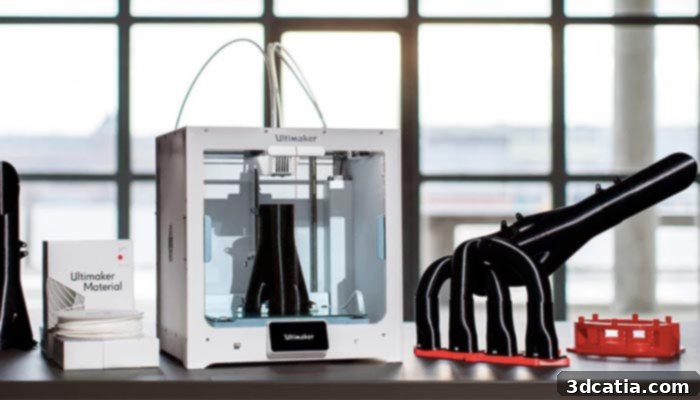
The Ultimaker S5 3D printer, the latest generation printer from the manufacturer, showcases the integration capabilities.
Further illustrating the program’s global impact and strategic importance, Ultimaker highlighted specific regional needs. At TCT Asia 2019 in February, the 3D printer manufacturer elaborated on how engineers in China – a country renowned for having the largest electronics market globally – stand to benefit enormously from enhanced access to Electrostatic Discharge (ESD) safe materials. In the electronics industry, static electricity can cause irreparable damage to sensitive components, making ESD safety a critical requirement for manufacturing environments. By making validated print profiles for ESD-safe materials available in the Ultimaker Marketplace, the alliance directly addresses this vital industry need. Engineers and designers working in electronics can now seamlessly integrate desktop 3D printing into their workflows to create jigs, fixtures, and functional prototypes that are not only precise but also safe for use with delicate electronic parts. This immediate access to specialized, industrial-grade materials through an easy-to-use platform significantly reduces barriers to entry for advanced additive manufacturing. At TCT Asia, Jos Burger, CEO at Ultimaker, emphasized this symbiotic relationship, commenting, “The growing importance of 3D printing gives us – as a leader in desktop 3D printing – an important role in ensuring a perfect collaboration between hardware, software and materials.” This statement encapsulates Ultimaker’s philosophy: true innovation in additive manufacturing stems from the harmonious integration of all three pillars. Burger also proudly acknowledged the partners’ invaluable contributions, adding, “I am proud to recognise their commitment to the Ultimaker Material Alliance Program during TCT Asia,” highlighting the collective effort driving this transformative initiative.
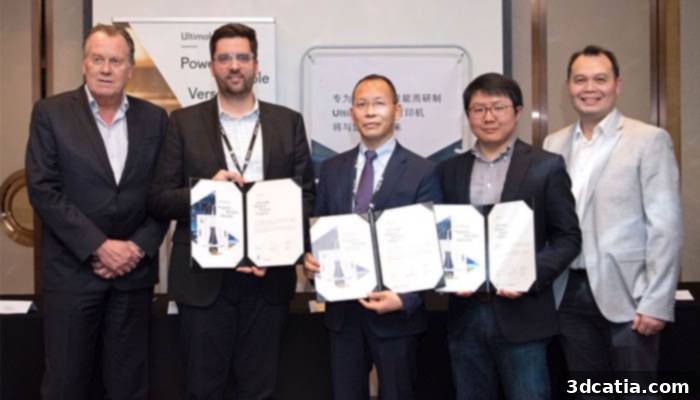
Essentium, eSUN, and Polymaker join the Ultimaker Material Alliance Program at TCT Asia, expanding the material ecosystem.
The Ultimaker Material Alliance Program represents a significant paradigm shift in the accessibility of advanced 3D printing. It empowers professional users with unprecedented material choice and application flexibility. As Paul Heiden further elaborated, “Professional users can now, for instance, select to print using a filament that is filled with metal to produce the same aesthetic effect as a more expensive metal system. As another outcome of the program, users can now select a material that is electrostatic discharge (ESD) safe, which allows engineers and designers in electronics industry to fully benefit from desktop 3D printing.” This illustrates two key advantages: aesthetic freedom and enhanced functionality. Metal-filled filaments, while not offering the full mechanical properties of pure metal, provide a cost-effective way to achieve the look and feel of metal parts, perfect for aesthetic prototypes, artistic creations, or custom architectural models, all without the substantial investment required for dedicated metal additive manufacturing systems. More importantly, the widespread availability of ESD-safe materials through certified print profiles directly translates into tangible benefits for industrial applications. It enables the creation of functional fixtures, protective casings, and assembly tools that safeguard sensitive electronics, ensuring product quality and operational safety. This integration of material science with user-friendly desktop technology accelerates product development cycles and reduces manufacturing costs, making sophisticated additive manufacturing accessible to a broader range of businesses, from small engineering firms to large multinational corporations.
The rapid expansion to over 80 partners within a year underscores the program’s success and its vital role in fostering an open material ecosystem. This collaborative approach ensures continuous innovation, pushing the boundaries of what is possible with FDM 3D printing. By providing a platform for leading material companies to develop and validate their filaments for Ultimaker printers, the alliance not only broadens the material palette but also guarantees reliability and performance. This commitment to an open system allows Ultimaker users to choose from a vast range of specialized polymers, composites, and functional materials, each optimized for specific industrial applications. Whether it’s high-temperature resistance, flexibility, biocompatibility, or specific mechanical properties, the Material Alliance Program ensures that engineers have the right tools for the job, transforming desktop 3D printers from mere prototyping machines into versatile, industrial-grade manufacturing assets. This ongoing material development is critical for further driving the adoption of additive manufacturing across various sectors, enabling more complex designs, higher-performing parts, and more efficient production workflows. Ultimately, the Ultimaker Material Alliance Program is not just about materials; it’s about empowering innovation, accelerating industrial transformation, and cementing Ultimaker’s position at the forefront of the desktop 3D printing revolution.
What are your thoughts on Ultimaker’s groundbreaking Material Alliance Program and its impact on the future of FDM 3D printing? Share your insights and comments below, or join the conversation on our Facebook and Twitter pages! Don’t forget to sign up for our free weekly Newsletter to stay informed with all the latest news and advancements in the exciting world of 3D printing, delivered directly to your inbox!