
Tungsten 3D Printing: Revolutionizing High-Performance Metal Additive Manufacturing
Tungsten, a material renowned for its exceptional properties, has rapidly emerged as a pivotal force in the 3D metal printing industry. Intensive research and development efforts in recent years have been strategically focused on maximizing its immense potential within additive manufacturing. For a long time, the inherent characteristics of tungsten, such as its brittleness and susceptibility to micro-cracking during conventional processing, presented significant challenges for its integration into advanced manufacturing techniques. However, continuous advancements in tungsten applications for additive manufacturing have led to a substantial breakthrough. A critical milestone was achieved around 2020, successfully overcoming these long-standing issues and paving the way for more reliable and robust tungsten parts. Further expanding its utility and versatility, 2021 saw the development of innovative processes for creating advanced tungsten-nickel-iron alloys, which offer enhanced properties and processing capabilities.
Beyond its role in industrial applications, tungsten also shows extraordinary promise in the burgeoning field of fusion energy. Its remarkable ability to endure the extreme temperatures, immense radiation, and harsh conditions prevalent in fusion reactors positions it as a key material for future energy solutions. As the global demand for sustainable and efficient energy sources grows, tungsten’s unique thermal and structural stability could be instrumental in achieving practical fusion power, potentially meeting future energy needs on an unprecedented scale. This article provides a comprehensive and in-depth overview of this versatile heavy metal, exploring its properties, diverse applications, advanced processing technologies in 3D printing, and the key players driving its innovation.
Unrivaled Properties of Tungsten: A Heavyweight of Engineering
The very name “tungsten” provides insight into its nature, derived from the Swedish term for “heavy stone,” a descriptor that perfectly encapsulates its status as the heaviest technical metal. This refractory, shiny white material boasts an impressive density of 19.25 g/cm³. While incredibly dense, pure tungsten can be surprisingly brittle, even with minimal contamination from other elements, which historically posed a challenge for its processing. What truly sets tungsten apart is its extraordinary thermal resistance: it holds the distinction of having the highest melting point of all metals, reaching an astounding 3,410°C, and an equally remarkable boiling point of 5,700°C. These extreme temperature tolerances make it an indispensable material for applications demanding exceptional heat stability, such as incandescent light bulb filaments, where it can withstand temperatures that would vaporize most other metals.
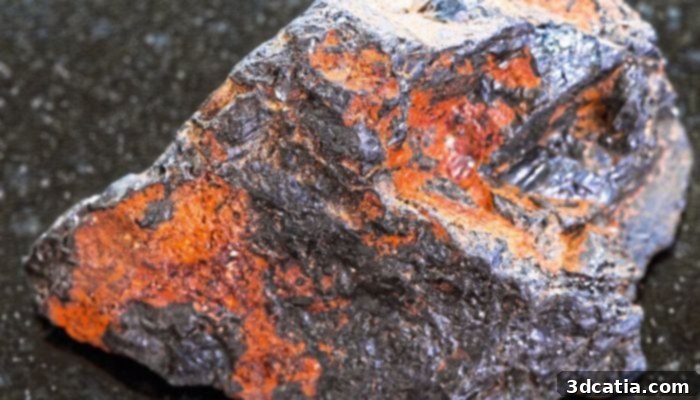
Tungsten in its pure form, a heavy and refractory metal. (Photo Credits: ©vvoe – stock.adobe.com)
In its pure form, tungsten exhibits a delicate balance, being either very soft and ductile or remarkably brittle, depending on its processing and crystalline structure. For most high-performance applications, it is almost always combined with other elements to form alloys that are celebrated for their extraordinary hardness, strength, and durability. The most renowned of these alloys is tungsten carbide, a ceramic composite material formed by mixing tungsten and carbon. This combination yields a material of unparalleled hardness, widely used in cutting tools, abrasives, and armor-piercing ammunition. Other critical combinations include high-speed steel, where tungsten contributes significantly to heat resistance and tool life, and alloys with metals such as cobalt, copper, bronze, chromium, iron, or nickel. Tungsten is also a vital component of the superalloy Hastelloy, a nickel-molybdenum-chromium blend known for its exceptional corrosion resistance in harsh chemical environments. In all these instances, the addition of tungsten is a strategic choice, resulting in rigid, high-strength materials capable of withstanding extreme operational demands and extending component lifetimes significantly.
Diverse Applications and Strategic Advantages of Tungsten
Due to its extraordinary suite of properties, particularly its superior strength, high melting point, and excellent heat and wear resistance, tungsten has become an indispensable metal across a myriad of critical sectors. Its prime utility is prominently showcased in the aerospace and defense industries, where performance under extreme conditions is paramount. Tungsten’s ability to maintain structural integrity at elevated temperatures makes it an ideal material for components such as rocket engine nozzles, which endure immense thermal stress during launch. It is also found in high-performance tools, crucial for manufacturing and maintenance, as well as in turbine blades for advanced aircraft, where its resistance to creep and erosion is highly valued. Furthermore, its density and strength make it suitable for specialized weapon heads and kinetic energy penetrators.
In the realm of medicine, tungsten proves to be an increasingly attractive option, primarily owing to its unique radiation-shielding properties and biocompatibility. The material is utilized in advanced MRI scans for enhanced imaging capabilities, in collimators to precisely direct radiation beams during radiotherapy, and for robust radiation protection in various medical devices and facilities, safeguarding both patients and practitioners. Its ability to absorb X-rays and gamma rays effectively makes it a safer and more efficient alternative to lead in many shielding applications. Beyond these high-stakes fields, tungsten also finds significant use in the automotive sector, particularly in spark plug electrodes and counterweights, and plays a role in the chemical industry for corrosion-resistant equipment. Even in leisure applications, such as high-density fishing weights or dart barrels, tungsten’s specific gravity offers distinct advantages. Moreover, it is a crucial component in ion generation devices, including cathodes and anodes, where its high electron emission properties are essential for efficient operation.
The broad applicability of tungsten stems from its exceptional resistance to degradation. It is remarkably biocompatible, making it safe for internal medical use. Its capacity to absorb X-rays and gamma rays provides superior shielding capabilities across various environments. Furthermore, tungsten is highly resistant to most acids and alkalis, ensuring its longevity and stability in aggressive chemical environments. Due to its superior resistance to corrosion, erosion, and excellent thermal conductivity, tungsten alloys are also extensively used in specialized manufacturing processes, such as the gravity die casting of aluminum. Here, it provides durable molds that can withstand repeated thermal cycling without significant wear. Overall, the unparalleled combination of physical, chemical, and thermal properties makes tungsten an exceptionally versatile material, perfectly suited for a vast array of demanding applications where conventional metals simply cannot perform.
Revolutionizing Tungsten Processing: Advanced 3D Printing Technologies
Historically, the unique characteristics of tungsten, particularly its extremely high melting point and inherent brittleness, made it challenging to process using traditional manufacturing methods. However, the advent of additive manufacturing has opened new frontiers for working with this valuable metal. Tungsten is currently processed using several cutting-edge 3D printing methods, each tailored to address its specific material properties.
One of the primary methods is Selective Laser Melting (SLM). This technique employs a high-powered infrared laser to precisely melt and fuse successive layers of tungsten powder, building up a complex part layer by layer. Initially, printing with pure tungsten via SLM presented significant technical difficulties due to its exceptionally high melting point, which required immense laser power and careful process control to achieve full density without defects. However, these challenges have been largely overcome through innovative material science, specifically by combining pure tungsten powder with binders or alloying elements such as nickel-iron (Ni-Fe) or nickel-copper (Ni-Cu). These composites lower the effective melting temperature and improve flowability and sinterability, enabling more robust and reliable part production. Beyond its technical advantages, the ability to 3D print tungsten offers an excellent alternative to harmful lead in various applications, particularly in radiation shielding and aluminum casting, providing a safer and more environmentally friendly solution.
The second significant process adapted for tungsten is binder jetting. This method involves depositing a liquid binding agent onto a powder bed, layer by layer, to create a “green part” which is then sintered or infiltrated in a separate high-temperature furnace. In a notable collaboration with a material manufacturer, ExOne, a leader in binder jetting technology, has successfully developed and commercialized a copper-tungsten composite material specifically optimized for use in their laser beam machines. This composite leverages tungsten’s density and thermal properties alongside copper’s excellent electrical and thermal conductivity, making it ideal for applications requiring both strength and efficient heat dissipation. Binder jetting offers advantages in terms of throughput and cost-effectiveness for larger batch production and allows for the creation of intricate geometries that would be impossible with conventional methods.
Finally, the Electron Beam Melting (EBM) process has also been successfully adapted to handle tungsten. EBM utilizes an electron beam to melt metal powder in a vacuum environment. A key advantage of the EBM process for tungsten is its capability to preheat the entire powder bed to very high temperatures, often hundreds of degrees Celsius, before melting. This elevated temperature minimizes the thermal stresses that typically lead to deformation and residual stresses in printed parts, which is particularly beneficial for a high-melting-point and potentially brittle material like tungsten. The preheating also enhances the ductility of the resulting parts, allowing for the creation of dense, crack-free tungsten components with superior mechanical properties. These advanced 3D printing technologies are continually evolving, pushing the boundaries of what is possible with tungsten and unlocking its full potential for a new generation of high-performance applications.
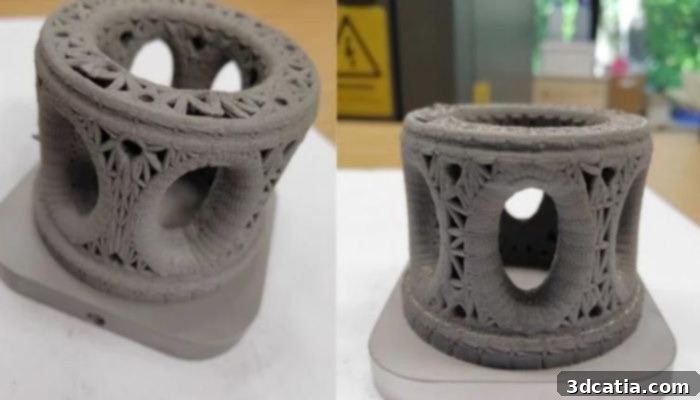
Complex parts that can be manufactured using advanced tungsten-nickel-iron alloy 3D printing. (Photo Credits: Wolfram Industrie GmbH)
Leading Companies Driving Tungsten 3D Printing Innovation
The growing importance of tungsten in additive manufacturing has attracted significant investment and research from several leading companies across the globe. These pioneers are not only developing new materials but also refining existing technologies to push the boundaries of what’s possible with tungsten 3D printing.
The Swedish company Höganäs AB stands out as a leading player in the advanced powder metallurgy market. While not exclusively focused on finished parts, Höganäs is critical for supplying high-quality metal powders. They utilize tungsten-titanium carbide as a mixed carbide additive, essential for enhancing the performance of cutting tools. Furthermore, they are deeply involved in the production of tungsten-based sintered carbide, a foundational material for many hard-wearing applications. Their expertise in powder formulation is vital for the success of various tungsten 3D printing processes. GE Additive, a significant and influential player in the broader metal 3D printing landscape, is also heavily invested in material research and development. Their expansive R&D efforts include extensive work on high-performance materials, with tungsten being a key focus. GE Additive leverages its considerable resources to explore new tungsten alloys and optimize printing parameters for their own range of advanced metal additive manufacturing machines, particularly for aerospace applications.
ExOne, now part of Desktop Metal, has established itself as a frontrunner in binder jetting technology, which is particularly well-suited for processing heavy metals like tungsten. Their innovative binder jetting platforms allow for the production of complex tungsten and tungsten composite parts with high precision and efficiency, making them a go-to solution for specific industrial demands. Other prominent companies such as EOS and Desktop Metal are actively engaged in numerous projects involving various metal powders, including tungsten. EOS, known for its leading laser powder bed fusion systems, continually researches new material applications, pushing the envelope for demanding industrial sectors. Desktop Metal, with its diverse portfolio of additive manufacturing technologies, is exploring ways to integrate tungsten into its solutions, aiming for broader accessibility and application of this critical material. Moreover, 3D Systems, another veteran in the additive manufacturing space, demonstrated its commitment to tungsten 3D printing by creating a comprehensive print parameter database license for tungsten a year ago. This valuable resource enables customers to reliably 3D print high-quality tungsten parts on their DMP Flex 350 metal 3D printer, significantly lowering the barrier to entry for businesses looking to adopt tungsten additive manufacturing. These companies, through their continuous innovation, are collectively shaping the future of tungsten 3D printing, making it more robust, versatile, and accessible for high-tech industries worldwide.
The integration of tungsten into 3D printing represents a significant leap forward for industries demanding high-performance materials capable of withstanding extreme conditions. From enabling more efficient fusion energy reactors to creating next-generation components for aerospace, medical, and automotive sectors, tungsten’s unique properties, coupled with advanced additive manufacturing techniques, are unlocking unprecedented possibilities. As research and development continue to advance, we can expect to see even more sophisticated tungsten alloys and refined printing processes, further solidifying its role as an indispensable material for future technological innovations.
What are your thoughts on the transformative potential of 3D printing with tungsten? Let us know in a comment below or on our LinkedIn, Facebook, and Twitter pages! Don’t forget to sign up for our free weekly newsletter here for the latest 3D printing news straight to your inbox! You can also find all our videos on our YouTube channel.
*Cover Photo Credits: ExOne Pressemitteilung