
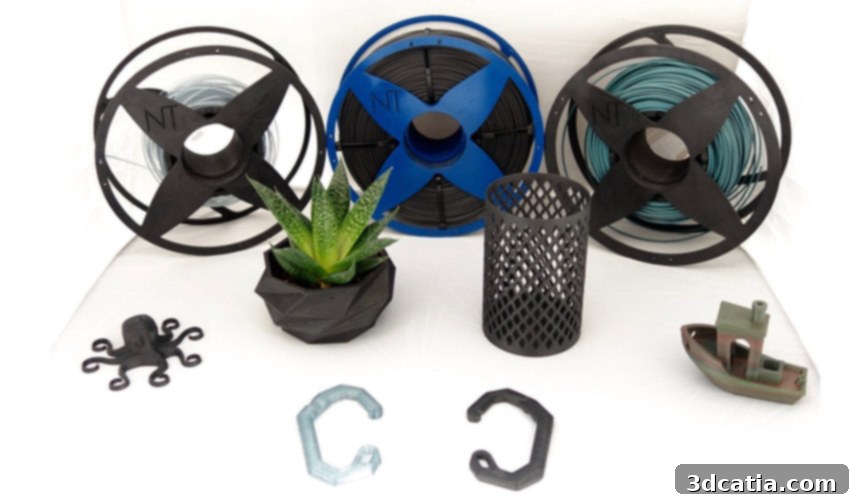
Nefilatek: Pioneering Sustainable 3D Printing with 100% Recycled Filaments
In an era where environmental consciousness is paramount, innovative companies are emerging to address the ecological footprint of various industries. Nefilatek, a dynamic Canadian startup, stands at the forefront of this movement within the additive manufacturing sector. Launched with a vision for a greener future, the company has introduced a groundbreaking range of 100% recycled 3D printing filaments. Established in 2018 following a highly successful Kickstarter campaign, Nefilatek is committed to making 3D printing a more sustainable and environmentally responsible manufacturing method. This ambitious endeavor places Nefilatek firmly among the growing number of projects that seamlessly integrate sustainability with advanced manufacturing technologies. Market trends strongly support this direction; a recent industry report projected massive growth in demand for eco-friendly filaments over the next five years, underscoring the urgency and relevance of Nefilatek’s mission. We had the distinct pleasure of speaking with Bastien Lepoutre, the visionary founder of Nefilatek, who provided an insightful deep dive into the intricate process of creating recycled filaments and shared his perspectives on the future convergence of recycling and 3D printing.
3DN: Can you introduce yourself and explain your connection to 3D printing?
Certainly. I recently completed my mechanical engineering degree just a month ago. My fascination with sustainable development began during my childhood, a passion that has profoundly shaped my academic and professional journey. It was at the start of my university studies that I first encountered 3D printing, and I was immediately captivated by its potential. I quickly immersed myself, developing several personal and academic projects that involved both 3D design and practical printing applications. This hands-on experience not only honed my technical skills but also deepened my appreciation for the innovative spirit of the 3D printing community, ultimately leading me to become an active participant within it.
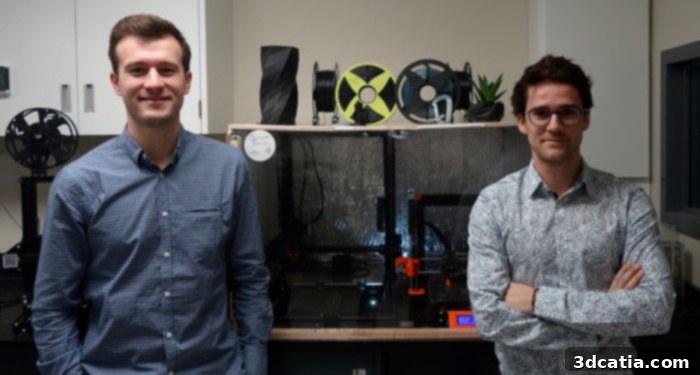
On the left, Bastien Lepoutre – founder of Nefilatek, and Angel Chauffray – partner & R&D engineer | Photo Credits: Nefilatek
3DN: How did the idea of creating Nefilatek originally come about?
My co-founders and I were incredibly enthusiastic about the capabilities of 3D printing. We firmly believe it represents a technology with immense potential for the future, capable of revolutionizing various industries from prototyping to end-use part production. However, as we delved deeper, we identified a significant drawback: traditional 3D printing often consumes substantial amounts of energy and, crucially, relies heavily on virgin plastic materials. This reliance on new plastics, coupled with the energy demands, struck us as fundamentally inconsistent with my core values and vision for sustainable development. Recognizing this critical conflict, we were compelled to explore alternative approaches. Our central question became: how could we integrate recycled plastic into the 3D printing process, thereby mitigating its environmental impact? This inquiry sparked the inception of Nefilatek, driven by a desire to transform 3D printing into a truly eco-conscious manufacturing solution.
3DN: Could you elaborate on the detailed process involved in creating your recycled 3D printing filaments?
The journey of transforming plastic waste into high-quality 3D printing filament is a multi-step process, each stage meticulously designed to ensure product integrity and performance. Our first and perhaps most critical step involves the careful sourcing of recyclable waste. The key here is to find homogeneous waste streams—materials that are consistent in type and composition. This uniformity is crucial for producing a filament with reliable and predictable properties. Once sourced, this plastic waste undergoes an initial preparation phase where it is thoroughly cleaned to remove superficial dirt and labels, ensuring a cleaner input for subsequent steps.
Following preparation, the cleaned waste is then fed into industrial grinders, which reduce it into smaller, manageable pellets or flakes. The size and consistency of these ground particles are vital for the efficiency of the next stage. These plastic pellets then go through an intensive decontamination process. This stage is paramount for removing any remaining impurities, such as residues, contaminants, or other non-plastic materials that could compromise the final filament’s quality. This rigorous cleaning also helps to further homogenize the plastic, ensuring that the material has consistent properties throughout, which is essential for uniform extrusion and print performance.
With the clean, decontaminated, and homogenized pellets ready, the next step is extrusion. In this stage, the plastic granules are fed into an extruder where they are heated to their melting point and then forced through a precisely sized die. This forms a continuous strand of filament. During the extrusion process, the molten plastic is subjected to further filtration. This secondary filtration is crucial for catching any microscopic impurities or inconsistent particles that might have escaped previous cleaning stages, preventing them from becoming weak points or clogging printer nozzles. After extrusion, the hot filament is carefully cooled and drawn to achieve the exact diameter required for 3D printing, typically 1.75 mm or 2.85 mm.
Finally, the continuous filament is spooled onto reels. A core part of our commitment to sustainability extends to our packaging: we have specifically chosen reusable reels. This conscious decision aims to minimize waste, encouraging our customers to return or reuse the spools once the filament is depleted, thereby closing another loop in the circular economy. This holistic approach ensures that from waste collection to the final product, every stage is optimized for environmental responsibility and quality.
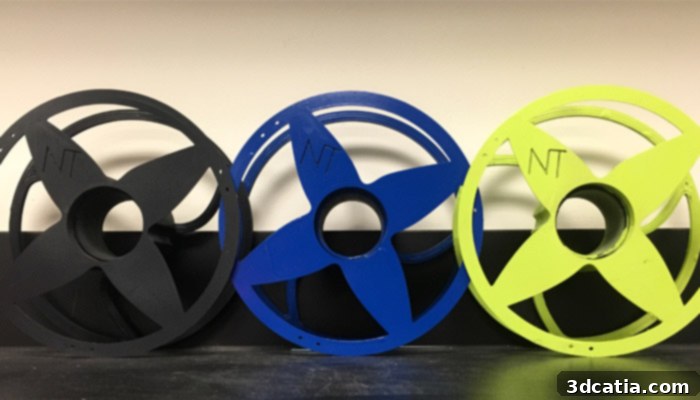
Photo Credits: Nefilatek
3DN: With which types of 3D printers are your filaments compatible?
Our mission is to make sustainable 3D printing accessible to a broad audience, which means ensuring wide compatibility for our filaments. Currently, our recycled filaments are designed to be compatible with the vast majority of FDM (Fused Deposition Modeling) 3D printers available on the market. This broad compatibility is primarily due to our focus on manufacturing 1.75 mm diameter filaments, which is the most common standard for desktop FDM machines. While other diameters, such as 2.85 mm (often used by brands like Ultimaker), exist, our current market analysis indicates that the demand for 1.75 mm filaments is overwhelmingly dominant. However, our manufacturing infrastructure is flexible, and we possess the technical capability to produce other diameters if a significant market need arises in the future.
Regarding the specific materials we offer, we currently have HIPS (High Impact Polystyrene) available, and our recycled PC (Polycarbonate) filament will be ready for release very soon. Each material has distinct printing requirements that users should be aware of to achieve optimal results. For HIPS, a printer equipped with a heated print bed is essential to prevent warping, and the extruder should be capable of reaching temperatures of up to 250°C. HIPS is often used as a support material or for durable, lightweight parts.
Polycarbonate, on the other hand, is a more advanced engineering material known for its exceptional strength, heat resistance, and transparency. Printing with PC requires more stringent conditions. Users will need a 3D printer with a closed enclosure to maintain a stable, high-temperature environment, which is crucial for preventing layer delamination and warping. Furthermore, a heated print bed capable of reaching up to 125°C is necessary, and the extruder must be able to achieve temperatures as high as 290°C. Given these high temperatures, a metal nozzle is highly recommended to withstand the heat and ensure consistent extrusion. By offering these high-performance recycled materials, we aim to provide sustainable options for a wide range of applications, from general prototyping to more demanding functional parts.
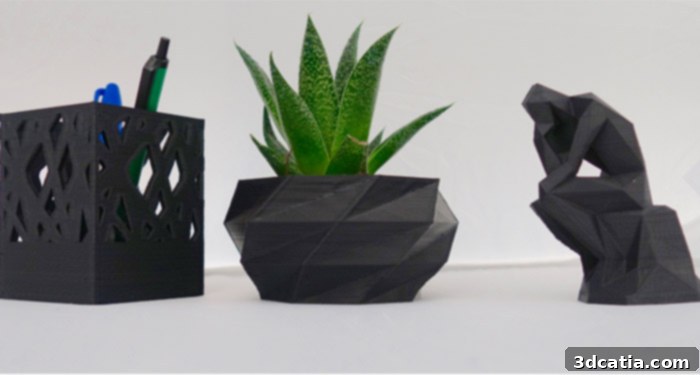
3D printed pieces using Nefilatek filament | Photo Credits: Nefilatek
3DN: Do you believe 3D printing is inherently more sustainable than other conventional manufacturing methods?
The sustainability of 3D printing, much like any manufacturing technology, largely depends on the specific application and context. It’s not a one-size-fits-all answer. For certain scenarios, I am convinced that 3D printing offers significant environmental advantages over traditional methods. Consider applications such as rapid prototyping, where it dramatically reduces the material and time wasted on iterative designs. For repair work, 3D printing allows for the creation of replacement parts on demand, extending the lifespan of products and preventing unnecessary disposal. Even for small-batch production or highly customized items, this technology proves to be more resource-efficient than conventional mass production techniques. A key benefit of additive manufacturing is its ability to produce lighter, geometrically optimized parts. This inherent design freedom means less material is often required, translating into reduced raw material consumption and, consequently, lower overall carbon footprint. Furthermore, when our 100% recycled filaments are used, the sustainability credentials of 3D printing are amplified considerably, creating a truly circular manufacturing process.
However, it’s crucial to approach this topic with a balanced perspective. We must acknowledge that 3D printers, particularly when viewed on a per-part basis for large-scale production, can demand a substantial amount of energy compared to highly optimized conventional processes like injection molding. This energy intensity per part means that for truly mass-produced goods, where millions of identical units are required, traditional injection molding might still be more energy-efficient and, thus, more sustainable in that specific context. Therefore, 3D printing’s sweet spot for sustainability lies in areas where its unique advantages—such as design complexity, customization, on-demand production, and material efficiency for lighter parts—outweigh the energy cost. It excels in reducing waste associated with inventory, shipping, and overproduction. Understanding these nuances is key to leveraging 3D printing as a genuinely sustainable manufacturing tool, strategically applying it where its benefits are maximized, and its environmental drawbacks are minimized.
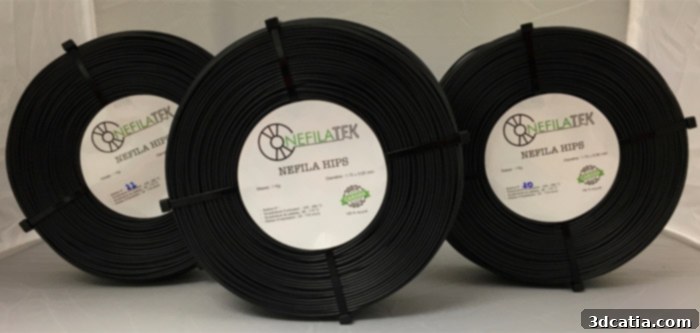
For the moment, only HIPS is offered | Photo Credits: Nefilatek
3DN: What exciting future projects are on the horizon for Nefilatek?
Our commitment to expanding sustainable options for the 3D printing community drives our future development. Our immediate and primary objective is to significantly broaden our portfolio of 100% recycled filaments. We are actively working on developing and launching new materials such as ABS (Acrylonitrile Butadiene Styrene), PLA (Polylactic Acid), PP (Polypropylene), and Nylon. Each of these materials presents unique properties and challenges in the recycling process, but our R&D team is dedicated to overcoming these to offer a diverse variety of high-quality, eco-friendly filaments to our customers. This expansion will allow users to tackle a wider range of applications, from robust engineering prototypes to biodegradable consumer goods, all while maintaining their commitment to sustainability.
Beyond material development, we are also investing in an innovative concept: the establishment of a small-scale production farm. This facility will operate exclusively using our 100% recycled filaments, effectively closing the loop from waste to product within our own ecosystem. The core objective of this production farm is twofold: first, to showcase the versatility and quality of objects produced with recycled materials, demonstrating that sustainability does not compromise performance or aesthetics. Second, and perhaps more importantly, it will allow us to offer customers a range of attractive, functional, and entirely recycled objects, manufactured using our own sustainable filaments. This initiative is designed to provide tangible examples of the circular economy in action, proving that valuable products can be created from waste, reducing reliance on virgin plastics and inspiring others to embrace sustainable manufacturing practices. We envision this farm as a testament to what’s possible when innovation meets environmental responsibility, paving the way for a more sustainable future in manufacturing.
3DN: Do you have any final message or words of wisdom for our readers?
Absolutely! For everyone passionate about 3D printing and sustainability, we sincerely encourage you to explore the potential of our 100% recycled filaments. Please don’t hesitate to contact us if you are interested in learning more about our products or how they can benefit your projects. We believe that together, we can make significant strides towards a more sustainable additive manufacturing industry. And most importantly, whether you’re designing, printing, or innovating, always remember to let your imagination run wild!
What are your thoughts on Nefilatek’s pioneering efforts in sustainable 3D printing? We invite you to share your insights and opinions in a comment below, or engage with us on our Facebook and Twitter pages! For all the latest news, trends, and innovations in the world of 3D printing, don’t forget to sign up for our free weekly Newsletter, delivered directly to your inbox!