
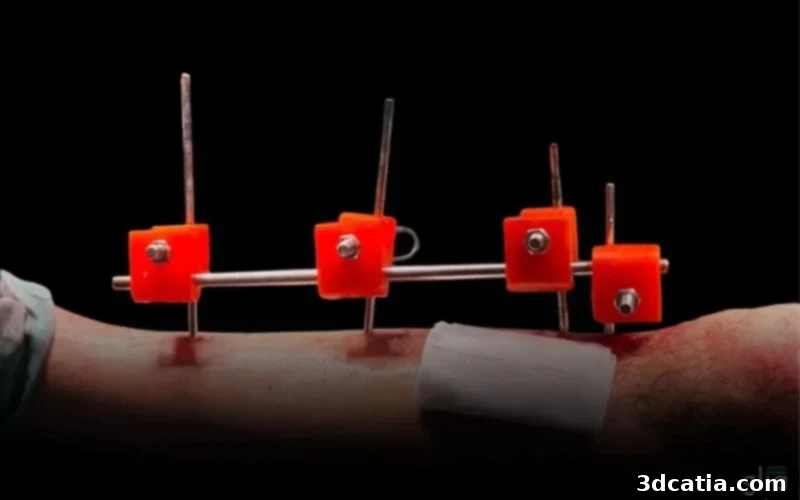
Revolutionary 3D Printed External Fixators Provide Hope in Gaza
In a region facing immense healthcare challenges, a beacon of hope has emerged through the ingenuity of doctors and engineers. GLIA, an international medical relief organization, has pioneered the creation of the world’s first 3D-printed external fixator within Gaza. This critical orthopedic device is designed to treat complex fractures in a setting where medical resources are severely limited and access to conventional equipment is nearly impossible.
The project leverages locally available materials, incorporating 3D printing technology, recycled plastic, and solar power, demonstrating a sustainable and resilient approach to healthcare in crisis. This innovative solution not only addresses the immediate needs of patients with severe fractures but also establishes a model for other resource-constrained environments worldwide.
To date, the 3D-printed external fixator has successfully prevented amputation or permanent disability in three patients. This achievement is especially significant given that over 90% of healthcare facilities in the region have been damaged or destroyed. Furthermore, the entry of medical supplies is heavily restricted, and hospitals are grappling with extreme shortages of essential equipment for basic trauma care. The development and implementation of this device represent a crucial step in mitigating the impact of these challenges and providing life-saving treatment to those in need.
Understanding External Fixators: A Vital Orthopedic Tool
An external fixator, often referred to as an “x-fix,” is a medical device utilized to stabilize and align fractured bones. Its adaptability to different types of fractures makes it an invaluable tool in orthopedic surgery. Surgeons typically opt for an external fixator when a fracture is too unstable for internal fixation methods or when the surrounding tissues have sustained significant damage, precluding immediate surgical intervention. This device serves as a temporary solution, providing stability and protection to the injured area while allowing the patient’s body to combat infection or recover from traumatic shock.
The prompt application of an external fixator is crucial for its effectiveness. Dr. Tarek Loubani, the medical director of GLIA, emphasizes that delaying the placement of this device can have severe consequences, including amputation or even death. Traditional external fixators can be prohibitively expensive, costing upwards of $500, and often require specialized imports. These factors make them largely unattainable in regions facing blockades or economic hardship. In the context of Gaza, where hospitals are struggling to maintain operations and access to commercial medical devices is severely restricted, the ability to locally produce these essential tools is a matter of survival.
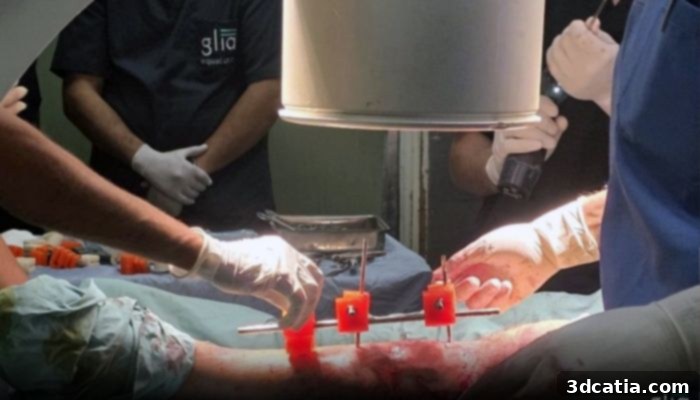
The First Surgery Using a 3D-Printed External Fixator
Resourcefulness in the Face of Adversity: Building with Local Materials
Despite the numerous challenges posed by the geopolitical landscape, the medical team in Gaza possessed a critical advantage: the availability of local materials for constructing the external fixator. Dr. Tarek explained that suitable metal components were found amidst the debris, which could then be connected to plastic joints created through 3D printing. The plastic components are made entirely from recycled materials and powered by solar energy, a necessity in an environment where access to electricity and clean water is limited.
Although the production process is time-consuming, with each component taking up to 12 hours to print, the system is now fully functional. Currently, twelve patients are awaiting the device, which has been consistently used in operational healthcare facilities since August 2025. These 3D-printed external fixators provide a reliable means of ensuring precision, reproducibility, and secure support for patients with critical orthopedic needs. The ultimate goal is to transition to a faster plastic extrusion system to expedite the production process. However, the ongoing uncertainty surrounding ceasefires and the threat of renewed attacks make long-term planning extremely challenging. One of GLIA’s facilities in Gaza has already been targeted in the past, highlighting the risks faced by those working to provide essential medical care.
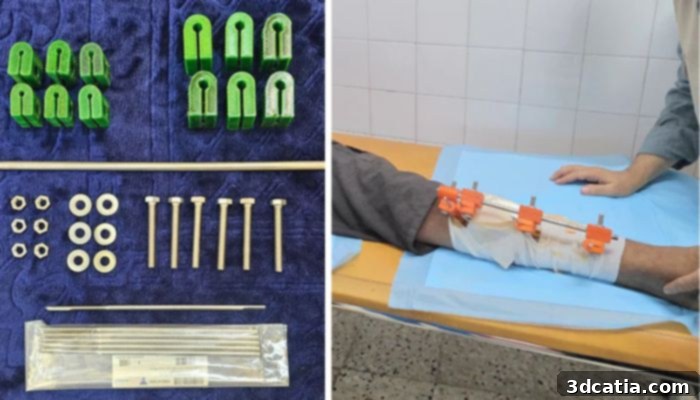
Kit with metal parts and 3D-printed components; patient with the external fixator.
An Open-Source Solution: A Model for Global Replication
One of the most remarkable aspects of this project is its commitment to open-source principles. Jen Wilson, GLIA’s Director of Production and Design, has affirmed that the organization has no intention of patenting any aspect of the x-fix or profiting from its use. The primary objective is to enable its replication wherever it is needed, particularly in low-income regions and conflict zones. By making the design and specifications freely available, GLIA aims to foster collaboration and innovation, empowering local communities to address their own healthcare challenges.
GLIA emphasizes that this project is the result of a collaborative effort involving Palestinian, Canadian, and British teams. The team worked in close partnership with Palestinian doctors to ensure that the materials used were properly sterilized and structurally sound for medical applications. Rejecting the traditional notion of “aid,” the organization views this work as an example of Palestinian innovation and resilience. Dr. Loubani, who spent three months working in Gaza’s emergency rooms, describes this project as “one of the most innovative projects” he has encountered, underscoring the ingenuity and resourcefulness of the Palestinian people in creating a device that is essential for the treatment of critically ill patients.
The success of the 3D-printed external fixator project in Gaza underscores the potential of leveraging technology and local resources to address healthcare challenges in resource-constrained environments. By embracing open-source principles and fostering collaboration, GLIA has created a model that can be replicated and adapted to meet the unique needs of communities around the world.
This groundbreaking initiative serves as a testament to the power of human ingenuity and the importance of providing access to essential medical care, even in the most challenging circumstances. It highlights the critical role that innovation and collaboration can play in improving healthcare outcomes and empowering communities to build a more resilient future.
The development of the 3D-printed external fixator is not just a technological achievement; it is a symbol of hope and resilience in the face of adversity. It demonstrates that even in the most difficult circumstances, it is possible to find innovative solutions to pressing challenges and make a tangible difference in the lives of those in need.
The impact of this project extends far beyond the immediate treatment of patients with fractures. It serves as an inspiration to healthcare professionals and engineers around the world, encouraging them to explore new and creative ways to address healthcare challenges in their own communities. By sharing its knowledge and resources, GLIA is fostering a global movement towards more sustainable, accessible, and equitable healthcare.
What are your thoughts on this remarkable news? Share your comments below or connect with us on LinkedIn and Facebook. For the latest 3D printing updates, subscribe to our free weekly Newsletter. Explore our videos on YouTube and discover more medical and dental 3D printing news here.
*All Photo credits: GLIA