

SPEE3D’s Cold Spray 3D Printing: Revolutionizing Rocket Engine Manufacturing for the Aerospace Industry
The aerospace industry stands at the precipice of a new manufacturing era, largely driven by the transformative capabilities of additive manufacturing, commonly known as 3D printing. This innovative technology is rapidly gaining traction, offering unprecedented flexibility, cost efficiencies, and speed in component production. Across the globe, forward-thinking companies are leveraging metal 3D printing to create highly complex and performance-critical parts, ranging from intricate rocket components to entire rocket engines. This paradigm shift is enabling faster design iterations, reduced material waste, and the production of lightweight, durable structures essential for space exploration and satellite deployment. Industry leaders such as Relativity Space have made significant strides, establishing dedicated additive manufacturing centers designed specifically for the rapid and scalable construction of rockets. Similarly, European entities like Orbex are at the forefront, showcasing how 3D printing facilitates the creation of advanced rocket propulsion systems, dramatically shortening lead times and optimizing performance.
In a significant development bolstering this trend, Australian 3D printer manufacturer SPEE3D has received a substantial AUD $1.5 million grant from the Australian government. This considerable investment is allocated to the development of the groundbreaking SPAC3D project, an initiative poised to reshape the landscape of rocket engine production. Through SPAC3D, SPEE3D aims to harness its proprietary and patented cold spray technology to print robust, high-performance rocket engines using various metal materials. This governmental backing underscores the strategic importance of advanced manufacturing capabilities within Australia’s burgeoning space sector, highlighting a commitment to fostering innovation and local expertise in a highly competitive global market.
The SPAC3D project is designed to capitalize on the inherent advantages offered by additive manufacturing, particularly SPEE3D’s unique approach. The core promise is the ability to manufacture high-quality, flight-ready components that are not only exceptionally reliable but also comparatively inexpensive to produce. This dual benefit of superior quality at a lower cost represents a significant leap forward for aerospace manufacturers. SPEE3D asserts that its patented cold spray process can print intricate metal parts up to 100 times faster than many other established metal 3D printing technologies currently on the market. This remarkable speed translates directly into vastly improved efficiency throughout the entire engine design, development, and production lifecycle. The implications for rapid prototyping, iteration, and ultimately, quicker deployment of space vehicles are profound. Steven Camilleri, CTO of SPEE3D, emphasizes the revolutionary nature of their work: “SPEE3D has developed a new way to manufacture rocket engines quickly with our advanced manufacturing process.” He further elaborated on the strategic impact of the government grant, stating, “The MMI grant will allow us to work with other partners in Australia to manufacture and test flight-ready engines for the emerging industrial space market.” This collaboration is crucial for validating the technology and integrating it seamlessly into the demanding requirements of the space industry.
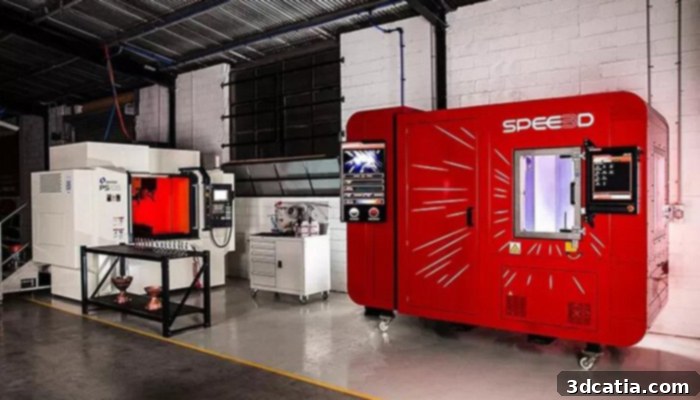
The Warp SPEE3D 3D printer from the Australian manufacturer, demonstrating its capability for large-scale metal additive manufacturing. (Photo Credit: SPEE3D)
Advancing Rocket Engine Production with Revolutionary 3D Printing Technologies
The aerospace industry’s increasing reliance on 3D printing stems from the technology’s inherent ability to deliver significant efficiencies. Foremost among these are substantial reductions in manufacturing costs, often achieved through optimized material usage and less waste, coupled with the ability to create complex parts in a fraction of the time required by conventional methods. SPEE3D’s pioneering cold spraying process exemplifies these advantages, offering a distinct approach to metal additive manufacturing. Unlike traditional methods that typically involve melting metal powders with lasers or electron beams, SPEE3D’s technology harnesses kinetic energy. This process involves accelerating metal powder to supersonic speeds and spraying it onto a substrate. Upon impact, the kinetic energy is converted into plastic deformation, causing the metal particles to bond together, layer by layer, without ever reaching their melting point.
This unique cold spray method offers several critical benefits for applications as demanding as rocket engine manufacturing. By avoiding high temperatures, it largely circumvents issues like thermal distortion, residual stresses, and changes in material microstructure that can occur with fusion-based 3D printing. This means the printed parts retain the original properties of the feedstock material, ensuring superior metallurgical integrity and mechanical performance—factors absolutely crucial for components operating under extreme pressures and temperatures in space. SPEE3D is confident that this cold spray process will enable them to produce high-quality, high-density components in a significantly shorter timeframe than traditionally possible. This speed is a game-changer for the aerospace sector, where development cycles can be notoriously long and costly. For example, the Australian manufacturer has already demonstrated its capabilities by printing a substantial 17.9 kg metal part in an astonishingly short three hours. Their flagship Warp SPEE3D printer, which operates on this precise cold projection process, boasts the capacity to print metal parts weighing up to 40 kg, achieving an impressive printing speed of 100 grams per minute. This level of rapid, large-scale metal fabrication opens new avenues for in-situ repair, on-demand part production, and accelerated prototyping for complex aerospace assemblies.
The Future of Aerospace Manufacturing: Competition and Collaboration
With the ambitious SPAC3D project, SPEE3D strategically positions itself to attract and collaborate with major players across the aerospace sector, aiming to demonstrate the compelling advantages of its cold spray technology. The goal is to convince these industry giants to adopt SPEE3D’s rapid and cost-effective manufacturing solutions for their own rocket component and engine production needs. However, the Australian company operates within a highly dynamic and competitive landscape. The race to industrialize additive manufacturing for space applications is intense, with numerous global entities making significant investments and breakthroughs.
Institutions like NASA are continually exploring and implementing various 3D printing techniques for everything from lunar habitat construction to advanced propulsion systems, pushing the boundaries of what’s possible in space. Private aerospace innovators such as SpaceX, with their focus on reusable rockets and ambitious Mars missions, extensively utilize 3D printing for critical components, often integrating it into their vertically integrated manufacturing processes to achieve unprecedented speeds and cost reductions. Companies like Orbex, as mentioned earlier, are specifically designing entire rocket engines with additive manufacturing in mind from the ground up, highlighting the inherent benefits of design freedom and performance optimization. Similarly, Relativity Space has pioneered robotic 3D printing for entire rocket structures, aiming for a fully 3D-printed rocket, showcasing a different scale of ambition and application for the technology.
The proliferation of these diverse approaches underscores the versatility and transformative potential of additive manufacturing. While SPEE3D’s cold spray offers unique advantages in speed and material integrity, other companies might specialize in high-temperature alloys, extremely complex geometries, or specific material combinations using different 3D printing processes. This vibrant ecosystem of innovation fosters both healthy competition and potential for collaboration, driving the entire aerospace industry forward. One undeniable certainty emerges from this rapidly evolving sector: the synergy between additive manufacturing and the aerospace industry is only just beginning. As technologies mature and new applications are discovered, 3D printing is set to become an even more integral part of how humanity reaches for the stars, making space travel more accessible, efficient, and sustainable.
What are your thoughts on SPEE3D’s pioneering rocket engine program, supported by the Australian government? Do you believe cold spray technology will become a dominant force in aerospace manufacturing? We invite you to share your insights in a comment below or join the conversation on our vibrant Facebook and Twitter pages. For those keen to stay abreast of the latest developments and innovations in the world of 3D printing, don’t forget to sign up for our free weekly newsletter, delivering all the essential news straight to your inbox!
Cover Image Photo Credit — SpaceX/Unsplash