
Top 5 Additive Manufacturing Videos: Unveiling Innovation in Healthcare, Space, and Sustainability
Welcome to our curated selection of the week’s most compelling videos, where we delve into the groundbreaking world of additive manufacturing and its transformative impact across diverse sectors. From revolutionizing healthcare solutions to envisioning future cities in space and promoting sustainable practices, these videos offer a comprehensive look at how 3D printing is shaping our present and future. We’ve handpicked content that not only educates but also inspires, showcasing the incredible potential and practical applications of this cutting-edge technology. Whether you’re a seasoned expert or new to the field, prepare to explore innovative designs, intricate processes, and visionary projects that are pushing the boundaries of what’s possible. Join us as we explore how additive manufacturing is becoming an indispensable tool for engineers, designers, medical professionals, and innovators worldwide. As always, happy watching, and may these insights fuel your curiosity and creativity!
Top 1: Transforming Healthcare with Medical 3D Printing Through Collaboration
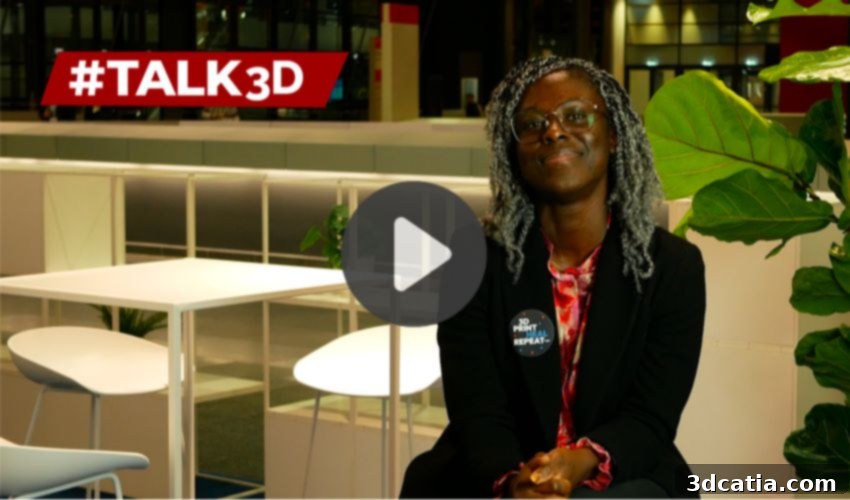
In this illuminating episode of #Talk3D, we had the privilege of speaking with Naomi Nathan, the Head of Medical at Mobility Goes Additive (MGA). MGA is not just an organization; it’s a vital ecosystem dedicated to fostering innovation within the medical additive manufacturing landscape. This dynamic network plays a crucial role in connecting various stakeholders, from researchers and developers to clinicians and industry leaders, all working towards advancing patient care through 3D printing. The interview with Naomi Nathan provides invaluable insights into how this collaborative network operates, highlighting its mission to accelerate the adoption of additive manufacturing in medical applications. She explains how individuals and organizations can leverage MGA’s extensive resources, expertise, and connections to propel their own initiatives in medical 3D printing. This includes opportunities for knowledge sharing, project collaboration, and accessing a community committed to solving complex healthcare challenges. Discover how MGA is nurturing an environment where groundbreaking ideas can flourish, leading to personalized prosthetics, advanced surgical guides, biocompatible implants, and novel medical devices that dramatically improve patient outcomes and quality of life. If you are passionate about the intersection of technology and healthcare and eager to contribute to this rapidly evolving field, this video is an essential watch to understand the power of community and collaboration in driving medical innovation. Learn more about MGA’s vision and how you can become an active participant in this transformative journey by watching the full interview below:
Top 2: What’s Faster? Injection Molding VS 3D Printing – A Comprehensive Speed and Cost Analysis
One of the most frequently asked questions in manufacturing is: which production method is truly faster and more cost-effective – injection molding or 3D printing? This insightful video from Formlabs tackles this burning question head-on, pitting an injection molding machine against a modern 3D printer in a direct comparative test. The comparison goes beyond mere production speed, delving into a comprehensive evaluation that considers crucial factors such as initial setup time, material costs, labor intensity, and scalability. Formlabs meticulously tracks the time it takes for each technology to produce identical parts, providing a transparent breakdown of the entire manufacturing process from start to finish. Crucially, the video doesn’t shy away from the hard numbers. It provides a detailed cost-per-part analysis, a vital metric for businesses deciding on their production strategy. Viewers will gain a clear understanding of how many parts need to be produced for one technology to become more economically viable than the other. This nuanced approach helps demystify the common misconception that one technology is inherently “better” than the other, instead illustrating that the optimal choice heavily depends on the specific application, production volume, design complexity, and budget constraints. For instance, while 3D printing often excels in rapid prototyping, small batch production, and custom part creation due to its minimal tooling requirements, injection molding typically becomes more cost-effective and faster at very high volumes once the initial mold investment is amortized. We strongly encourage you to watch the video yourself to uncover the definitive results of this fascinating head-to-head challenge and discover which technology ultimately takes the prize for specific scenarios. The findings might surprise you and provide valuable guidance for your next manufacturing project.
Top 3: Could 3D Printing One Day Build Cities In Space? The Future of Extraterrestrial Construction
The ambition to explore and colonize space is growing, and with it, the need for innovative construction methods that can operate beyond Earth’s atmosphere. This captivating video from The Economist explores a truly visionary concept: the possibility of utilizing advanced robotics and artificial intelligence, powered by additive manufacturing, to construct entire cities in space. The idea isn’t just science fiction; it addresses the significant logistical and cost challenges associated with transporting building materials from Earth. By leveraging local resources and 3D printing technologies, future space missions could become far more self-sufficient and sustainable. The video highlights how AI-guided robots could autonomously design and fabricate structures on celestial bodies, using regolith (lunar or Martian soil) as primary building material. This approach minimizes the mass that needs to be launched from Earth, dramatically reducing mission costs and increasing feasibility. The Economist’s piece references pioneering companies already working towards this future. For instance, Relativity Space is showcased for its audacious goal of 3D printing entire rockets on Mars, demonstrating a bold commitment to in-situ resource utilization. Another compelling example is Orbital Composites, a company focused on 3D printing solar power stations directly in orbit, providing essential energy infrastructure for future space endeavors. These examples illustrate the tangible steps being taken towards making extraterrestrial construction a reality. Imagine habitats, research stations, and even entire communities being built layer by layer by advanced additive manufacturing systems, creating sustainable outposts for humanity’s expansion into the cosmos. This video offers a thrilling glimpse into the future, showcasing how 3D printing is not just for terrestrial applications but could be a cornerstone of humanity’s off-world aspirations. Don’t miss this opportunity to see what incredible possibilities the future of space exploration could hold with additive manufacturing at its core!
Top 4: Master Your Design Workflow: 3D Printing A Rotating Organizer Tray with Shapr3D
Unleash your creativity and enhance your organizational skills with this detailed tutorial from Shapr3D, guiding you through the process of designing and 3D printing your very own rotating organizer tray. This project is an excellent demonstration of how additive manufacturing can be used to create highly customized, functional solutions for everyday problems. Such a versatile organizer would be perfect for decluttering various spaces, from neatly storing art and office supplies like pens, markers, and paper clips, to organizing workshop essentials such as nuts, bolts, washers, and small tools. The beauty of this design lies in its modularity and stackable nature, featuring trays that smoothly spin when mounted on a central pipe, offering easy access to all your items. The possibilities for customization are truly endless, allowing you to modify dimensions, add compartments, or even change the aesthetic to perfectly suit your needs and personal style. The video meticulously walks you through each step of the design process within the intuitive Shapr3D software, providing a practical lesson in essential CAD tools and techniques. Key tools discussed and demonstrated include: the **revolve tool** for creating circular symmetrical shapes for the trays; the **shell tool** for hollowing out objects to save material and weight; the **fillet tool** for smoothing sharp edges, enhancing aesthetics and user safety; the **pattern tool** for efficiently duplicating features; **boolean operations** for combining or subtracting shapes; **offset face tools** for adjusting surface dimensions; and **visualization techniques** to review and refine your design before printing. By mastering these tools, you’ll not only be able to create this specific organizer but also gain valuable skills applicable to a wide array of future 3D printing projects, mastering your design workflow for both functionality and form.
Top 5: Driving a Greener Tomorrow: Sustainability and Additive Manufacturing
Are you curious about how 3D printing is not only revolutionizing industries but also actively contributing to a more sustainable future? This enlightening video from the University of Bristol provides a deep dive into how additive manufacturing is becoming a cornerstone of environmental responsibility. At the University of Bristol, dedicated researchers are engaging in impactful collaborations with local businesses and industries to leverage this cutting-edge technology for tackling pressing global challenges. Co-led by the visionary Professor Jennifer Johns, this pioneering project meticulously explores various facets of how additive manufacturing champions sustainability. The video highlights how 3D printing facilitates localized production, significantly reducing supply chain complexities and the carbon footprint associated with long-distance transportation. It demonstrates how on-demand manufacturing minimizes waste, as parts are produced only when needed, contrasting sharply with traditional mass production methods that often lead to excess inventory and material scrap. Furthermore, the project examines additive manufacturing’s critical role in supporting circular economy models, where products and materials are kept in use for as long as possible through repair, reuse, and recycling. By enabling the creation of lighter, more efficient components, 3D printing also contributes to energy savings in sectors like automotive and aerospace. The video showcases real-world examples and case studies from various industries, illustrating how this transformative work is sparking innovation in healthcare, automotive, aerospace, and beyond, leading to solutions that could fundamentally change the way we live and work. Discover how the University of Bristol’s commitment to sustainable additive manufacturing is paving the way for a greener, more resource-efficient future, proving that technological advancement and ecological stewardship can go hand-in-hand.
We hope this week’s collection of videos offered you a valuable glimpse into the dynamic and expansive world of additive manufacturing. From the intricate networks supporting medical 3D printing with MGA to the fascinating debate between injection molding and 3D printing speeds, and the ambitious vision of building cities in space, the potential of this technology is truly boundless. The practical tutorial on designing an organizer tray and the crucial discussions around sustainability underscore the versatility and importance of 3D printing in our daily lives and for our planet’s future. What were your thoughts on MGA’s collaborative network for medical 3D printing, or perhaps the compelling comparison between manufacturing speeds? Let us know your insights and perspectives in a comment below or engage with us on ourLinkedIn,Facebook, andTwitter pages! Don’t forget to sign up for our free weeklyNewsletter here to receive the latest 3D printing news straight to your inbox! You can also find an extensive library of all our captivating videos on our dedicatedYouTube channel, ensuring you never miss an update on the evolving world of 3D printing.