
Additive Manufacturing Jobs: A Deep Dive into Recruitment Trends and Future Outlook
Behind the groundbreaking advancements in additive manufacturing technologies lies a critical component: the expertise and innovative spirit of highly skilled professionals. These individuals possess profound knowledge in cutting-edge subjects, driving the evolution and adoption of 3D printing across diverse industries. It’s undeniable that the allure of 3D printing attracts a wide array of talent, and companies globally have been actively recruiting. But to what extent? What are the precise contours of recruitment trends within the dynamic 3D printing landscape? Understanding these patterns is crucial for both job seekers looking to enter this exciting field and companies aiming to build robust, future-ready teams.
To shed light on the intricate state of the job market in additive manufacturing, we delve into a comprehensive study, leveraging data from the ‘3Dnatives Job Board’. This valuable resource tracked over 250 international job offers specifically within the 3D printing sector throughout 2018. The insights gleaned from this analysis offer a foundational understanding of the market’s demands. We sought to answer key questions: Which sectors are leading the recruitment drive? What specific profiles are most coveted by employers? And who is doing the most hiring – agile startups or established corporate giants? The findings of our study are further enriched by the expert perspective of Audrey Chikhaoui, the founder of Rosa Parks Consulting. Since its establishment in 2014, her recruitment firm has specialized in the Industrial IT and Additive Manufacturing sectors, providing her with a unique vantage point to offer invaluable market insights and astute forecasts regarding the trajectory of the 3D printing job market.
Growing Demand for Long-Term Commitment: Full-Time Roles Dominate
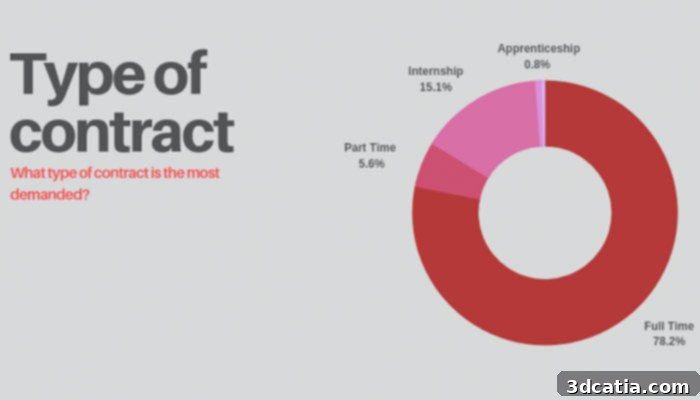
A significant revelation from the analysis of job offers published on 3Dnatives’ Job Board in 2018 highlighted a strong preference for long-term engagements. A substantial 78.2% of all advertised positions were full-time contracts, signaling a mature and stable demand for expertise in additive manufacturing. Internships, though vital for nurturing new talent, constituted a smaller portion at 15.1%. These figures are highly indicative of the industry’s progression; additive manufacturing is no longer a nascent technology confined to experimental phases. Its widespread adoption into mainstream production workflows necessitates professionals capable of sustaining and advancing long-term developments. Companies are not merely experimenting with 3D printing; they are integrating it deeply into their operations, requiring permanent, dedicated staff to manage complex projects, drive innovation, and oversee ongoing operations.
Furthermore, the increasing number of companies successfully leveraging 3D printing for growth and competitive advantage fuels this need for sustained talent acquisition. As these businesses scale their additive manufacturing capabilities, the demand for candidates who can commit to longer assignments, often in strategic leadership or highly technical roles, naturally increases. There is a palpable shift in confidence surrounding this technology; businesses now perceive additive manufacturing as a mature, reliable, and strategically important tool. This confidence translates directly into greater resource allocation towards development, implementation, and expansion, driving the recruitment of seasoned managers and executives. As Audrey Chikhaoui aptly noted, “The 2018 trend also shows that recruiting companies are ready to invest in more structuring and dimensioning positions, investing more easily in the recruitment of managers and executives.” This signifies a broader organizational commitment to embedding additive manufacturing expertise at all levels, from technical execution to strategic oversight.
Who’s Hiring and What Skills are in Demand?
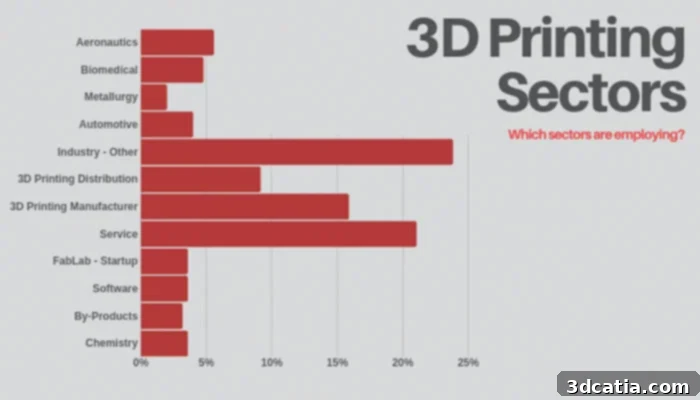
Additive manufacturing’s transformative potential has been recognized and utilized for many years in established sectors such as aeronautics, medical, and automotive industries. These historical adopters were quick to identify the immense benefits of such a flexible and innovative production method for prototyping, tooling, and even end-use parts. However, our study reveals an interesting dynamic: these pioneering sectors, while still significant users, were not necessarily the top recruiters in 2018. They published 5.6%, 4.8%, and 4% of the analyzed job offers respectively. This could be attributed to their earlier adoption, potentially having already built substantial in-house teams or relying on established external service providers. The actual leading recruiter in 2018 was the manufacturing industry in a broader sense, encompassing diverse sub-sectors like energy, consumer goods, general transport, defense, and industrial equipment, which collectively accounted for a significant 24% of all job offers. This trend underscores the widespread integration of additive manufacturing beyond its initial niche applications, becoming a fundamental component across the entire manufacturing spectrum.
Closely following the broad manufacturing sector were 3D printing services, representing 21% of job offers, and 3D printer manufacturers, contributing 16%. This robust activity in the service and hardware segments is clear evidence of the market’s strengthening ecosystem. Service bureaus, which offer on-demand 3D printing, design optimization, and post-processing, are expanding to meet growing client demand. Meanwhile, printer manufacturers are continuously innovating, requiring talent in research, development, assembly, and sales to bring new generations of machines to market. The year 2018 also marked the emergence of new, specialized sectors, particularly in software dedicated to additive manufacturing. As Audrey Chikhaoui observed, “The year 2018 saw the emergence of new sectors such as the emergence of software dedicated to additive manufacturing. We were already familiar with STL data preparation and editing software designed for additive manufacturing and known in the market to convert files to STL format, correct defects, modify the design and prepare the construction platform, but we are seeing more and more software solutions for security and data protection coming onto the market.” This indicates a growing need for software engineers and developers specializing in everything from design optimization and simulation to build process management, quality control, and, notably, cybersecurity for digital manufacturing workflows.
The Rise of Multidisciplinary Technical Talent
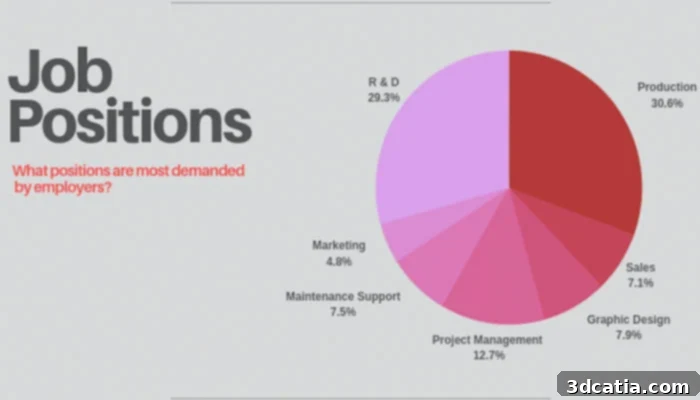
From the candidate perspective, the profiles most sought after are predominantly engineers and technicians, reflecting the highly technical nature of additive manufacturing. Roles such as machine operators, process engineers, and R&D specialists require a strong technical background. Our study showed that positions in research and development (R&D) combined with other highly specialized technical roles accounted for 19.8% + 9.5% of demand, while pure production roles made up an impressive 30.6%. These statistics are hardly surprising given that additive manufacturing necessitates a profound understanding of diverse disciplines, including mechanical engineering, materials science, software development, and digital design. The successful operation and innovation in this field rely on individuals who can bridge these traditional boundaries and apply integrated knowledge to complex challenges.
Beyond core technical roles, there is also significant demand for professionals in project management and 3D design functions. While one might intuitively expect a higher emphasis on 3D modeling, given its foundational role in the printing process, the data suggests a balanced need across the entire value chain. Project managers are crucial for overseeing the intricate stages of additive manufacturing projects, from concept to delivery, ensuring efficiency and adherence to timelines. Moreover, the importance of support, maintenance, and after-sales service (SAV) roles cannot be overstated. As industrial 3D printing systems become more sophisticated and widely deployed, the need for expert technical support to ensure continuous operation, troubleshoot issues, and provide timely maintenance is becoming increasingly critical for companies to maximize their investment and maintain production uptime.
An encouraging development observed in the additive manufacturing job market is the increasing feminization of recruited profiles. The AM sector has, perhaps more rapidly than the broader industrial landscape, begun to integrate women into its workforce at an early stage. Historically, women in industrial roles were often concentrated in support functions like Human Resources or marketing and communications. However, this trend is shifting significantly within additive manufacturing. Women are increasingly taking on responsibilities in more operational and technical professions, including production management, research and development, sales engineering, and other core technical roles. This diversification of talent not only enriches the workforce but also contributes to a broader range of perspectives and innovative solutions within a rapidly evolving field.
The Employers: Startups Paving the Way, Giants Adopting
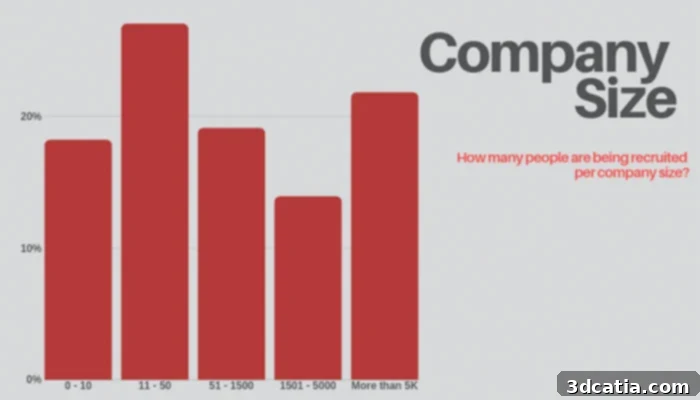
An in-depth analysis of the job offers published on 3Dnatives revealed an intriguing pattern regarding the types of companies that were most actively recruiting in 2018. The highest volume of recruitment came from companies with 11 to 50 employees, indicating a robust startup and SME ecosystem driving innovation and expansion in the 3D printing space. This segment was closely followed by large enterprises, defined as those with more than 5,000 employees. This apparent contrast, while initially surprising, paints a clear picture of two distinct yet complementary realities shaping the additive manufacturing industry.
Firstly, the proliferation of numerous startups specialized in 3D technologies has significantly contributed to the demand for talent. These agile companies are often at the forefront of developing niche applications, pioneering new materials, or creating specialized software and hardware solutions. As they grow and scale their innovative offerings, their recruitment needs naturally expand. These startups embody the entrepreneurial spirit of the additive manufacturing sector, constantly pushing boundaries and creating new market segments. Secondly, the active recruitment by major groups underscores their strategic interest and deep commitment to integrating additive manufacturing into their daily operations and long-term business strategies. Global conglomerates across various sectors, such as industrial giant Bosch, beauty powerhouse L’Oréal, and automotive leaders BMW and Volkswagen, are not merely dabbling in 3D printing. They are making substantial investments to leverage AM for prototyping, custom tooling, spare parts, and even direct digital manufacturing of end-use components, recognizing its potential for supply chain resilience, product customization, and accelerated innovation. This dual-pronged recruitment approach by both nimble startups and established titans signifies a healthy and expanding market for AM professionals.
The Future Landscape of the 3D Printing Labor Market
Considering the steady and robust growth that the additive manufacturing market has demonstrated over the past decade, it is logical to expect that recruitment trends will continue to mirror and amplify this expansion. As 3D printing technologies become more sophisticated, accessible, and integrated into global supply chains, an increasing number of companies will seek out highly qualified candidates to support this burgeoning growth. The pervasive nature of 3D printing, affecting a multitude of sectors from aerospace to consumer goods, suggests a continued diversification of roles within the job market. This dynamic environment is not just expanding existing job categories but is also serving as a fertile ground for the emergence of entirely new professional profiles, much like the advent of the internet created unprecedented demand for web integrators, graphic designers, webmasters, and a host of digital specialists.
The future of the additive manufacturing job market will likely see an increased need for professionals adept in interdisciplinary fields. We can anticipate the rise of roles such as AM Process Engineers, Digital Manufacturing Specialists, Material Scientists focused specifically on AM feedstock, and experts in ethical AI applications for additive manufacturing. Professionals skilled in sustainable AM practices will also be in high demand as industries increasingly prioritize environmentally conscious production methods. However, this growth trajectory is not without its challenges. As Audrey Chikhaoui highlighted, “In terms of recruitment, the Additive Manufacturing sector, like the industry, faces difficulties in finding the skills to meet the ever-increasing demand of their customers. Much more than profiles in mechanics, it has become very complicated to find system engineers, software engineers or electronics engineers. In addition, the time required to identify competent candidates is getting longer, recruiting processes are very time-consuming, ranging from six months to a year, which can be problematic for the clients’ business.“
This scarcity of specialized talent, particularly in advanced engineering disciplines like system, software, and electronics engineering, creates significant hurdles. The gap between traditional academic curricula and the specific, evolving demands of additive manufacturing means that upskilling and reskilling initiatives will become even more crucial. Furthermore, the protracted recruitment processes, sometimes extending from six months to a year, underscore the highly specialized nature of these roles and the intense competition for top talent. This extended hiring timeline can significantly impact project timelines and business growth, emphasizing the urgent need for more streamlined and effective talent acquisition strategies. Ultimately, the 3D printing job market is a vibrant, evolving ecosystem that demands adaptability, continuous learning, and a proactive approach from both employers seeking talent and individuals aspiring to build careers within this transformative industry.
Find our full 3D Printing Job Market, 2019 Infographic HERE
We invite you to share your thoughts on this study and the future of the additive manufacturing job market in a comment below or connect with us on our Facebook and Twitter pages! Don’t forget to sign up for our free weekly Newsletter, with all the latest news in 3D printing delivered straight to your inbox, ensuring you stay ahead in this rapidly evolving field!