

Mini Strip: Pioneering Sustainable and Minimalist Automotive Design with 3D Printing Innovation
In an era where environmental consciousness is paramount, the automotive industry faces increasing pressure to innovate towards more sustainable practices. British car manufacturer MINI, renowned for its iconic design and agile performance, has been at the forefront of this shift, actively striving to embed eco-responsibility into its core philosophy. This commitment culminated in a groundbreaking collaboration with the esteemed British fashion designer Paul Smith, giving birth to a truly visionary concept car: the Mini Strip. This project is not merely an exercise in design; it’s a bold statement, meticulously crafted to embody the powerful principles of “Simplicity, Transparency, Sustainability.”
The Mini Strip project began with a clear objective: to distill the essence of a modern vehicle down to its most fundamental components, thereby challenging conventional automotive design and manufacturing. Drawing its foundation from the Mini Cooper SE, an electric vehicle already aligned with a future of reduced emissions, the Strip takes minimalism to an unprecedented level. Every element of the vehicle has been re-evaluated, with only the absolutely necessary components retained or re-imagined. This radical approach not only reduces material consumption but also encourages a deeper appreciation for the vehicle’s functionality and form, setting a new benchmark for sustainable automotive design.
A Bold Partnership for a Greener Future
The collaboration between MINI and Paul Smith is a testament to the idea that innovation often springs from diverse perspectives. Paul Smith, celebrated for his distinctive blend of tradition and modernity, coupled with a playful use of color and texture, brought a fresh, non-automotive viewpoint to the design table. This unique partnership allowed for a critical re-examination of what a car truly needs to be, free from the constraints of established automotive conventions. Smith’s influence is profoundly evident in the Strip’s thoughtful deconstruction of traditional car design, focusing instead on honest materials and essential functionality. This alliance underscores MINI’s dedication to exploring unconventional paths to achieve its sustainability goals, moving beyond incremental improvements to envision a truly revolutionary product that redefines the future of mobility.
The choice of the all-electric Mini Cooper SE as the base vehicle was a deliberate step in reinforcing the project’s green credentials. By starting with an emission-free powertrain, the designers could focus their innovative efforts on the car’s physical structure, materials, and manufacturing processes. This holistic approach to sustainability considers the entire lifecycle of the vehicle, from its production and active use to its eventual end-of-life recycling. The Mini Strip thus becomes a powerful symbol of a potential future for the automotive industry – one where sustainability is not an afterthought but an intrinsic part of the design and engineering process from the very beginning, ensuring environmental responsibility at every stage.
Redefining Materials: Recycled and Reimagined
One of the most striking aspects of the Mini Strip is its pervasive use of recycled and sustainable materials. This isn’t merely a token gesture; it’s a fundamental design principle that permeates every part of the car, challenging the status quo of material sourcing in automotive manufacturing. For instance, the floor mats are ingeniously crafted from recycled rubber, a material known for its exceptional durability and resilience, offering a practical yet profoundly environmentally conscious solution. Similarly, the seat coverings have been developed from recycled fabrics, showcasing how what was once considered waste can be transformed into high-quality, aesthetically pleasing, and comfortable components. This comprehensive commitment to repurposing waste highlights a crucial shift towards a circular economy within automotive manufacturing, minimizing reliance on virgin resources and significantly reducing landfill waste.
Beyond the obvious, Paul Smith and MINI pushed the boundaries further, exploring innovative manufacturing techniques. To create durable yet aesthetically unique parts, a significant portion of the Mini Strip’s bespoke components were manufactured using advanced additive manufacturing techniques, specifically 3D printing. These critical parts were created from recycled polymers, demonstrating the incredible potential of combining sustainable materials with cutting-edge production methods. 3D printing offers unparalleled flexibility in design, allowing for the creation of intricate geometries and custom parts without the need for traditional tooling, which often leads to substantial material waste. This not only ensures material efficiency but also opens up possibilities for on-demand production and highly localized manufacturing, further reducing the carbon footprint associated with complex global supply chains and excess inventory. The integration of these materials and methods speaks volumes about the project’s forward-thinking ethos.
The Art of “Perfect Imperfection”
The Mini Strip challenges conventional notions of automotive aesthetics, particularly concerning its exterior finish. Eschewing the typical layers of paint and glossy lacquers found on most vehicles, the bodywork features only a thin, transparent layer of paint. This minimalist coating serves its essential purpose – protecting the metal from corrosion – while deliberately revealing the raw, unpolished texture of the underlying material. This unique aesthetic effect results in a subtly rough appearance, which Paul Smith eloquently dubbed “the perfect imperfection.”
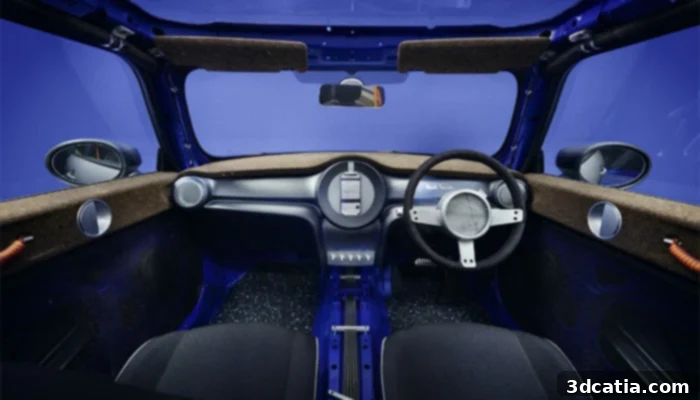
The sleek interior of the MINI Strip, embodying minimalism and sustainability (photo credits: MINI)
This concept of “perfect imperfection” is a profound statement on transparency and authenticity in design. It celebrates the inherent qualities of materials rather than concealing them beneath superficial finishes, promoting an honest and raw aesthetic. In a world often obsessed with flawless, factory-produced uniformity, the Mini Strip embraces character and honesty, inviting observers to appreciate the material’s true form and journey. This design philosophy extends seamlessly into the interior, where the same methodical approach was applied. The cabin is deliberately clean, featuring simplified geometries and an absence of superfluous trim and embellishments. All interior components, from the dashboard to the door panels, are designed with sustainability in mind, crafted from recycled parts and minimal finishing, creating an environment that is both highly functional and profoundly ethical, reflecting a deep respect for resources.
Innovation Through Additive Manufacturing: Beyond Aesthetics
As highlighted earlier, the adoption of 3D printing was a cornerstone in the development of the Mini Strip, allowing designers to create sustainable and highly distinctive components that pushed the boundaries of traditional manufacturing. While maintaining a visual connection to modern Mini designs, certain signature elements were re-envisioned through additive manufacturing processes. For instance, the iconic rocker panels and dynamic wheel arches, critical design features that define the Mini’s unique profile, were carefully re-designed and 3D printed directly from recycled plastic. This innovative application represents a significant leap forward for the British carmaker, showcasing a tangible commitment to integrating more environmentally friendly and technologically advanced manufacturing processes into its production pipeline, setting a precedent for future models.
The benefits of using 3D printing with recycled plastics are profoundly multifaceted. Firstly, it allows for highly optimized part geometries that would be challenging or even impossible to achieve with traditional molding techniques, potentially reducing material usage and vehicle weight, which in turn enhances efficiency. Secondly, it enables on-demand production, minimizing waste associated with mass manufacturing, inventory surplus, and logistical complexities. Thirdly, and perhaps most crucially for the Mini Strip, it provides a viable and scalable pathway for incorporating post-consumer and post-industrial plastic waste into high-value automotive components. This paradigm shift is not just about making parts; it’s about pioneering new ways to build cars, paving the way for a more resource-efficient, less wasteful, and ultimately more sustainable future for the entire automotive industry. MINI’s embrace of these cutting-edge technologies signals a clear intent to produce not just electric cars, but truly environmentally conscious vehicles from concept to curb, impacting every facet of design and production.
Designed for a Circular Economy: End-of-Life Recyclability
The commitment to sustainability in the Mini Strip extends far beyond its initial production and period of use. A core tenet of its design philosophy was ensuring the car could be efficiently recycled at the very end of its operational life, minimizing its environmental footprint over its entire existence. Thanks to the meticulous selection and application of various recycled and mono-material components, the vehicle has been constructed in a manner that facilitates straightforward disassembly and precise material segregation. This intelligent approach is fundamental to enabling a truly circular economy, where valuable materials are kept in use for as long as possible, rather than being discarded as waste after a single lifecycle. By designing for disassembly and recyclability from the ground up, MINI and Paul Smith have created a prototype that comprehensively addresses the entire lifecycle environmental impact of an automobile, setting a challenging yet achievable precedent for future vehicle development and challenging the industry to adopt similar practices.
The collaborative synergy between Paul Smith’s distinctive artistic vision and MINI’s renowned engineering prowess, combined with the seamless integration of cutting-edge technologies like 3D printing, has culminated in a car with a truly remarkable and thought-provoking design. It’s a vehicle that doesn’t just transport; it powerfully communicates a message about responsibility, innovation, and finding profound beauty in simplicity. Oliver Heilmer, Head of Design at MINI, who played a pivotal role in working alongside Paul Smith on the transformative Strip project, perfectly encapsulated the immense value of this unique partnership. He praised Paul Smith’s unique contribution, stating: “Paul asked essential questions right at the start with his non-automotive, and therefore fresh, perspective. The process was an invaluable learning experience. You constantly ask yourself about what is really necessary and what is not, if you think it is – why? With every item, you choose if it stays or if it goes, and it provides you with a fresh new view on a given space.” This insightful quote highlights the transformative power of an outsider’s perspective, forcing an introspection that ultimately leads to more innovative, meaningful, and responsible design solutions that transcend conventional boundaries.
Looking Forward: The Profound Impact of the Mini Strip
The Mini Strip is far more than just a concept car; it’s a profound statement about the future direction of automotive design and manufacturing, challenging established norms and inspiring new possibilities. It serves as a compelling proof-of-concept for how an iconic brand can retain its cherished identity while radically re-thinking its approach to sustainability across all facets of production and design. By powerfully showcasing the viability and aesthetic appeal of recycled materials, the efficiency of advanced manufacturing techniques like 3D printing, and the elegance of a minimalist design philosophy, the Strip offers a tangible blueprint for how the entire industry can move decisively towards a more environmentally responsible and resource-efficient future. It challenges consumers and manufacturers alike to critically consider the true cost and intrinsic value of every component, every material, and every fundamental design choice made in vehicle creation.
This visionary project is not just about reducing carbon footprints or recycling waste; it’s about fostering a new aesthetic paradigm, one that finds genuine beauty in raw materials and profound honesty in design. The “perfect imperfection” ethos championed by the Mini Strip could inspire a broader trend towards products that proudly celebrate their origins and their journey, moving decisively away from hyper-polished, often wasteful, consumerism towards a more conscious and appreciative approach to ownership. The Mini Strip, therefore, stands as a luminous beacon of innovation, powerfully demonstrating that luxury, iconic design, and uncompromising environmental responsibility can not only coexist but can mutually enhance each other in the urgent pursuit of a better, more sustainable world for all.
What are your thoughts on the groundbreaking Mini Strip? Do you believe this minimalist and sustainable approach truly represents the transformative future of automotive design and manufacturing? We invite you to share your valuable insights and comments below or join the engaging conversation on our Facebook and Twitter pages! For those keenly interested in staying abreast of the very latest innovations in 3D printing and sustainable manufacturing, don’t forget to sign up for our free weekly newsletter to receive all the cutting-edge news and developments directly in your inbox!
*Thumbnail Photo Credits: MINI