

Revolutionizing Space Propulsion: NASA and Aerojet Rocketdyne Advance 3D Printed Rocket Engines for Future Missions
In a significant leap forward for space exploration and advanced manufacturing, NASA has announced a strategic partnership between its Robotic Deposition Technology (RDT) team and Aerojet Rocketdyne. Aerojet Rocketdyne, a renowned American leader in rocket and missile propulsion systems, headquartered in Sacramento, is collaborating with NASA to push the boundaries of 3D printing, with a particular focus on metal additive manufacturing. This pivotal collaboration aims not only to refine and expand the capabilities of these cutting-edge fabrication technologies but also to substantially enhance NASA’s prowess in developing liquid rocket engines for a diverse range of applications, including lunar landers, on-orbit stages, and advanced spacecraft. Through this synergistic partnership, NASA’s RDT team and Aerojet Rocketdyne have already achieved remarkable milestones, successfully manufacturing rocket engine hardware that has endured and passed rigorous cold spray and hot fire tests, demonstrating unprecedented levels of performance and reliability under extreme conditions. This advancement signals a new era for space propulsion, promising lighter, more efficient, and more robust systems for humanity’s next ventures beyond Earth.
The innovative work driving these advancements is primarily spearheaded by a dedicated team at NASA’s Marshall Space Flight Center, located in Huntsville, Alabama. This expert group has been meticulously designing and fabricating next-generation propulsion components, including high-performance combustion chambers, intricate nozzles, and precision-engineered injectors. A core focus of their development strategy involves the integration of sophisticated automated robotic deposition 3D printing technologies. These advanced additive manufacturing techniques encompass cold spray deposition, which builds material layers at high velocities without melting; laser wire direct closeout, allowing for precise and robust closures; laser powder bed fusion, creating dense parts layer by layer from metallic powders; and laser powder directed energy deposition, which uses a laser to melt powdered material as it’s deposited. Through the application of these diverse methods, NASA is committed to evolving these manufacturing processes. The ultimate goal is to validate the operability, enhance the performance, and ensure the reusability of these components through extensive hot fire testing, utilizing weight-optimized materials that can withstand the immense stresses of spaceflight. This methodical approach is critical for the development of propulsion systems that are not only powerful but also sustainable for long-duration missions.
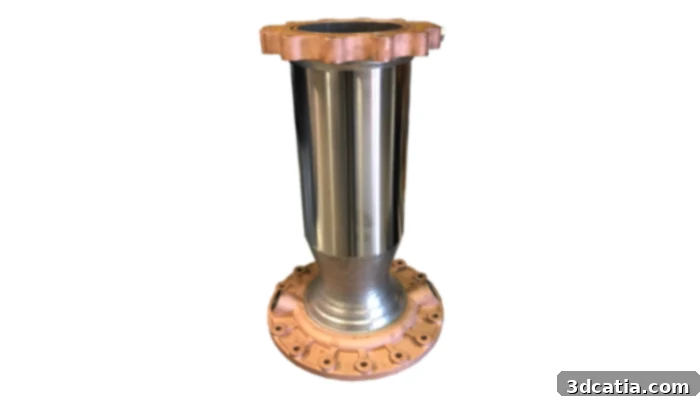
A meticulously 3D-printed bimetallic lightweight thrust chamber assembly, ready for its crucial hot fire testing at NASA’s Marshall Space Flight Center in Huntsville, Alabama. (Photo Credits: NASA)
Building on a foundation of rigorous experimentation, the RDT team has a history of successful hardware development and testing. Last year, under the auspices of the Long Life Additive Manufacturing Assembly, or LLAMA, project, they conducted a series of comprehensive tests on various components, including advanced injectors and robust carbon composite nozzles. A major highlight of the LLAMA project involved the successful hot fire testing of a 3D printed lightweight combustion chamber and nozzle, proving the viability of additive manufacturing for critical engine parts. More recently, in a continuation of their fruitful collaboration, NASA and Aerojet Rocketdyne have successfully concluded an even more advanced phase of hardware testing under a new, lamoid-named initiative: the Advanced Lander Propulsion Additive Cold-spray Assembly, or ALPACA, project. This project marks another significant milestone, with its components designed to meet the demanding requirements of future lunar and planetary landers. Thomas W. Teasley, a distinguished engineer at the Marshall Space Flight Center, expressed immense satisfaction with the results, stating, “Testing of the RDT Advanced Lander Propulsion Additive Cold-spray Assembly (ALPACA) chamber went very well and demonstrated a new technology capability for NASA and industry partners.” This sentiment underscores the profound impact of this partnership on advancing critical propulsion technologies for both governmental and commercial space endeavors. The success of ALPACA not only validates the innovative approaches used in additive manufacturing but also paves the way for integrating these technologies into operational space missions.
The comprehensive testing protocols for the ALPACA project demonstrated the exceptional resilience and performance of the 3D-printed hardware. During these rigorous trials, the engine hardware accumulated an impressive record of eight separate starts, totaling an extensive 365.4 seconds of hot fire duration. This sustained operation under extreme conditions is a crucial indicator of reliability for long-duration space missions. NASA further detailed the harsh environment the combustion chamber endured, reporting that it experienced internal pressures soaring up to 750 pound-force per square inch (psi) across all conducted tests. Concurrently, calculated hot gas temperatures within the chamber approached a blistering 6,200 degrees Fahrenheit, mimicking the intense heat generated during actual rocket firings. Beyond the primary combustion chamber, an additional three different carbon composite nozzles, each engineered to produce 7,000 pounds of thrust, were also subjected to these challenging tests. These nozzles spectacularly demonstrated their capacity to withstand extreme environmental conditions, with measured nozzle temperatures exceeding 4,000 degrees Fahrenheit during testing. In essence, the entire hardware assembly successfully navigated and endured an onslaught of extreme pressures, incredibly high temperatures, and other punishing conditions—all factors that rocket engine components must flawlessly withstand to ensure proper functionality and mission success in the unforgiving vacuum of space. These results are not just data points; they represent a fundamental validation of additive manufacturing’s potential to revolutionize space propulsion.
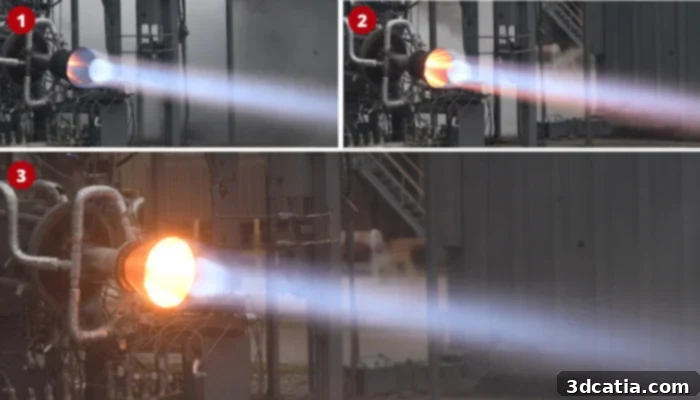
The dedicated Robotic Deposition Technology team successfully completed the initial phase of testing a sophisticated 3D-printed metal thrust chamber assembly at NASA’s Marshall Space Flight Center in Huntsville, Alabama, with numbers indicating the sequential order of testing occurrences. (Photo Credits: NASA)
Bryan Webb, a Senior Engineer at Aerojet Rocketdyne, highlighted the strategic importance of this collaboration, stating, “The RDT ALPACA effort between NASA and Aerojet Rocketdyne is another exemplary instance of our collaboration and partnership in advancing additive manufacturing technologies.” This ongoing synergy between a leading government space agency and a private propulsion giant is instrumental in accelerating the pace of innovation. The profound advancements achieved in additive manufacturing technologies are transformative because they enable the production of liquid rocket engine parts that are significantly more lightweight and remarkably cost-efficient compared to traditional, often heavy and complex hardware. This paradigm shift in manufacturing offers a multitude of benefits that extend far beyond simple material and cost savings. Lighter engine components translate directly into increased payload capacity for launch vehicles, enabling missions to carry more scientific instruments, crew supplies, or even larger habitats, thereby maximizing the scientific return and operational capabilities of each launch. Furthermore, the inherent flexibility of 3D printing allows for intricate, optimized designs that are impossible to achieve with conventional manufacturing methods, leading to improved engine performance and efficiency. This, in turn, functions to profoundly benefit both NASA’s ambitious future space endeavors, such as the Artemis program aiming for a sustained human presence on the Moon and eventual missions to Mars, and a burgeoning commercial space industry that increasingly relies on cost-effective and reliable propulsion solutions. The ability to rapidly prototype, test, and iterate designs also significantly shortens development cycles, pushing humanity closer to its extraterrestrial ambitions at an accelerated pace.
The success of projects like ALPACA demonstrates a clear trajectory towards a future where additive manufacturing is not just a complementary technology but a cornerstone of space propulsion development. The inherent advantages of 3D printing—such as the ability to consolidate multiple parts into a single, complex component, reduce waste, and manufacture on demand—are perfectly suited for the demanding environment of space engineering. As NASA continues to push the boundaries of exploration, from probing the mysteries of the Moon’s south pole to establishing a foothold on Mars, these advanced manufacturing techniques will be crucial in supplying the next generation of spacecraft with robust, reliable, and reusable propulsion systems. This collaboration between NASA and Aerojet Rocketdyne is not just about building better rocket engines; it’s about engineering the future of space travel, making it more accessible, sustainable, and ambitious than ever before. The continued investment in and refinement of these additive manufacturing processes promise to unlock unparalleled opportunities for scientific discovery, technological innovation, and the expansion of human presence across the solar system.
For those eager to delve deeper into the specifics of these groundbreaking tests and the overarching vision, the full press release from NASA provides extensive details. You can find more information and read the complete announcement HERE. We are keen to hear your thoughts and insights on NASA’s revolutionary ALPACA project and the broader implications of 3D printing for space exploration. Feel free to share your perspective in a comment below or engage with us on our social media platforms: find us on Facebook, Twitter, and LinkedIn pages! To stay continually updated with the very latest news, innovations, and developments in the rapidly evolving world of 3D printing, remember to sign up for our free weekly Newsletter here, delivering cutting-edge insights directly to your inbox.