
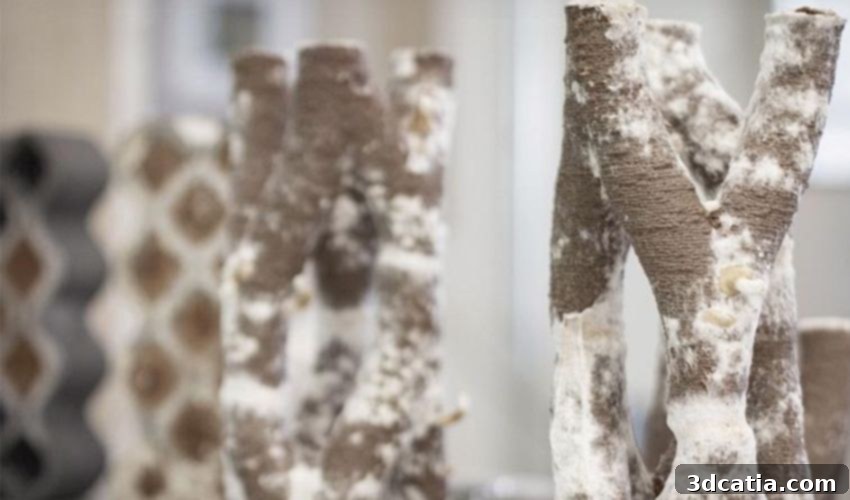
The Fungal Future: How Mycelium and 3D Printing Are Revolutionizing Sustainable Materials
In a world grappling with environmental challenges, the pervasive impact of conventional materials like plastic is undeniable. However, the narrative often overlooks other significant contributors to our planet’s carbon footprint. The cement industry, for instance, ranks as the third-largest industrial source of CO2 emissions globally, according to the UN Environment Program 2020. A quick glance around our urban landscapes reveals the omnipresence of cement and concrete, underscoring the urgent need for sustainable alternatives in construction and manufacturing. Fortunately, dedicated research is paving the way for innovative materials that promise a greener future. Among these pioneering solutions is mycelium, the intricate root structure of fungi. When combined with the design flexibility of 3D printing, this bio-based material demonstrates immense potential to transform various industries, offering an eco-friendly path forward.
For many years, mushroom mycelium has captivated scientists and researchers as a compelling building material. More precisely, it’s not the fruiting body of the mushroom itself that serves as the raw material, but its complex subterranean network – the mycelial root system. This system is composed of delicate, thread-like structures known as hyphae. These hyphae grow outwards, branching and fusing together to form a dense, interconnected web that is the mycelium. This organic network possesses a remarkable ability to colonize and penetrate other materials, such as wood or straw, absorbing nutrients essential for its growth. With a consistent supply of water, the fungus thrives, expanding its reach. This naturally occurring process, often described as a symbiotic or parasitic existence depending on the specific interaction, is actively harnessed to create advanced bio-composites. By introducing nutrient-rich substrates, the mycelium acts as a powerful natural adhesive, binding these materials together into a solid, moldable, and ultimately, printable matrix.
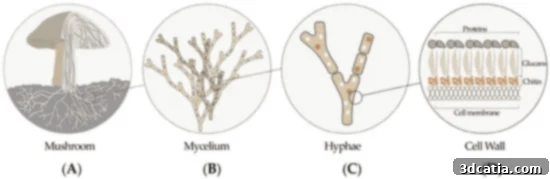
Schematic of the root system (photo credits: Biomimicry)
Beyond their structural capabilities, fungi are renowned for their exceptional carbon sequestration abilities. This means they can actively absorb and store atmospheric carbon dioxide, playing a crucial role in mitigating climate change. Furthermore, many fungal species are incredibly versatile in their nutrient requirements, readily utilizing organic waste and residual materials as “feed” for their growth. This inherent ability to transform waste into valuable resources makes mycelium-based materials perfectly aligned with the principles of a circular economy, minimizing waste and maximizing resource efficiency. In this innovative context, mycelium can be actively cultivated and engineered to produce a diverse range of sustainable materials, moving beyond mere academic curiosity to practical, scalable solutions.
Unveiling the Unique Properties of Mycelium Materials
Mycelium stands out as an exceptionally promising sustainable material due to its abundance in nature and its complete renewability. The process of culturing and preparing mycelium-based composites is remarkably cost-effective and demands significantly less energy compared to the production of traditional building materials. At the end of their lifecycle, these materials are also inherently easy to dispose of, as they are naturally biodegradable and recyclable, completing a truly circular material flow. These attributes collectively position mycelium as an incredibly attractive and genuinely sustainable option for various applications, especially in the construction sector.
One of mycelium’s most fascinating characteristics stems from its organic origin; it readily adapts to its environment, much like other biological structures such as animal bones or plant tissues. This inherent biological intelligence grants mycelium the remarkable ability to regenerate and even self-heal, a trait virtually unheard of in conventional synthetic materials. Furthermore, from a human health perspective, mycelium-based substances are entirely harmless, non-allergenic, and non-toxic. In fact, if derived from edible mushroom species, the mycelium itself can even be consumed, highlighting its purity and safety. This makes it an ideal choice for interior applications where occupant health is paramount.
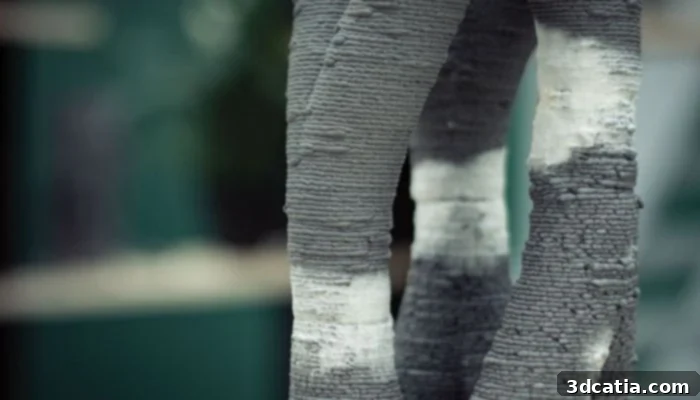
Mycelium is considered a sustainable material for various applications (photo credits: Shape Lab – Institute of Architecture and Media, TU Graz)
The physical properties of mycelium are equally impressive and diverse, enabling a wide array of functional uses. It exhibits excellent heat-insulating capabilities, contributing to energy efficiency in buildings. Moreover, it is inherently flame-resistant, offering a significant safety advantage over many flammable conventional materials. While often perceived as fragile, dried mycelium composites can be surprisingly strong and stable, capable of bearing substantial loads. Some formulations can even be made hydrophobic, resisting water absorption. These combined properties make it an outstanding candidate for insulation, acoustic panels, and even durable furniture. Indeed, mushroom mycelium possesses the versatility to replace a vast range of traditional materials, including leather, wood, cardboard, polystyrene foam, and insulating wool, thereby opening up diverse application avenues across multiple industries.
Mycelium is already making significant inroads as a sustainable building material in various architectural and construction projects, particularly for its self-growing properties, inherent flame resistance, and superior insulation. Its ability to withstand heavy loads also makes it suitable for interior design elements and furniture production. Beyond construction, mycelium is increasingly adopted in the design, fashion, art, and consumer goods sectors as a truly alternative and sustainable material. Its remarkable regenerative capabilities even hint at future applications in the demanding field of medicine. The realization of these diverse applications is a testament to the targeted cultivation techniques and sophisticated processing methods developed for mushroom mycelium, unlocking its full potential as a material of the future.
Innovating with Mycelium: The Power of 3D Printing
The marriage of mycelium with 3D printing, also known as additive manufacturing, represents a paradigm shift in sustainable production. 3D printing is celebrated for its unparalleled design freedom, enabling the creation of geometrically complex structures that would be impossible or prohibitively expensive to produce with traditional methods. As an additive process, it inherently minimizes material waste—sometimes almost eliminating it entirely, depending on the specific technique—thereby making it an exceptionally sustainable manufacturing method. When combined with naturally occurring, biological materials like mycelium, additive manufacturing transcends its existing green credentials, offering an unprecedented opportunity for truly ecological and environmentally responsible production.
In the realm of mycelium 3D printing, extrusion-based processes are the most commonly employed. These methods involve extruding a specially formulated mycelium composite, typically in a paste-like consistency, layer by layer to build a desired shape. The beauty of this approach lies in its adaptability: by varying the composition of the mycocomposite — the blend of mycelium and its substrate — designers and engineers can fine-tune the resulting material’s properties to achieve specific performance characteristics. This innovative fungal material also grants immense creative freedom, allowing for diverse aesthetic outcomes in terms of colors, textures, and patterns. However, successful 3D printing with living mycelium requires meticulous attention to several crucial processing steps.
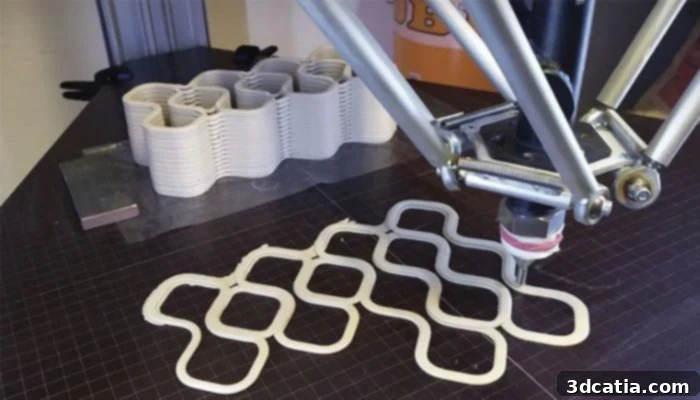
3D printing with mycelium (photo credits: Shape Lab – Institute of Architecture and Media, TU Graz)
The entire 3D printing process with mycelium is inherently complex, demanding precise control over numerous parameters. It commences with the initial “feeding” of the mycelium culture with additional raw materials, carefully selected to facilitate robust growth. These substrates can range from readily available organic waste materials such as wood chips, sawdust, paper, and cardboard, to even materials traditionally considered non-recyclable or unusable. This deliberate blending creates a novel substrate, often referred to as a mycocomposite, myco-material, or fungus-based material. Following this, the growth of the fungal network must be meticulously controlled and the material cultivated to achieve the specific rheological properties necessary for successful printing – primarily, it must be flowable, elastic, and malleable. Only once these precise material characteristics are attained can the actual 3D printing process commence.
During the printing phase, maintaining an absolutely sterile environment is paramount. Mycelium is a living organism and, as such, is highly susceptible to bacterial infestation and other forms of contamination. As the material interacts with various components within the 3D printer and is exposed to the ambient environment, the risk of unwanted microbial growth significantly increases. After the initial printing of the desired structure, a crucial second colonization phase takes place. In this stage, the living mycelium embedded within the printed form actively continues its growth, expanding its network and solidifying the composite material, enhancing its structural integrity and mechanical properties.
Once the printed object reaches its desired size, shape, and density, the final and critical step of drying begins. Heating the material carefully stops the active growth process of the living mycelium within the mushroom-based composite. This cessation of growth is absolutely essential for two primary reasons: first, it prevents the fungus from altering the material properties of the composite during its subsequent application and use, ensuring stability. Second, it prevents the mycelium from potentially spreading to other materials in its final environment, maintaining the integrity and intended function of the product. This controlled drying process transforms the living, growing material into a stable, durable, and functional bio-composite.
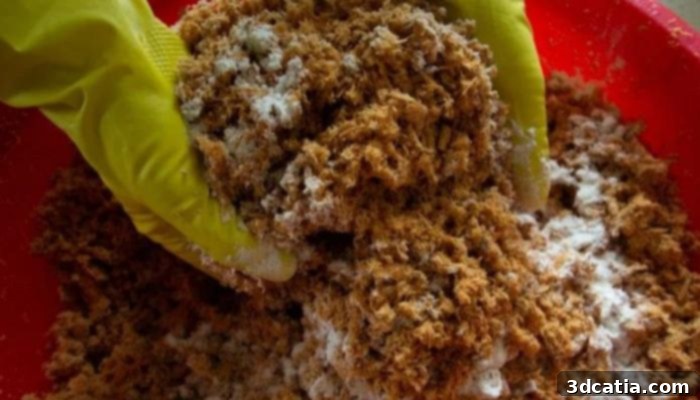
Preparation of the mycelium substrate (photo credits: Stavebni sporitelna Ceske sporitelny)
Transformative Applications of Mycelium in the Modern World
To truly grasp the profound potential of mycelium as an environmentally conscious material for the future, it is invaluable to delve into specific groundbreaking projects across various fields of application. These examples illustrate how this bio-innovative material is moving from laboratory research to real-world implementation.
Revolutionizing Architecture with Mycelium
A prime example of mycelium’s architectural promise comes from the Shape Lab of the Institute of Architecture and Media at Graz University of Technology. Their extensive research project, conducted from 2020 to 2024, culminated in the development of MyCera, a novel material ingeniously combining clay, sawdust, and mycelium. The project’s overarching goal, as stated in their research paper, was to “find a practicable, long-term solution to the global problem of waste management and CO² emissions, which also affects the construction industry and the disposal of construction waste.” The scientists posited that by intelligently aligning mycelial growth, it could serve as an effective fiber reinforcement for 3D-printed clay structures, enhancing their strength and integrity.
Their approach capitalized on mycelium’s properties as a biological binder. The material was processed using a Delta WASP 40100 Clay printer, a machine frequently chosen for mycelium processing due to its open material system, which allows it to handle material pastes of diverse compositions and viscosities. The MyCera research project achieved remarkable success. While further tests are ongoing regarding the long-term durability of the material, initial findings strongly indicate that MyCera is a highly promising composite, poised to contribute significantly to the sustainable construction of buildings in the future. The paper confidently concludes, “After conducting sufficient research [we can confirm that] the proposed material composition could replace cement-based binders,” signaling a major breakthrough in eco-friendly construction.
Another compelling architectural application is “The Tree Column” by London-based Blast Studio. This unique column structure is not only made from a mycelium composite but also innovatively incorporates urban waste. It consists of used cardboard, specifically discarded coffee cups and pizza boxes collected from the streets of London. These waste materials are shredded, mixed with water, and then blended with mushroom mycelium. A robotic arm precisely prints this paste layer by layer, forming ten modular sections that, when assembled, create an impressive two-meter-high column. What makes this project particularly fascinating is that after printing, the column continued to grow, becoming overgrown with edible mushrooms, before being dried to stabilize it into a load-bearing architectural element.
ETH Zurich also explored the biomimicry inherent in mycelium through a similar tree-inspired project. Collaborating with KIT in Karlsruhe and the ETH Center in Singapore, these institutions developed “MycoTree,” a branched, load-bearing structure made from mycelium and bamboo, fabricated using 3D printing. The primary objective was to demonstrate the immense potential of novel organic resources for the construction industry, particularly when combined with advanced 3D printing and optimized geometric designs to achieve maximum stability and structural efficiency.
The array of projects leveraging mycelium in the construction sector is extensive and diverse. Beyond buildings and walls, this includes innovative structures for underwater applications. Urban Reef, for instance, is a company that utilizes 3D printing to create artificial reefs, employing both traditional ceramics and more unconventional materials like coffee grounds and mycelium, thereby contributing to marine ecosystem restoration.
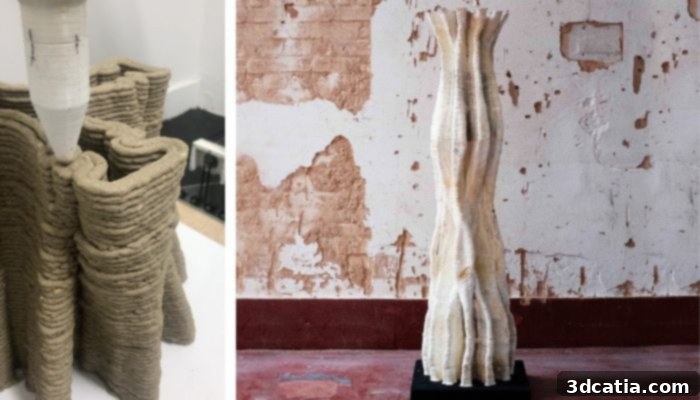
The Tree Column (photo credits: Blast Studio)
Mycelium in Interior Design and Furniture
The preceding architectural examples unequivocally highlight the extensive experimentation with mycelium-based building materials within the vertical construction sector. This innovative trend extends seamlessly into interior architecture and the broader design landscape, where mycelium is being incorporated into numerous furniture projects, redefining aesthetics and sustainability.
The Czech company Buřinka presents a collection of sustainable designer furniture under the name SAMOROST, crafted from a combination of wood and mycelium. The designs deliberately echo the natural origin of their materials, creating pieces that are both functional and visually organic. Dutch artist Eric Klarenbeek’s “Myco Chair” takes this concept further, crafted not from wood, but from mycelium and straw. This ingenious material choice results in remarkably lightweight furniture pieces that challenge traditional notions of material strength and density. A growing number of other artists and designers are similarly exploring mycelium’s potential, playing with its natural forms and textures to create avant-garde and eco-conscious furniture. German-Iranian architect Yasmine Mahmoudieh, for instance, unveiled an entire collection of mycelium furniture at the prestigious Architecture Biennale 2023 in Venice, showcasing the material’s high-design appeal.
However, mycelium’s application in interior design extends beyond furniture. The bioMATTERS design studio has developed “MYCO ALGA,” innovative interior tiles that experimentally combine two distinct biological materials: algae and mushroom mycelium. These sustainable tiles represent a fusion of natural elements, offering a unique aesthetic and environmental profile for interior surfaces, further demonstrating the material’s versatility in creating sustainable living spaces.
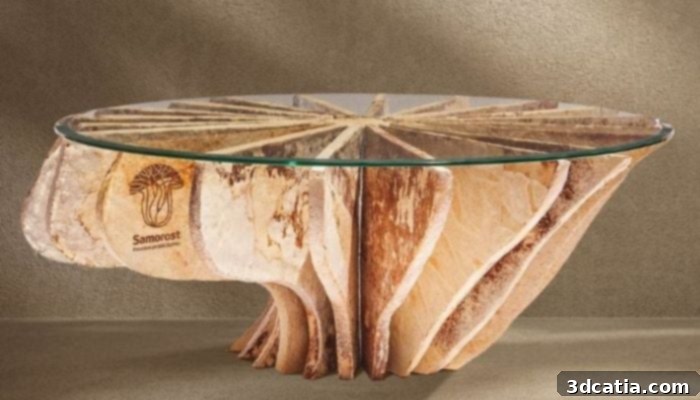
Mycelium-based designer furniture from SAMOROST (photo credits: Stavebni sporitelna Ceske sporitelny)
Mycelium in Consumer Goods and Healthcare Innovation
While aesthetics and design are certainly important, not all mycelium projects are solely focused on visual appeal. The Fraunhofer Institutes UMSICHT and IBP, as part of the “FungiFacturing” project, undertook extensive research into the acoustic properties of mycelium, specifically targeting its potential for sound absorption. Their ambitious goal was to develop high-performance sound absorbers using this innovative material. This pioneering approach was further advanced in a related research project at Fraunhofer IWU, where researchers successfully cultivated mycelium in a highly targeted manner, processed it effectively through 3D printing, and ultimately produced high-performance acoustic loudspeakers, demonstrating its utility in functional consumer goods.
Although the projects spanning design, architecture, and conventional consumer goods showcase remarkable diversity and proven applications, perhaps the most astonishing frontier for mycelium-based materials lies within the field of medicine. This unexpected utility is primarily attributed to the fungal mycelium’s inherent regenerative properties – a characteristic that sets it apart from almost all other synthetic or natural materials.
Leveraging these regenerative capabilities, ETH Zurich and TU Delft collaborated to develop an innovative hydrogel, partially based on the shiny lacquer fungus (Ganoderma lucidum), a local tree fungus known for its medicinal properties. This bio-gel was precisely 3D printed into a grid structure, and remarkably, after approximately 20 days, it formed a robust, self-healing “skin.” This groundbreaking research project yielded fascinating insights for medical technology, offering a glimpse into future applications like advanced wound dressings or even robotic skin. However, to sustain the regenerative capabilities of this “fungal skin,” further research is crucial to identify effective methods for continuously nourishing and maintaining the living fungal component.
Collectively, all these diverse projects are instrumental in advancing the research and practical application of mushroom mycelium. They provide invaluable data and methodologies on how mycelium can be cultivated and processed, particularly through advanced 3D printing techniques, to establish it as a viable and sustainable alternative to numerous established materials and conventional manufacturing processes. The ongoing innovation in this field points towards a future where fungal materials play a central role in building a more sustainable and resilient world.
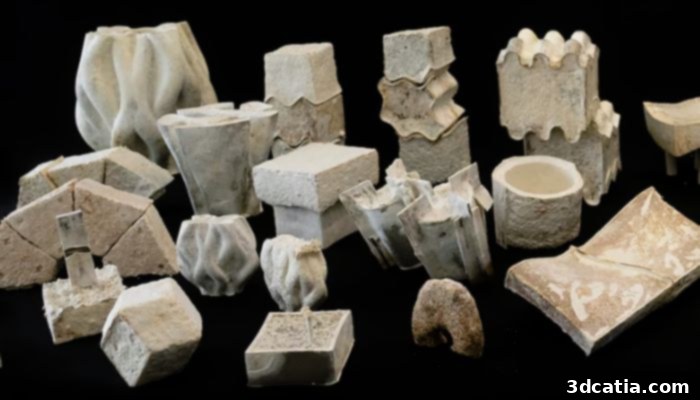
Renewable, biodegradable building blocks made from fungal mycelium (photo credits: PLP Labs)
What are your thoughts on the groundbreaking advancements in 3D printing with mycelium? Let us know your perspective in a comment below or connect with us on our LinkedIn, Facebook, and Twitter pages! Don’t forget to sign up for our free weekly newsletter here for the latest 3D printing news straight to your inbox! You can also find all our videos on our YouTube channel.
*Cover Photo Credits: Shape Lab – Institute of Architecture and Media, TU Graz