
Revolutionizing Hydropower: How Additive Manufacturing is Boosting U.S. Energy Independence with Rapid RUNNERS
Hydropower stands as a cornerstone of the United States’ renewable energy portfolio, reliably accounting for nearly 27% of utility-scale renewable electricity generation, according to the Department of Energy (DOE). At the heart of this crucial technology are turbine runners – intricate, rotating components that efficiently convert the kinetic energy of falling water into clean electricity. These runners are indispensable to the function of hydroelectric dams across the nation, ensuring a stable and sustainable power supply. However, the vast majority of these vital components are currently produced overseas. This reliance on international suppliers creates significant vulnerabilities in the domestic energy supply chain; when a runner fails, the lead time for creating and receiving a replacement can extend to years, leading to costly delays and prolonged periods of lost clean energy generation.
Recognizing this critical strategic gap and the imperative to bolster national energy independence, the DOE took decisive action, allocating a significant $15 million investment to its Oak Ridge National Laboratory (ORNL). This substantial funding was earmarked for an ambitious project aimed at developing a cutting-edge system to domestically produce these essential turbine runners. The resulting initiative, aptly named “Rapid Research on Universal Near Net Shape Fabrication Strategies for Expedited Runner Systems” (Rapid RUNNERS), is poised to revolutionize the manufacturing landscape. This groundbreaking program integrates the transformative capabilities of additive manufacturing, commonly known as 3D printing, with advanced conventional machining tools to establish a robust, efficient, and entirely domestic production pipeline for hydropower runners. This strategic move not only addresses immediate supply chain challenges but also positions the U.S. at the forefront of advanced manufacturing for critical infrastructure components.
The Rapid RUNNERS project at ORNL is a comprehensive three-year endeavor designed to build a complete end-to-end manufacturing ecosystem. During this intensive period, the dedicated Rapid RUNNERS team is tasked with developing the sophisticated software, specialized hardware, advanced robotics, and innovative manufacturing strategies indispensable for fabricating these large-scale, high-performance components. At the core of this ambitious program is an intelligent software platform that orchestrates the simultaneous operation of six or more industrial robots. These highly dexterous robots are programmed to execute a diverse array of manufacturing tasks, including precision wire arc welding for material deposition, meticulous grinding for surface finishing, advanced metrology for accurate quality control, and various other functions that have traditionally required extensive manual labor. This multi-robot, automated approach represents a significant leap in manufacturing efficiency and precision, dramatically accelerating the production process while ensuring unparalleled quality and consistency in the domestically produced turbine runners. By automating these complex steps, Rapid RUNNERS is setting a new standard for advanced manufacturing processes in the energy sector.
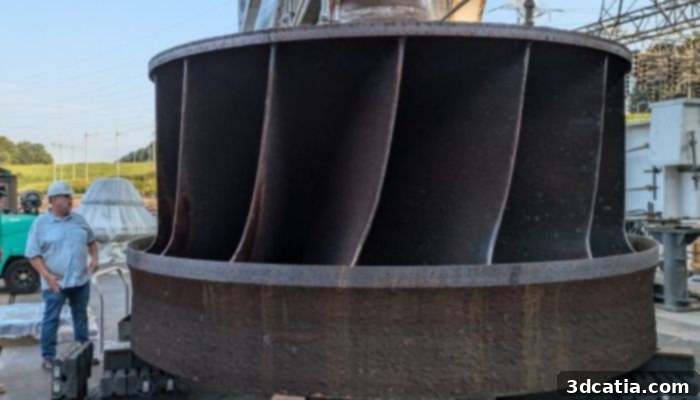
ORNL’s Jay Tiley inspects a hydroelectric runner from TVA’s Cherokee Dam (photo credits: Jim Tobin/ORNL, U.S. Dept. of Energy)
As a crucial demonstration of its system’s impressive capabilities, the Rapid RUNNERS project at ORNL will culminate in the production of three full-scale turbine runners for hydropower dams. The fabrication process leverages an advanced robotic welder that meticulously deposits metal layer by layer, progressively building up the complex geometry of the runner. While the specific material solution employed remains proprietary, the underlying technology clearly falls under the umbrella of Directed Energy Deposition (DED). DED is a powerful additive manufacturing strategy renowned for its ability to rapidly create large-format, high-density metal parts. This method allows for the direct deposition of material, resulting in components that are exceptionally close to their desired final dimensions – a state known as “near-net-shape.”
The significant advantage of producing near-net-shape parts through DED is two-fold: it drastically reduces the amount of raw material waste and substantially minimizes the subsequent machining time required. Following the additive manufacturing phase, traditional precision machining techniques are then employed for post-processing. This hybrid approach ensures that the runners achieve the extremely tight tolerances and high surface finishes required for optimal hydrodynamic performance and longevity, but in a way that is far more time and materially efficient than entirely conventional manufacturing procedures, which often involve extensive material removal from large billets or complex casting processes. This strategic combination of DED and conventional machining epitomizes the innovation driving the Rapid RUNNERS project, offering an optimized pathway for domestic runner production.
The impact of this domestic manufacturing capability on the United States’ energy infrastructure cannot be overstated. Adam Stevens, an R&D staff member at ORNL and the technical lead for the Rapid RUNNERS project, highlighted the profound benefits, stating that “right now, it takes around 18 months to produce one of these. If you can’t operate a hydropower turbine because you’re waiting for a part, that’s 18 months of clean energy you’re not generating. This approach can fill the gap in the domestic industrial base.” This significant reduction in lead time – from a year and a half to a fraction of that – directly translates into consistent clean energy generation, greater grid stability, and substantial economic savings by avoiding prolonged outages. The ability to rapidly produce these critical components domestically enhances energy security, fosters a more resilient supply chain, and significantly mitigates the economic and environmental costs associated with current foreign reliance. This initiative is a clear demonstration of how advanced manufacturing can directly support the nation’s renewable energy goals and strengthen its industrial foundation.
The three demonstration runners being produced by ORNL are all Francis-style turbines, which are a specific and widely used design of large, robust stainless-steel runners known for their high efficiency in medium-head applications. The first of these will serve as a foundational prototype, allowing the team to refine processes and validate design parameters. The second runner is slated for potential installation in a real-world operating environment: the Tennessee Valley Authority’s (TVA) Ocoee Dam in Parksville, Tennessee. The Ocoee Dam, an integral part of the regional power network, houses five generating units that collectively produce 24 megawatts of electricity. The runner destined for this dam will be a substantial five feet in diameter, showcasing the project’s capability to produce components for existing, operational infrastructure. This installation will provide invaluable data on the performance and durability of an additively manufactured runner under actual service conditions, further validating the Rapid RUNNERS technology.
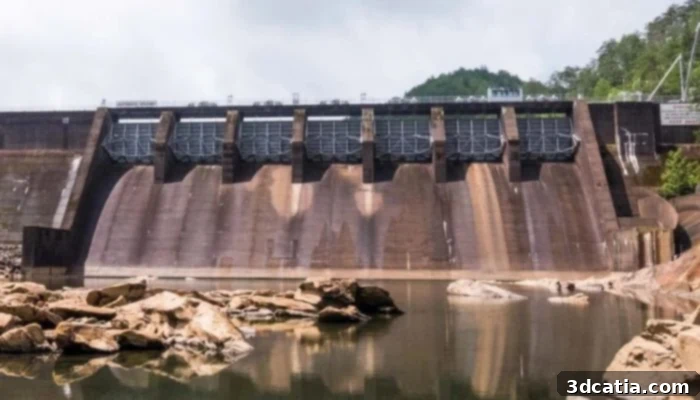
The Rapid RUNNERS team is manufacturing a runner for the Ocoee Dam in Tennessee, pictured here (photo credits: Ocoee Adventure Center)
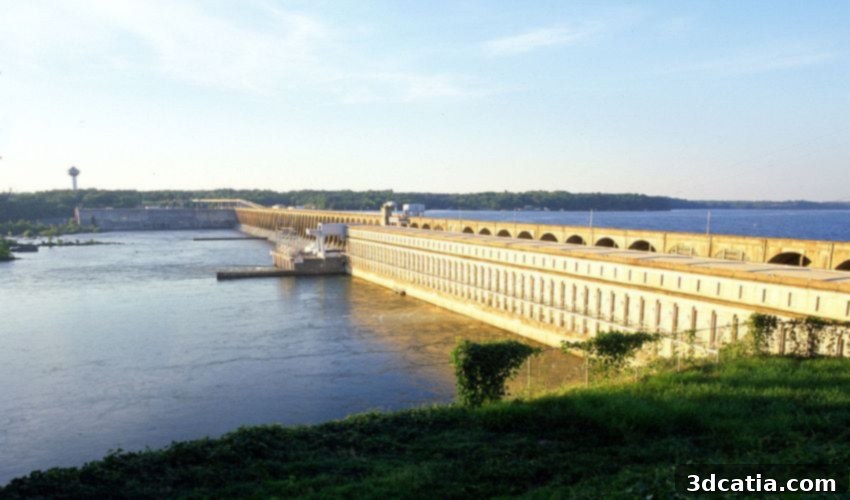
The third and arguably most ambitious runner produced by ORNL under this project will be for the TVA’s historic Wilson Dam. This colossal dam is home to 21 generating units, capable of producing an impressive 653 megawatts of electricity, making it one of the largest hydroelectric facilities in the United States. The runner designed for the Wilson Dam is proportionally massive, measuring an astonishing 15 feet in diameter, standing 8 feet high, and weighing more than 46 tons. Manufacturing a component of this immense scale with traditional methods would typically involve complex casting or forging operations, leading to extremely long lead times, significant material waste, and intricate logistics. This is precisely where additive manufacturing demonstrates its unparalleled advantage: it is ideally suited for creating such large-scale pieces because it can build intricate geometries and large volumes of metal much faster and more efficiently than any individual conventional system. The DED process, with its ability to deposit material precisely where needed, minimizes waste and streamlines production. According to scientists at ORNL, this revolutionary approach is expected to greatly reduce the agonizing waiting times for these critical, large-scale components and, in doing so, foster significant economic growth within the advanced manufacturing sector for energy infrastructure across the nation.
While additive manufacturing has seen prior applications in hydropower projects, the Rapid RUNNERS program is set to be a truly transformative force, poised to revolutionize the entire industry in the United States. Adam Stevens of ORNL succinctly captured this potential, stating that “this has the potential to transform forging and casting of large-scale metal components.” This bold claim underscores the far-reaching implications of the technology developed through Rapid RUNNERS. Stevens further elaborated that the innovative manufacturing platform developed by the project “will allow for domestic production of infrastructure-scale net-shape components for energy, defense, shipbuilding, hydropower, and municipal water supply – any industry that requires a large piece of metal could benefit from this.” This vision extends far beyond hydroelectric dams, offering a future where critical heavy components for various strategic sectors can be manufactured quickly, efficiently, and domestically, strengthening national security, boosting economic resilience, and driving innovation across the industrial landscape. To delve deeper into the groundbreaking work of Rapid RUNNERS and its future implications, click here.
The integration of additive manufacturing into hydropower projects represents a pivotal step towards enhancing efficiency, bolstering domestic supply chains, and securing the future of renewable energy. This innovative approach by ORNL’s Rapid RUNNERS project is not just about making parts; it’s about building a more resilient, sustainable, and economically vibrant industrial future for the United States. We invite your thoughts: What do you think about incorporating additive manufacturing into hydropower and other heavy industries? Let us know in a comment below or join the conversation on our LinkedIn, Facebook, and Twitter pages! Don’t forget to sign up for our free weekly newsletter here for the latest 3D printing news straight to your inbox! You can also find all our compelling videos and interviews on our YouTube channel.