
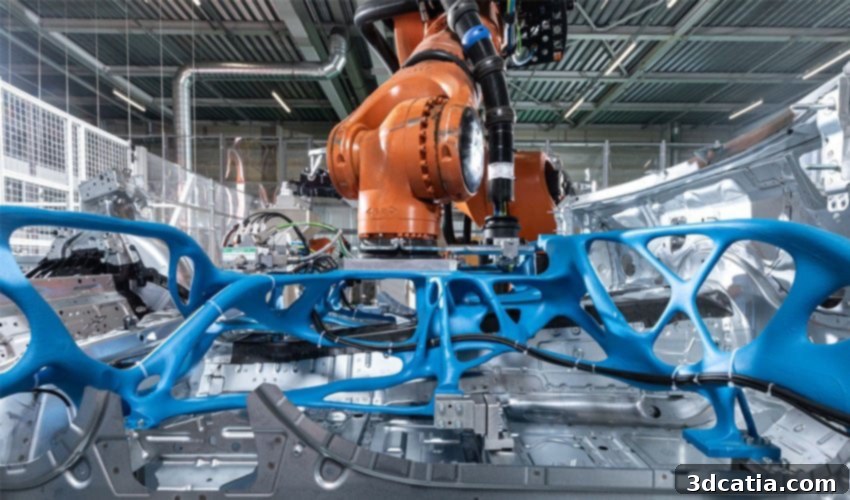
BMW’s Additive Manufacturing Revolution: Pioneering Lightweight Robotic Grippers for Enhanced Production
The BMW Group has firmly established additive manufacturing as a cornerstone of its production processes. With a remarkable legacy spanning over three decades, the esteemed automaker has harnessed the power of 3D printing to create an extensive range of automotive components, specialized tools, crucial work aids, and advanced training materials. Central to this enduring commitment to innovation is the “Additive Manufacturing Campus” located in Oberschleißheim, Germany. This cutting-edge facility serves as the epicenter for BMW’s additive manufacturing advancements, where, just last year, an impressive total of over 300,000 parts were meticulously produced using a diverse array of sophisticated 3D printing technologies. Demonstrating their continuous drive for pioneering solutions, the Campus recently unveiled groundbreaking 3D-printed XXL grippers. These colossal grippers have been seamlessly integrated into a press system dedicated to the production of all carbon-fiber-reinforced polymer (CFRP) roofs for the iconic German brand, marking a significant stride in automotive manufacturing efficiency and design.
These innovative robotic grippers stand as a testament to the transformative potential of additive manufacturing. Each unit, weighing approximately 120 kilograms, required a printing duration of 22 hours, a remarkably efficient timeframe considering their substantial size and complex functionality. By strategically employing additive manufacturing techniques, BMW has achieved a significant 20% reduction in the final product’s weight compared to traditional manufacturing methods. This substantial weight saving is not merely a design triumph; it translates directly into enhanced operational efficiency on the production line, allowing for faster movements, reduced energy consumption, and less wear and tear on the robotic systems. The manufacturing process itself is a sophisticated fusion of two distinct yet complementary 3D printing technologies. Selective Laser Sintering (SLS) is expertly utilized for crafting the intricate vacuum and needle grippers, which are absolutely crucial for the delicate yet firm lifting and manipulation of lightweight CFRP components. Concurrently, Large Scale Printing (LSP) is employed to produce the expansive roof shell and the robust load-bearing structure of the gripper. A notable environmental benefit of the LSP process is its utilization of recycled plastic injection pellets, making it an exceptionally sustainable and economically viable method for manufacturing large-scale components. This eco-conscious approach leads to an impressive 60% decrease in CO2 emissions during the production of these advanced grippers, underscoring BMW’s dedication to both performance and planetary responsibility.
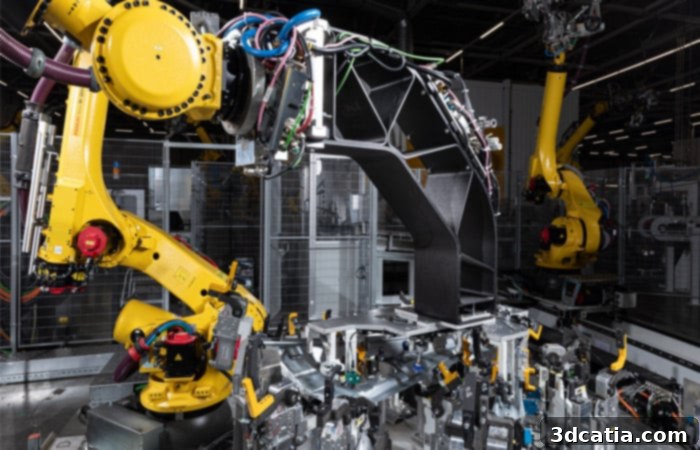
Example of a 3D-printed gripper at the Regensburg plant
Jens Ertel, the Head of BMW Additive Manufacturing, articulated the profound advantages stemming from the increased adoption of additive manufacturing within the BMW Group’s sophisticated production ecosystem. He emphasized, “The increasing use of additive manufacturing in the BMW Group production system has many benefits. For example, we are able to quickly, economically, and flexibly produce our own production aids and handling robots, which we can individually adapt to specific requirements at any time, as well as being able to optimise their weight. Less weight allows higher speeds on the production line, shorter cycle times and reduced costs. Plus, smaller robots can be used in the medium term, which also cuts CO2 emissions and costs.” This statement encapsulates BMW’s strategic vision, highlighting how 3D printing empowers them to rapidly iterate and customize production tools and robots. The ability to fine-tune weight for optimal performance is a critical factor, directly impacting manufacturing efficiency. Lighter grippers mean robots can operate at higher velocities, significantly shortening cycle times and subsequently reducing overall production costs. Furthermore, the reduced weight allows for the deployment of smaller, more energy-efficient robots over time, contributing to substantial reductions in CO2 emissions and operating expenses. This flexibility and cost-effectiveness provide a distinct competitive advantage, enabling BMW to swiftly adapt to evolving production demands and maintain its leadership in automotive innovation.
The German automotive powerhouse consistently pushes the boundaries of innovation, as vividly demonstrated by their latest pioneering development unveiled last summer: a sophisticated bionic robotic gripper engineered for unparalleled efficiency. This advanced gripper boasts a topologically optimized design, a cutting-edge approach that mimics natural structures to achieve maximum strength with minimum material. Its complex structure integrates a roof shell meticulously produced by an LSP printer, precise suction cups manufactured through the SLS process, and a robust load-bearing structure ingeniously optimized using bionic principles. Additive manufacturing plays an absolutely pivotal role in the creation of these components, particularly in producing the intricate sand casting mold. This mold is subsequently filled with liquid aluminum, a process that yields an additional 25% reduction in the gripper’s weight. These exceptionally lightweight and robust grippers are primarily deployed in the manufacturing of CFRP roofs specifically for high-performance BMW M models, where every gram saved contributes to superior vehicle dynamics. The remarkable enhancement in lightweight design has led to a dramatic reduction in the number of robots required for this specific production task, plummeting from three to a single robot, thanks to the gripper’s significantly reduced mass and increased handling capacity. Moreover, the Landshut plant has further optimized its operations by implementing double clamps, each individually manufactured through advanced 3D printing techniques, thereby maximizing efficiency and productivity on the assembly line.
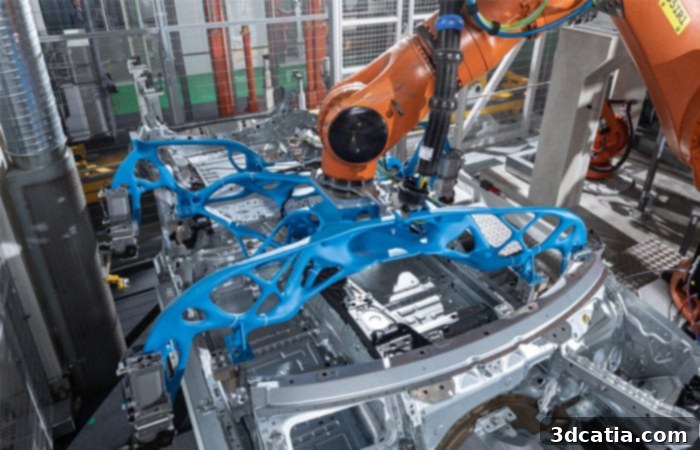
The new generation of bionic grippers, installed in Munich
BMW’s relentless pursuit of innovation has reached new heights, with the Munich plant now successfully deploying an even more advanced iteration of bionic grippers. These state-of-the-art grippers are engineered with the remarkable capability to precisely handle and maneuver the entire floor assembly of a BMW i4, a task demanding immense strength and precision. This revamped gripper model represents a significant leap forward in lightweight design, weighing in at a mere 110 kilograms. This achievement signifies a notable 30% reduction in weight compared to its already optimized predecessor, an astounding feat in engineering. This impressive weight reduction was made possible through the BMW Group’s strategic investment in and extensive utilization of the Synera software tool. Synera is a highly sophisticated and widely adopted platform within BMW, renowned for its unparalleled ability to facilitate rapid and highly efficient component optimization, especially for complex designs intended for additive manufacturing. The integration of such advanced software tools underscores BMW’s holistic approach to leveraging digital innovation alongside physical manufacturing prowess, driving continuous improvement in both design and production capabilities. This synergy between advanced software and additive manufacturing is key to unlocking new levels of performance and efficiency in automotive production.
Markus Lehmann, Head of Plant Engineering and Robotics at the BMW Group’s Munich plant, provided invaluable insights into the ongoing expansion of additive manufacturing applications. He remarked, “At the Munich plant, we are continuously expanding the use of production aids created through additive manufacturing. When it comes to the field of gripper and handling systems, we use 3D printing to equip our established grippers with individual, printed attachments and are already replacing complete gripper systems with highly-integrated and weight-optimised bearing structures. When handling the full BMW i4 floor assembly, this allowed us to reduce the weight of the complete gripper by 30 percent – 50 kg – and thus to extend the service life of our facilities.” Lehmann’s statement highlights a dual strategy: initially enhancing existing grippers with custom 3D-printed attachments, and subsequently transitioning to fully replacing entire gripper systems with advanced, weight-optimized, and highly integrated designs. This progressive adoption demonstrates a clear commitment to integrating additive manufacturing at every level of the production process. The significant weight reduction, specifically the 50 kg saving on the BMW i4 floor assembly gripper, has a profound impact beyond just operational speed. It directly translates into reduced strain and wear on the robotic facilities, thereby extending their operational service life, minimizing maintenance requirements, and ultimately contributing to greater overall cost efficiency and sustainability within the manufacturing plant. This strategic approach ensures that BMW not only innovates in product design but also in the very methods by which those products are brought to life.
BMW Group’s pioneering efforts in additive manufacturing, particularly their relentless innovation in developing highly efficient and lightweight robotic grippers, represent a significant paradigm shift in automotive production. Their commitment to leveraging technologies like SLS and LSP, coupled with smart design principles such as topological optimization and bionics, showcases a forward-thinking approach that prioritizes efficiency, sustainability, and technological leadership. From the large-scale production of essential automotive parts and tools at the Additive Manufacturing Campus to the development of specialized grippers that drastically reduce weight and CO2 emissions, BMW is setting new benchmarks for the industry. The successful integration of these 3D-printed solutions, as evidenced by the XXL grippers for CFRP roofs and the advanced bionic grippers for the BMW i4 floor assembly, demonstrates tangible improvements in manufacturing speed, cost-effectiveness, and environmental impact. The strategic investment in design optimization software like Synera further solidifies BMW’s position at the forefront of industrial additive manufacturing, promising continued advancements in how complex automotive components are designed, produced, and assembled. These innovations not only enhance BMW’s internal operations but also provide a compelling blueprint for how the broader manufacturing sector can embrace 3D printing for a more agile, sustainable, and high-performance future.
What do you think of BMW Group’s impressive use of additive manufacturing and its revolutionary grippers? We invite you to share your thoughts and insights in a comment below or join the conversation on our LinkedIn, Facebook, and Twitter pages! Don’t forget to sign up for our free weekly newsletter here to receive the very latest 3D printing news delivered straight to your inbox! You can also find all our compelling videos and in-depth content on our YouTube channel.
*All Photo Credits: BMW Group