
Mud Frontiers: Emerging Objects Pioneers Sustainable 3D Printed Earthen Architecture for a Greener Future
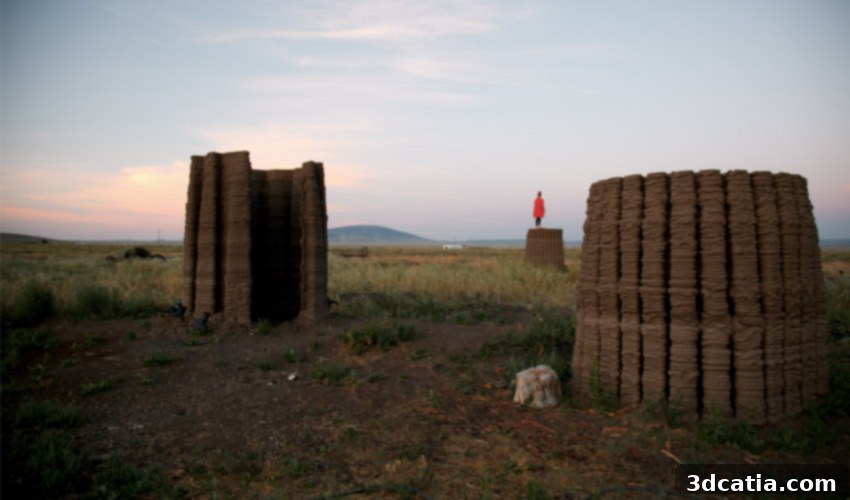
In a groundbreaking endeavor pushing the boundaries of sustainable construction, Emerging Objects has unveiled its latest ambitious undertaking: “Mud Frontiers.” This innovative project is a testament to the potential of additive manufacturing when paired with ancient building wisdom, aiming to champion more sustainable and universally accessible construction methodologies. Spearheaded by the visionary architectural duo, Ronald Rael and Virginia San Fratello, the initiative features a collection of four distinct 3D printed huts. These structures are meticulously crafted from a unique mud-based material, drawing profound inspiration from the historic earthen dwellings that once dotted the banks of the Rio Grande River in Colorado’s San Luis Valley, enduring up until the 19th century.
Named Hearth, Beacon, Lookout, and Kiln, each hut represents a unique exploration of form, function, and material possibility. The creation of these remarkable structures was made possible through a strategic collaboration with 3D Potter, a company renowned for its specialized ceramic 3D printing technology, which played a pivotal role in bringing these earthen visions to life.
Emerging Objects: A Legacy of Sustainable Innovation in Additive Manufacturing
Emerging Objects has firmly established itself as a frontrunner within the additive manufacturing sector, consistently exploring the vast and often untapped possibilities that this technology offers, particularly with an emphasis on environmental stewardship. The company’s philosophy is deeply rooted in promoting more sustainable construction practices, advocating for the use of local, recyclable, and natural materials whenever possible. Their portfolio boasts a diverse range of projects that exemplify this commitment.
Consider, for instance, their pioneering work in creating 3D printed substrates designed to aid in the restoration of damaged seabed ecosystems. This project highlighted how additive manufacturing could be leveraged to create complex, biologically friendly structures that support marine life. Another notable example is the enchanting small cabin of curiosities, a project that captured widespread attention not just for its whimsical design but for its ingenious use of unconventional materials. The cabin’s distinctive tiles were 3D printed from an extraordinary blend of cement, locally sourced sawdust, salt, and even discarded grape skins from Californian vineyards. Such projects underscore Emerging Objects’ dedication to uncovering new, environmentally conscious applications for 3D printing, transforming waste into valuable building components and demonstrating the versatility of additive manufacturing.
For the Mud Frontiers project, the American company turned its innovative gaze towards one of humanity’s most ancient and abundant building materials: mud. This natural resource, often overlooked in modern construction, became the cornerstone for creating the four unique huts, serving as a powerful reminder of nature’s inherent design potential and the beauty of simplicity.
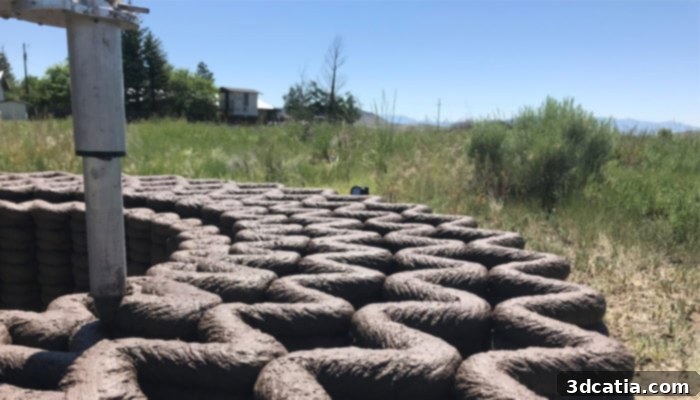
Emerging Objects utilized an innovative mud-based 3D printing technique to construct these sustainable structures | Credits: Rael San Fratello
Pioneering On-Site Construction: Research, Materials, and the Potterbot XLS-1
The journey to the Mud Frontiers project began with extensive and meticulous research. The architects at Emerging Objects delved deep into the typical construction methods historically employed in the San Luis Valley region. Their studies encompassed understanding the intricate processes behind handmade clay structures and the traditional pottery crafted from the rich, diverse mud and clay deposits found in the Sangre de Christo and San Juan mountains. This historical context was crucial, providing a foundation of local wisdom and material understanding that informed their modern additive manufacturing approach.
A key realization during their research was the desire to conduct the 3D printing process directly on site. This ambition presented a significant challenge: the need for a highly mobile and easily transportable machine capable of efficiently extracting and utilizing a material similar to the indigenous clay and mud mixture found locally. To overcome this hurdle, they sought expertise from 3D Potter, a Florida-based manufacturer celebrated for its advanced ceramic 3D printers. The collaboration proved fruitful, as 3D Potter designed and developed a specialized small mobile robot specifically for the project, aptly named the Potterbot XLS-1.
The Potterbot XLS-1 was engineered to be robust yet agile, allowing for unparalleled flexibility in on-site fabrication. Its design facilitated the direct utilization of locally sourced earth, transforming readily available soil into a viable building material. This capability not only significantly reduced transportation costs and carbon footprint associated with traditional construction materials but also fostered a deeper connection between the structures and their natural surroundings. The ability to print large-scale structures rapidly using the very soil beneath their feet opened up new paradigms for accessible and environmentally responsible architecture, demonstrating a powerful synergy between ancient practices and cutting-edge technology.
Insights from the Frontier: Accessibility, Robustness, and the Humble Material
Ronald Rael and Virginia San Fratello, reflecting on the project in an interview with Dezeen, eloquently articulated the profound lessons learned from their pioneering work. Rael stated, “What we learned was really how accessible, robust, and powerful it was to print large scale structures so quickly using the soil just beneath our feet.” This observation encapsulates the core philosophy of Mud Frontiers: leveraging the earth’s most abundant material to create resilient and functional architecture with remarkable efficiency. The project illuminated innovative workflows for printing, refined material mixture processes, and explored novel structural applications. Furthermore, it sparked deeper theoretical discussions about new and old ways of living and designing for a sustainable future, all centered around what Rael aptly described as “humankind’s most humble material.”
Their experience underscored the untapped potential of local earth as a primary construction medium, challenging conventional notions of building materials and methods. The ease of access to raw mud, coupled with the rapid prototyping capabilities of 3D printing, presented a compelling case for a paradigm shift in how we approach construction, especially in regions with limited access to traditional building supplies or a desire to reduce environmental impact. The robustness of the resulting structures also proved that “humble” does not equate to “fragile,” but rather points to an inherent strength and durability that has withstood the test of time in historical earthen buildings.
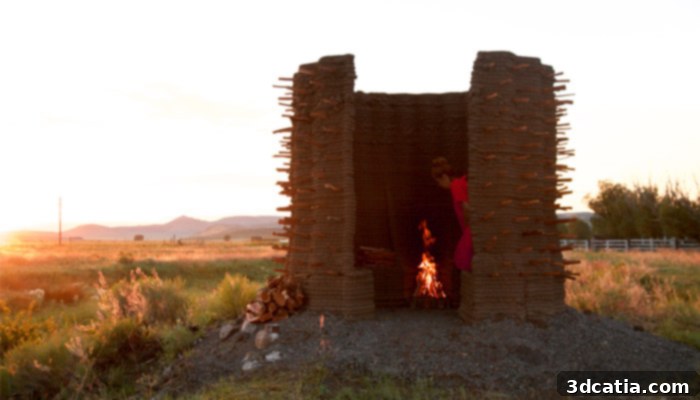
A closer look at the Hearth hut, demonstrating the intricate details achievable with mud 3D printing | Credits: Rael San Fratello
The Four Huts: Diverse Explorations in Earthen Architecture
The four 3D printed huts of the Mud Frontiers project – Hearth, Beacon, Lookout, and Kiln – each possess a distinctive structure and purpose, serving as individual architectural experiments within a cohesive sustainable vision. This diversity highlights the versatility of 3D mud printing and the architects’ innovative approach to design.
Hearth: A Sanctuary of Warmth and Strength
The Hearth hut, for instance, showcases a remarkably thin 3D printed mud wall, a testament to the precision achievable with the Potterbot XLS-1. This slender earthen shell is ingeniously reinforced with rot-resistant juniper wood, a locally abundant and sustainable material. These wooden elements are strategically embedded to join the two walls of the structure, providing essential stability without compromising the interior’s aesthetic appeal or the raw beauty of the mud. Furthermore, the architects thoughtfully incorporated a circular mud bank around the central fireplace, creating a natural, inviting seating area that emphasizes warmth and communal gathering. The design of Hearth not only demonstrates structural innovation but also embraces passive thermal strategies, utilizing mud’s inherent insulating properties to maintain a comfortable interior climate.
Lookout: An Ascent to Perspective
In stark contrast to Hearth, the Lookout hut offers a completely different experience. As its name suggests, Lookout is conceived as a unique kind of staircase, an ascending architectural feature designed for climbing to gain a commanding view of the surrounding landscape. The hut’s construction involved the successive application of multiple layers of mud material, meticulously built up to form a spiral or coiled shape, reminiscent of traditional pottery techniques but on a monumental scale. This layered approach not only gives Lookout its distinctive form but also structurally integrates the viewing platform into the very fabric of the hut, making the journey to the top an integral part of its architectural expression. It serves as a striking example of how 3D printing can create functional, climbable structures from earth, redefining the boundaries of what is possible with sustainable materials.
Kiln: A Functional Hub for Creativity
The Kiln hut, true to its name, houses a fully functional oven, designed for firing 3D printed vases and other earthenware objects. This integration of production within the living space embodies a closed-loop system of creativity and sustainability. The oven is efficiently fed by local juniper wood, further emphasizing the project’s commitment to utilizing readily available resources. Kiln demonstrates how additive manufacturing, combined with traditional crafts, can foster local economies and promote self-sufficiency. It transforms the hut from a mere dwelling into a workshop, a place where the earth itself is not only the building material but also a tool for crafting new objects, thus extending the lifecycle and utility of the humble mud.
Beacon: A Guiding Light of Innovation
While specific detailed descriptions for Beacon were not provided in the initial outline, its inclusion among Hearth, Lookout, and Kiln suggests its distinct contribution to the project’s overall narrative of diverse structural exploration. Each hut, including Beacon, was designed to push a specific boundary or explore a particular concept related to mud 3D printing, whether it be structural integrity, unique spatial arrangements, or integration with local resources and culture. Together, these four huts form a comprehensive showcase of the aesthetic, functional, and environmental potential of 3D printed earthen architecture.
Broader Implications and the Future of Earthen 3D Printing
The Mud Frontiers project by Emerging Objects is more than just an architectural experiment; it represents a significant leap forward in the quest for sustainable and accessible housing solutions. By demonstrating the viability of 3D printing with readily available local earth, Rael and San Fratello have opened up exciting new avenues for reducing construction waste, lowering material costs, and minimizing the environmental footprint of buildings. This approach has profound implications for developing regions, disaster relief efforts, and communities seeking environmentally responsible living solutions. Imagine communities empowered to build their own durable, climate-responsive homes using the very ground beneath their feet, fostering self-reliance and local craft.
Furthermore, the project highlights the beauty and inherent value of natural materials, challenging the perception that modern architecture must rely solely on industrialized, high-energy-intensive components. The aesthetic appeal of the Mud Frontiers huts, with their organic forms and natural textures, suggests a return to building in harmony with nature, creating structures that are not only sustainable but also deeply connected to their environment and cultural heritage. This innovative blend of ancient materials with cutting-edge technology points towards a future where sustainable architecture is not a niche concept but a widespread, accessible reality, inspiring a new generation of architects, builders, and inhabitants to reconsider their relationship with the earth.
Join the Conversation on Sustainable Innovation
What are your thoughts on this pioneering project from Emerging Objects? Do you believe 3D printed earthen architecture holds the key to a more sustainable future? We invite you to share your insights and opinions in a comment below or join the discussion on our Facebook and Twitter pages! Don’t forget to sign up for our free weekly Newsletter to receive all the latest news, innovations, and developments in the world of 3D printing directly to your inbox!