
Revolutionizing 3D Printing: How MIT’s AI-Powered System Ensures Flawless Manufacturing
The landscape of additive manufacturing is undergoing a continuous and rapid transformation, evolving at an unprecedented pace. This constant advancement, while exciting, inevitably introduces a significant layer of complexity, making it increasingly challenging for even seasoned professionals to master all its diverse applications and technologies. A common hurdle, especially in 3D printing, lies in identifying and applying the optimal printing parameters. Misjudging factors like print speed, material extrusion rate, or temperature can lead to costly errors, wasted materials, and extensive human resource allocation for troubleshooting. The precise parameters required for successful 3D printing are highly dependent on the specific technology and material being used, creating a dynamic and often unpredictable environment. To address these persistent challenges and streamline the manufacturing process, visionary researchers at the Massachusetts Institute of Technology (MIT) have harnessed the power of artificial intelligence (AI) and machine learning to introduce a groundbreaking system designed to prevent and correct errors in real-time.
At the heart of MIT’s innovation is a sophisticated machine learning system specifically engineered to monitor and manage material processing during 3D printing. Its primary objective is to autonomously prevent potential errors and, if any arise, rectify them instantaneously, all without requiring human intervention. This advanced AI system was meticulously trained through extensive simulations, where it developed a robust understanding of optimal printing parameters by learning from a vast neural network. This rigorous training enabled the system to discern the intricate relationships between various parameters and their impact on print quality. Following countless simulated tests and refinements, the MIT researchers seamlessly integrated their system into a practical 3D printer. The results were nothing short of remarkable: the 3D-printed components demonstrated significantly higher accuracy and superior quality compared to parts produced using traditional methods, directly attributable to the AI’s ability to adapt and optimize parameters in real-time. This breakthrough promises to reduce waste, accelerate production cycles, and enhance the overall reliability of additive manufacturing processes.
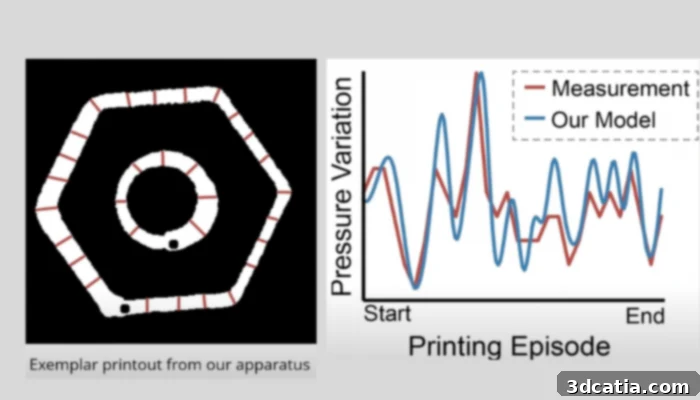
Data show the imperfections and problems which can arise during printing (photo credits: MIT).
Why is Artificial Intelligence Essential in Modern 3D Printing?
The interdisciplinary research team at MIT, comprising experts from mechanical engineering, electrical engineering, and computer science, was driven by a singular, overarching goal: to fundamentally simplify 3D printing. Their vision was to empower companies to more easily integrate novel and advanced materials into their 3D printing workflows and to ensure that the manufacturing process remains robust and consistent, regardless of fluctuating material properties or environmental conditions. This adaptive capability is crucial for industrial applications where consistency and precision are paramount. Wojciech Matusik, a distinguished professor of electrical engineering and computer science at MIT, lead author of the research, and head of the Computational Design and Fabrication Group (CDFG) within the Computer Science and Artificial Intelligence Laboratory (CSAIL), eloquently elaborated on the significance of their work. He stated, “This project is really the first demonstration of building a manufacturing system that uses machine learning to learn a complex control policy. If you have manufacturing machines that are more intelligent, they can adapt to the changing environment in the workplace in real-time, to improve the yields or the accuracy of the system. You can squeeze more out of the machine.” Matusik’s insight underscores the transformative potential of intelligent machines, capable of real-time adaptation, leading to increased productivity, enhanced accuracy, and optimized resource utilization across various manufacturing sectors. This not only democratizes access to complex 3D printing technologies but also positions additive manufacturing as a more resilient and versatile tool for innovation.
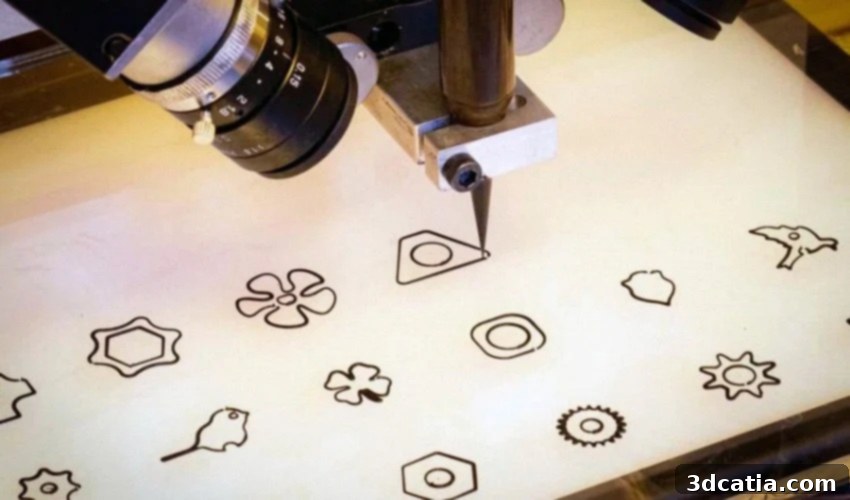
A particularly formidable challenge for the MIT researchers stemmed from the inherent variability of 3D printing. The optimal printing parameters are never static; they constantly fluctuate based on a multitude of factors, including the specific material composition, the hardware configuration of the printer, and even subtle variations between different batches of the same material. To effectively address this dynamic environment, the team developed a sophisticated machine vision system. This system incorporates two high-resolution cameras strategically focused on the printer’s nozzles, diligently observing and recording the properties of the material as it is extruded and deposited. By continuously capturing visual data, the AI can detect nascent imperfections or deviations in real-time. The images captured are then processed by the AI, which leverages its learned intelligence to identify and categorize defects. Crucially, based on this immediate feedback, the system intelligently adjusts the printing parameters for the remainder of the process, effectively preventing the recorded defects from escalating or reoccurring. This proactive, data-driven approach minimizes material waste, saves significant time, and dramatically enhances the consistency and quality of the final 3D-printed parts, demonstrating a true leap forward in smart manufacturing.
The Path to Successful AI Simulation for Real-World Applications
The foundation of training this advanced AI system was built upon the widely recognized principle of “trial and error,” albeit executed within a highly controlled and efficient simulated environment. The core task assigned to the machine learning system was to autonomously select and fine-tune the correct pressure parameters for material extrusion. When an error occurred—typically due to the system applying either too much or too little material during the virtual print—this negative feedback served as a critical learning point. Through countless simulated iterations and continuous learning from these “errors,” the AI progressively refined its understanding and decision-making capabilities. The researchers meticulously observed that after numerous simulated prints, the AI-driven 3D printing process consistently yielded significantly more accurate and precise results. This extensive simulation-based training proved invaluable, allowing the system to learn and optimize without the prohibitive costs, time, and material waste associated with physical experimentation, showcasing the immense power of simulation in accelerating AI development.
While simulations offer a powerful training ground, it is a well-understood axiom that the real world presents a far more complex and noisy environment. To successfully bridge the gap between theoretical training and practical application, the MIT researchers ingeniously developed a sophisticated numerical model. This model was designed to meticulously account for and incorporate all the subtle yet significant details that characterize real-world 3D printer operation, including mechanical noise, environmental fluctuations, and other unpredictable variables. By embedding this comprehensive “noise model” into their system, they were able to create a digital twin that accurately mirrored the physical conditions of a working 3D printer. One researcher highlighted the profound impact of this approach, commenting, “The interesting thing we found was that, by implementing this noise model, we were able to transfer the control policy that was purely trained in simulation onto hardware without training with any physical experimentation. We didn’t need to do any fine-tuning on the actual equipment afterwards.” This remarkable achievement signifies a pivotal moment in manufacturing, demonstrating that highly complex AI control policies can be developed and validated entirely in a virtual environment, then deployed directly onto physical hardware with unparalleled success. This drastically reduces development cycles, slashes research and development costs, and accelerates the adoption of advanced AI-powered 3D printing solutions across industries. For those eager to delve deeper into the intricacies of this fascinating 3D printing and AI project by MIT researchers, further details are available by clicking HERE.
The integration of AI into 3D printing is set to redefine the future of additive manufacturing, offering unprecedented levels of precision, efficiency, and adaptability. We are eager to hear your thoughts on this transformative development in 3D printing using AI! Share your insights in a comment below or join the conversation on our LinkedIn, Facebook, and Twitter pages! Don’t forget to sign up for our free weekly Newsletter here to receive the latest 3D printing news straight to your inbox. You can also find all our compelling videos on our YouTube channel, showcasing more innovations in the world of additive manufacturing.
*Cover Photo Credits: MIT