
3D Printing Revolutionizes Prosthetic Care for Ukrainian War Victims: The iGrip Story
The unprovoked invasion of Ukraine by Russia, which commenced on February 24th, 2022, has plunged the nation into a profound humanitarian crisis. The conflict has tragically impacted millions of lives, leading to widespread displacement, destruction, and an alarming number of casualties. Among the most devastating consequences is the significant number of civilians and soldiers who have sustained severe injuries, frequently necessitating life-altering amputations. In the face of such immense suffering, the urgent need for innovative solutions in medical aid and rehabilitation has become paramount. This is where the transformative potential of additive manufacturing, commonly known as 3D printing, emerges as a beacon of hope and practical assistance.
Indeed, 3D printing technology is proving to be an indispensable tool in addressing the critical demand for prosthetic limbs for these war victims. Its ability to create customized, cost-effective, and rapidly deployable medical devices makes it uniquely suited for humanitarian efforts in conflict zones. A recent and inspiring example of this innovation comes from Gerwin Smit, a dedicated researcher at Delft University of Technology (TU Delft) in the Netherlands. Smit has pioneered the development of an advanced prosthetic hand, ingeniously crafted using a hybrid manufacturing approach that combines the precision of 3D printing with the efficiency of laser cutting. This groundbreaking method allows for the production of highly functional and durable prosthetics that are both economical and accessible.
The iGrip: An Accessible and Affordable Solution
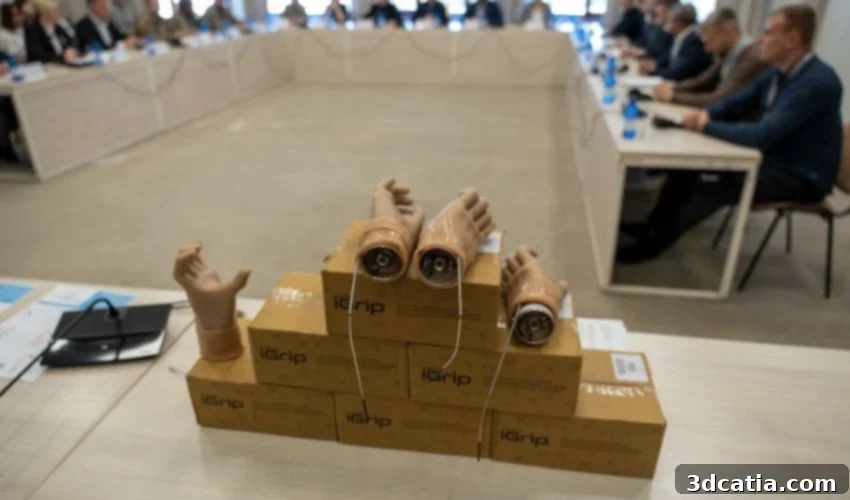
Named the “iGrip,” and affectionately known as the “Hundred Dollar Hand” due to its remarkably low production cost, this prosthetic device stands as a testament to what is possible when innovation meets compassion. For a staggering 80% of the global population residing in countries where traditional prosthetic hands are prohibitively expensive and often out of reach, the iGrip offers a reliable and accessible alternative. Its design prioritizes functionality and ease of use, ensuring that recipients can regain a significant degree of independence in their daily lives. The impact of such affordability cannot be overstated, breaking down significant barriers to rehabilitation for countless individuals worldwide.
The journey of these life-changing hands began even before the full-scale invasion of Ukraine. Since 2021, these innovative prosthetic hands have been successfully distributed and utilized in India, demonstrating their efficacy and practicality in real-world scenarios. Building on this success and driven by the urgent needs in Ukraine, the Indian social enterprise firm Vispala has taken a crucial step to make the iGrip available to Ukrainian war victims. Through a significant humanitarian gesture, Vispala, with the vital support of American IT giant Cisco, has generously donated 350 of these specialized hands to Ukraine. This international collaboration underscores the power of partnerships in delivering critical aid where it is most needed.
The official delivery of the iGrip hands to Ukraine marked a truly momentous occasion, symbolizing hope and resilience amidst adversity. The ceremony took place in the heart of the Ukrainian capital, Kyiv, a city that has endured immense hardship. The event was attended by high-ranking Ukrainian ministers, alongside the distinguished ambassadors of the United States and India, highlighting the international significance and collaborative spirit of this humanitarian endeavor. Such diplomatic presence emphasized the shared commitment to supporting Ukraine and its people during their challenging recovery.
A Vision for Continued Humanitarian Progress
Mr. Gerwin Smit, the brilliant mind behind the iGrip, expressed immense satisfaction and pride regarding the donation. His dedication extends beyond the initial development, as he is deeply committed to continuing this vital humanitarian work. He aims to expand the reach and impact of his innovations with the invaluable assistance of the Movendi Foundation. This esteemed foundation is dedicated to empowering disabled individuals in developing countries by providing them with the resources and support they need to lead fulfilling lives. Smit’s words reflect his passion and unwavering commitment: “I’m happy that we can contribute to this wonderful initiative. And I’m also hoping that, with help from the Movendi Foundation we can raise enough money to make another donation to Ukraine.” This sentiment underscores a broader ambition to ensure that more individuals affected by conflict and disability can benefit from affordable prosthetic solutions.

Ukraine has suffered extensive damage in the course of the Russian invasion, as shown in this view of Mariupol from April 14 2022. (Photo credit: REUTERS/Alexander Ermochenko)
Gerwin Smit’s Expertise and the Wider Role of 3D Printing in Crisis
Mr. Smit’s contributions to the field of prosthetics are built upon a foundation of extensive research and practical experience. His PhD research, for instance, focused on the intricate development of a new ultralight prosthetic hand that utilized hydraulics, showcasing his commitment to pushing the boundaries of prosthetic design and functionality. This deep expertise is evident in the robust and user-friendly design of the iGrip, which is now making a tangible difference in the lives of many.
The application of 3D printing in aiding Ukrainian war victims extends beyond prosthetic limbs. This versatile technology is proving invaluable in various humanitarian efforts. For example, in September of the previous year, we highlighted the remarkable work of Oxford Performance Materials. This company has leveraged 3D printing to develop highly specialized orthopaedic implants for Ukrainian war victims. The precision and customizability offered by additive manufacturing are crucial for creating implants that perfectly fit individual patient anatomies, accelerating recovery and improving quality of life. Such advancements are critical for complex reconstructive surgeries, ensuring better outcomes for those with severe injuries.
Beyond direct medical aid, 3D printing and related technologies are also being employed in broader efforts to document and preserve. A significant initiative is Artic3D’s project, undertaken in collaboration with the Ukrainian police. This project utilizes 3D scanning technologies to meticulously document invaluable cultural artifacts and the extensive damage inflicted by Russian forces. By creating detailed 3D models, they are not only preserving a digital record of Ukraine’s rich heritage but also gathering crucial evidence of war crimes. This dual function of humanitarian aid and forensic documentation exemplifies the multi-faceted utility of advanced digital manufacturing tools in times of conflict. These efforts highlight the power of technology to address both immediate physical needs and the long-term historical and legal implications of war.
The Transformative Power of Additive Manufacturing in Humanitarian Aid
The success of the iGrip hand project, alongside other initiatives, powerfully illustrates the profound potential of 3D printing in humanitarian contexts. The ability to rapidly design, iterate, and produce essential medical devices on demand, often close to the point of need, represents a paradigm shift in disaster relief and rehabilitation. Traditional manufacturing processes for prosthetics are typically slow, expensive, and require specialized infrastructure, making them unsuitable for emergency situations or regions with limited resources. 3D printing bypasses many of these limitations, offering a flexible and efficient alternative.
One of the key advantages of 3D printing is the unparalleled level of customization it offers. Each prosthetic can be tailored precisely to the individual’s unique anatomy, ensuring a comfortable fit and optimal functionality. This personalization is particularly crucial for complex injuries sustained in conflict. Furthermore, the localized production capabilities mean that prosthetics can be manufactured closer to the recipients, reducing logistical challenges, shipping costs, and delivery times. This agility is vital in dynamic and unpredictable environments like war zones, where rapid response can make a critical difference in patient care and rehabilitation timelines.
The “Hundred Dollar Hand” moniker is more than just a catchy name; it signifies a monumental leap towards equitable access to healthcare. By drastically reducing costs, projects like the iGrip empower organizations to reach a much larger population in need. This economic viability opens doors for sustained aid programs and fosters a sense of self-reliance within affected communities, as the technology becomes more accessible. The collaboration between academic institutions like TU Delft, social enterprises like Vispala, and corporate partners like Cisco serves as a powerful model for future humanitarian interventions. It demonstrates that combining innovative research, focused distribution, and corporate social responsibility can yield transformative results on a global scale.
As the war in Ukraine continues to exact its toll, the ongoing efforts to provide advanced medical solutions are more critical than ever. The resilience of the Ukrainian people is met with the ingenuity and compassion of the international community, leveraging technologies like 3D printing to mitigate suffering and restore dignity. The iGrip project is not just about providing a prosthetic hand; it’s about giving back independence, hope, and a path towards recovery for those who have lost so much. More information about the iGrip and TU Delft’s involvement can be found HERE.
What are your thoughts on the revolutionary prosthetic iGrip hand and its impact on Ukrainian war victims? We encourage you to share your perspective in a comment below or join the discussion on our social media channels: LinkedIn, Facebook, and Twitter! Don’t forget to sign up for our free weekly Newsletter here to receive the latest 3D printing news directly in your inbox. You can also explore all our insightful videos on our YouTube channel for more in-depth content.
*Cover photo credits: Ministry of Health Ukraine/ TU Delft