
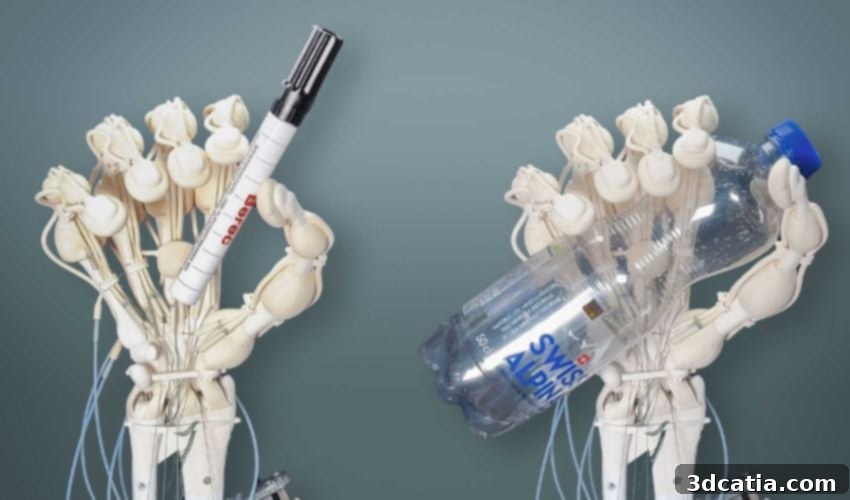
Revolutionizing Soft Robotics: Advanced 3D Printing Unlocks New Possibilities with Novel Materials
The landscape of robotics is undergoing a profound transformation, driven by an accelerating pace of research and development that aligns closely with ever-evolving application areas and complex requirements. At the forefront of this evolution is the burgeoning field of soft robotics. Unlike their conventional counterparts, which are typically constructed from rigid materials such as steel or aluminum, soft robots are engineered from pliable, elastic materials. This fundamental difference grants them remarkable capabilities, including elastic deformations and an inherent ability to minimize hazards commonly associated with rigid machinery. The advantages of soft robotics are proving invaluable across a diverse spectrum of industries, notably in healthcare, where seamless human-machine interaction is paramount, and in delicate tasks such as grasping fragile or intricately shaped objects without causing damage. These robots promise a future where technology works more harmoniously and safely alongside humans, adapting to complex environments with unprecedented flexibility.
Parallel to the advancements in robotics, the domain of 3D printing, also known as additive manufacturing, has experienced exponential growth, fueled by an expanding array of novel applications. This shared trajectory of rapid development creates a natural synergy between robotics and additive manufacturing. Consequently, it is becoming increasingly common for robots to be fabricated using 3D printing technologies, leveraging its capacity for intricate designs and customized parts. Historically, additive manufacturing has primarily been limited to processing quick-curing plastics, which, while useful, often lack the desired elasticity and durability for advanced soft robotics applications. However, a significant paradigm shift is underway, marked by an advanced and rapidly expanding portfolio of compatible materials. This material innovation is unlocking entirely new dimensions of development and application potential. In a landmark contribution to this field, a collaborative study spearheaded by researchers from the Massachusetts Institute of Technology (MIT) and ETH Zurich in Switzerland has cast a spotlight on the pivotal role of a uniquely 3D-printed robotic hand, demonstrating a breakthrough in material processing for soft robotics.
This groundbreaking research marks a significant milestone: for the first time, scientists spanning the Atlantic have successfully demonstrated the 3D printing of slow-curing plastics. These innovative materials possess superior elastic properties and enhanced durability, enabling a handheld robot to be printed in a single, continuous pass. This remarkable achievement was made possible through a strategic collaboration with the US start-up Inkbit and its proprietary technology. The joint effort culminated in the study titled “Vision-controlled jetting for composite systems and robots,” which aimed to produce high-resolution, complex structures with diverse material properties. A core objective was to mimic the sophisticated functions of natural organisms in a synthetic form, pushing the boundaries of biomimetic design. To achieve this, the researchers ingeniously integrated advanced 3D printing techniques with sophisticated laser scanners and a real-time feedback mechanism, creating a system capable of unprecedented precision and material versatility. This fusion of technologies represents a significant leap forward in the capabilities of additive manufacturing, particularly for the demanding requirements of soft robotics.
This novel approach has effectively circumvented previous limitations, allowing for the 3D printing of low-viscosity, slow-curing polymers that exhibit exceptional elasticity and resilience. The ability to process these materials opens up vast new possibilities for the fabrication of complex, robust robotic components. These components can now be designed with a sophisticated blend of different, high-quality materials, integrating both elastic and rigid structures within a single print. This hybrid material capability is critical for creating robots that can perform a wider range of tasks, from delicate manipulation to withstand significant forces. Furthermore, the successful continuous printing of highly intricate, filigree parts and human-like structures complete with internal cavities represents a monumental leap forward for soft robotics. This capability is essential for embedding complex functionalities, such as integrated sensors, actuators, and fluidic channels, directly within the robot’s structure, eliminating the need for post-assembly. The profound implications of these findings were recognized through their publication earlier this month in the esteemed scientific journal, Nature, underscoring the significance of this technological breakthrough for both additive manufacturing and advanced robotics.
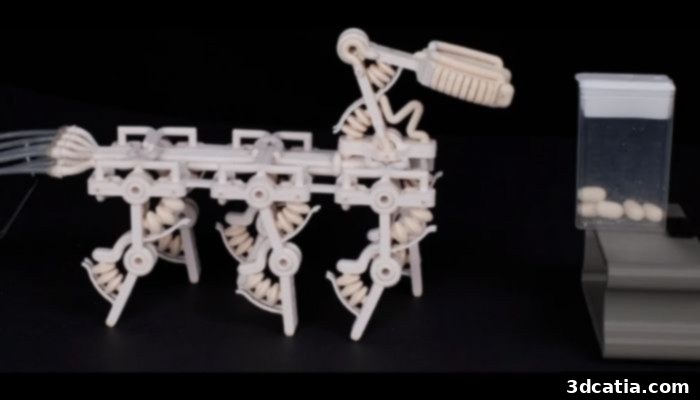
The study shows new possibilities for soft robotics and 3D printing, enabling integrated, multi-material designs. (Image: Thomas Buchner et al.; Nature)
As a core component of their extensive study, the teams from ETH Zurich and Inkbit rigorously tested their innovative printing approach across a multitude of diverse application examples. Their efforts led to the successful production of a wide spectrum of high-resolution composite materials and an assortment of advanced robots. These included sophisticated robotic hands, pneumatically operated walking manipulators capable of complex locomotion, highly functional heart pumps designed for medical applications, and various intricate metamaterial structures that exhibit unique mechanical properties. Among these impressive creations, a particular highlight was a robotic hand engineered with artificial bones and ligaments. What makes this creation particularly noteworthy is its construction from an array of different polymers, carefully selected for their distinct mechanical properties. Crucially, the hand was designed with internal cavities, purpose-built to seamlessly house integrated sensors and other electronic components. A testament to the advanced capabilities of the new printing method, this complex robotic hand was printed in a single, continuous session, eliminating the need for any subsequent assembly steps. This single-pass fabrication was primarily facilitated by the revolutionary properties of the polymers employed, which allowed for the creation of intricate, multi-material structures with integrated functionalities.
“We would not have been able to produce this hand with the fast-curing polyacrylates that we used to use in 3D printing,” explains Thomas Buchner, a PhD student in the ETH robotics group and the first author of the groundbreaking study. His statement underscores the critical material hurdle that had previously constrained the development of truly advanced soft robots. He further elaborates on the solution: “We are now using slow-curing thiol-ene polymers. These have very good elastic properties and return to their original state much faster than polyacrylates after bending.” This shift to thiol-ene polymers represents a pivotal material science breakthrough, enabling the creation of robots that can exhibit high degrees of flexibility and rapid recovery from deformation, essential characteristics for dexterous manipulation and dynamic interaction in complex environments. The ability to precisely control the curing process and leverage the superior mechanical properties of these new polymers has been instrumental in pushing the boundaries of what is achievable in soft robotics.
The inherent properties of thiol-ene polymers make them exceptionally well-suited for a myriad of demanding applications in soft robotics. Their superior elasticity and remarkable ability to return to their original shape quickly after deformation render them ideal for crafting the elastic bands and intricate ligament structures within the robotic hand, mimicking biological tissues. Beyond their elasticity, a significant advantage of thiol-enes is that their stiffness can be very finely adjusted and precisely tuned. This unparalleled control over mechanical properties allows researchers and engineers to adapt the material characteristics to the exact requirements of specific soft robotic applications, whether it’s for a highly flexible gripper or a more rigid yet still compliant structural element. This tunability is crucial for creating functional robots that can interact with their surroundings safely and effectively. “Robots made of soft materials such as the hand we have developed have distinct advantages over conventional robots crafted from rigid metals: because they are soft and compliant, the risk of injury is substantially reduced when they operate in close proximity or direct interaction with humans. Furthermore, their inherent gentleness and adaptability make them far better suited to handling fragile goods without causing damage,” explains ETH Professor Robert Katzschmann. This highlights the paradigm shift from purely industrial, force-driven robots to collaborative, delicate, and safe robotic systems.
A New Technological Approach for Advanced 3D Printing and Soft Robotics
The innovative approach pioneered by MIT, ETH Zurich, and Inkbit in the development of the advanced robotic hand signifies more than just a material breakthrough; it also ushers in a new technological paradigm for 3D printing. This method offers high throughput and an automated multi-material printing process with impressive scalability, critical features for moving from laboratory prototypes to industrial production. At the heart of this advancement lies the successful integration and processing of the aforementioned slow-curing polymers, specifically thiolenes and epoxides, which were absolutely key to the creation of the articulated robotic hand. However, the ability to effectively process these challenging materials using 3D printing is intricately tied to the underlying technology itself. Until now, conventional inkjet 3D printing systems were predominantly limited to fast-curing polymers. This limitation stemmed from the process requirement where, after each layer cured, a mechanical device would scrape off any unevenness to ensure the appropriate quality and smooth surface finish of the subsequent layers. Applying such a scraping device to slow-curing polymers, which remain viscous for an extended period, would cause it to stick and render the process unfeasible. This crucial challenge necessitated a radical re-evaluation and redesign of the printing technology, making it imperative to delve deeper into the innovative method employed by ETH Zurich and Inkbit in their pioneering research.
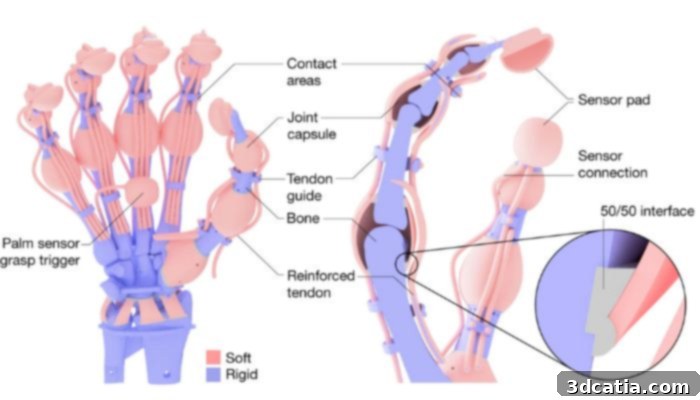
The intricate 3D-printed robotic hand consists of artificial bones, tendons, and ligaments, meticulously crafted from various materials, including soft, elastic plastics and more rigid components, all in a single print. (Image: Thomas Buchner et al; Nature)
The fundamental benefit stems from the revolutionary Vision Controlled Jetting technology developed by the US start-up Inkbit, a pioneering spin-off from MIT. This sophisticated printing technology operates on an inkjet process where precisely controlled nozzles meticulously apply the desired viscous material at each specific point on the build platform. Each layer is then systematically cured by a targeted UV lamp. The true innovation and differentiating factor of this technology, however, lies in its integrated real-time feedback system. After each layer is applied and partially cured, a high-resolution 3D laser scanner instantly inspects the printed surface for any minute unevenness or inconsistencies. Crucially, this real-time geometric data is then fed back into the system, which takes these irregularities into immediate account when precisely calculating the application of the subsequent layer. This iterative, intelligent process ensures exceptional accuracy and smooth surface finishes, even with challenging slow-curing materials, fundamentally transforming the capabilities of additive manufacturing.
“A feedback mechanism compensates for these irregularities when printing the next layer by calculating the precise adjustments to the amount of material to be printed in real time,” explains Wojciech Matusik, a distinguished professor at MIT and a co-author of the seminal study. This intelligent feedback loop means that the advanced scanning system doesn’t merely capture the 3D structure; it enables an immediate, dynamic adaptation of the printing parameters through a digital closed-loop control system. This eliminates the traditional necessity for clunky and often problematic mechanical scraping solutions, facilitating a truly non-contact process. Consequently, this allows for the continuous printing of plastics that cure slowly and possess varying degrees of elasticity, from highly flexible elastomers to more rigid components, all within a single, integrated build. To manage complex geometries and overhanging features during the printing process, a specialized wax material is utilized as a support structure. Once the printing is complete, this wax can be easily melted away at a modest 60 degrees Celsius, leaving behind the intricate, multi-material robotic component without any damage or residue.
Despite these remarkable advancements, the research team candidly acknowledged certain challenges encountered during this pioneering project. One notable difficulty was observed with some printed parts exhibiting deformation when exposed to the open air, a common issue in additive manufacturing often related to material stresses and curing kinetics. Additionally, the interfaces – or surface layers – between different materials in multi-material prints did not always achieve optimal adhesion, suggesting an area for future refinement. Despite these minor hurdles, the researchers remain optimistic, expressing confidence that these issues can be significantly improved with ongoing development. The overarching success of the technology, characterized by its exceptionally high resolution, rapid printing process, and broad compatibility with a wide range of materials exhibiting diverse properties, already unlocks an immense variety of possibilities. This includes the creation of innovative hybrid, soft/rigid robots and countless other advanced applications across various sectors. The collaborative efforts of MIT and ETH Zurich have undeniably optimized Inkbit’s printing technology, specifically for the seamless integration and use of slow-curing polymers, through rigorous testing and application validation. Their future research will now concentrate on exploring even more profound possibilities and undertaking the ambitious task of printing and testing increasingly complex structures. Inkbit’s long-term vision is clear: to further develop and commercialize this transformative technology, bringing these next-generation manufacturing capabilities to a wider market. For those interested in delving deeper into the specifics of this groundbreaking study, further details can be found HERE.
What are your thoughts on this innovative 3D-printed robotic hand and the transformative research collaboration between MIT and ETH Zurich? The ability to fabricate complex, multi-material soft robots in a single pass opens up unprecedented possibilities for future robotic applications, from delicate surgical tools to more adaptive industrial automation. We’d love to hear your insights and predictions for where this technology might lead! Let us know your perspective in a comment below or join the conversation on ourLinkedIn,Facebook, andTwitter pages! Don’t miss out on the latest advancements and sign up for our free weeklyNewsletter here, delivering the most relevant 3D printing news straight to your inbox! You can also explore all our insightful videos and demonstrations on our dedicatedYouTube channel.
*Cover photo credits: ETH Zürich, Thomas Buchner