

Markforged Metal X Unlocks Pure Copper 3D Printing: A Game-Changer for High-Performance Industries
The landscape of additive manufacturing is continuously evolving, with breakthroughs in materials and processes pushing the boundaries of what’s possible. A significant recent announcement from US manufacturer Markforged heralds a new era for metal 3D printing: the capability to produce pure copper parts on its Metal X system. This development is not just incremental; it’s a pivotal moment, especially considering copper’s notorious difficulty to 3D print using conventional laser-based methods like Laser Powder Bed Fusion. Markforged’s Metal X, an accessible metal additive manufacturing solution, now offers a unique advantage by enabling the creation of complex pure copper components with exceptional electrical and thermal conductivity, opening doors for innovation across critical sectors.
Copper, renowned for its superior conductivity and malleability, is a cornerstone material in countless industrial applications. From intricate electrical wiring to efficient heat exchangers, its properties are indispensable. However, the very characteristics that make it valuable also pose substantial challenges for additive manufacturing. Traditional laser-based metal 3D printing processes struggle with pure copper due to its high reflectivity and excellent thermal conductivity. Lasers, which rely on absorbing energy to melt and fuse metal powders, find it difficult to efficiently process copper, as much of the laser’s energy is reflected rather than absorbed, hindering proper layer fusion and leading to inconsistent part quality. This has often limited manufacturers to using copper alloys, which, while easier to print, do not offer the same peak performance as pure copper.
Markforged’s Innovative Approach to Metal 3D Printing
Markforged, a pioneer in the additive manufacturing market, introduced its first metal 3D printer, the Metal X, in 2017. This machine distinguishes itself from direct laser-based systems by employing an extrusion process, conceptually similar to Metal Injection Molding (MIM). This proprietary technology, known as Atomic Diffusion Additive Manufacturing (ADAM), involves extruding metal powder bound in a plastic filament. Parts are printed layer by layer, then washed to remove the binder, and finally sintered in a furnace. During sintering, the metal particles coalesce, and the part achieves its final dense metallic form. This unique approach bypasses the reflectivity challenges faced by laser-based systems, making it possible to work with materials like pure copper, which were previously considered unprintable in their pure form.
The Metal X platform has already proven its versatility by enabling the creation of parts in various materials, including different grades of steel and Inconel. The addition of pure copper to this growing material library marks a significant milestone. Unlike other players in the market, such as GE Additive or Optomec, who have specialized laser systems capable of printing copper (often with significant investments required), Markforged’s solution offers a relatively more accessible entry point for companies looking to leverage the benefits of additive manufacturing for high-performance copper components. The ability to produce pure copper parts with high density and excellent material properties on an extrusion-based system represents a democratizing force in metal additive manufacturing.
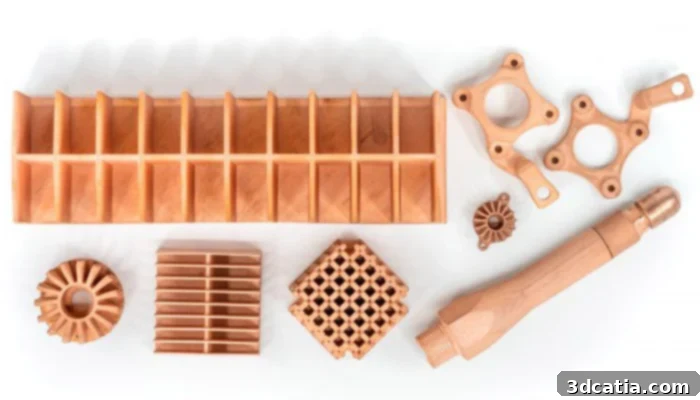
Different 3D printed copper parts on Metal X | Credits: Markforged
Pure Copper’s Game-Changing Properties for Additive Manufacturing
Markforged’s CEO and founder, Greg Mark, aptly articulated the significance of this development: “Copper is the engine of our world. It is everywhere. It builds our cars, activates telephones and runs electrical equipment. Copper has always been an expensive and difficult material to machine, incompatible with other 3D printing processes in its pure form. Today, we have made it easier and cheaper to produce. Markforged’s 3D printed copper will be a game-changer for the automotive and electronics industries, and will open the door to innovation in many other areas.” His statement underscores the pervasive role of copper in modern technology and the transformative potential of making it readily available for additive manufacturing.
The copper offered by Markforged through its Metal X system boasts impressive material properties, crucial for demanding applications. It exhibits high thermal conductivity, exceeding 350 W/mK, and an electrical conductivity of 84% IACS (International Annealed Copper Standard). These figures are critical. High thermal conductivity is vital for components that need to dissipate heat efficiently, such as heat sinks, heat exchangers, and cooling systems in electronics. High electrical conductivity is indispensable for electrical contacts, busbars, and power transmission components, where minimizing resistance and energy loss is paramount. The ability to 3D print such components in pure copper means manufacturers can now design previously impossible geometries, optimized for performance, without compromising on the intrinsic properties of the material.
Transforming Industries: Automotive, Electronics, and Beyond
The immediate impact of Markforged’s pure copper 3D printing capability is anticipated across several key industries. The automotive sector, in particular, stands to gain significantly. Markforged has already initiated collaborations with automotive manufacturers to test 3D printed copper parts. A notable success story involves the design and production of welding rods used for spot-welding vehicle body parts. These are highly critical components, and their performance directly impacts vehicle integrity. After extensive testing, the automotive manufacturer confirmed that the 3D printed copper welding rods exhibited comparable strength and performance to traditionally manufactured ones.
What truly sets this apart are the dramatic improvements in manufacturing efficiency. The automotive partner reported a staggering 12-fold reduction in production times and a 6-fold reduction in costs for these specific welding rods. This level of efficiency gain is revolutionary, allowing manufacturers to quickly iterate designs, produce custom tooling on demand, and reduce lead times significantly. Beyond welding rods, the potential applications in automotive extend to specialized heat exchangers for electric vehicle (EV) battery cooling, optimized electrical connectors, motor components, and custom tooling designed to improve assembly lines. These advancements are critical for the ongoing transition to electric vehicles, which heavily rely on efficient thermal management and robust electrical systems.
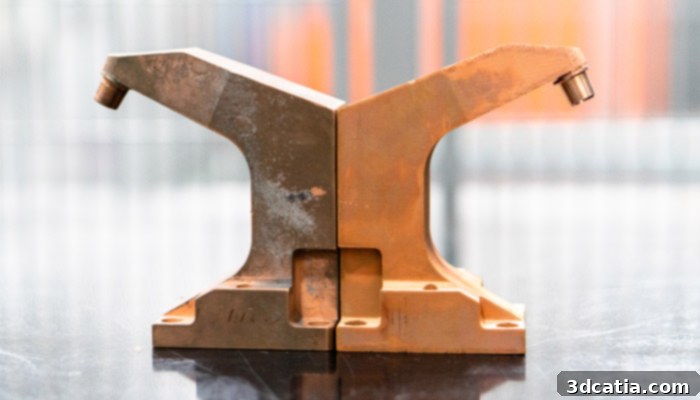
On the left, a machined copper part; on the right, the same but 3D printed | Credits: Markforged
The electronics industry is another major beneficiary. Components like heat sinks, custom electrical connectors, busbars, and specialized circuit elements demand high conductivity and often complex geometries. Additive manufacturing with pure copper allows for the creation of intricate internal structures in heat sinks, maximizing surface area for heat dissipation, or highly optimized electrical paths that were previously impossible or prohibitively expensive to produce via traditional machining. This enables smaller, more powerful, and more efficient electronic devices, driving innovation in consumer electronics, telecommunications, and industrial control systems.
Beyond Savings: Inventory Reduction and Agile Manufacturing
The benefits of additive manufacturing with Markforged’s Metal X extend beyond just reduced production times and lower costs. It introduces an agile manufacturing paradigm that fundamentally alters supply chain dynamics. By enabling manufacturers to design and produce parts on demand, it significantly reduces the need for large inventories. This “just-in-time” manufacturing capability is invaluable, particularly in industries like automotive, where thousands of unique components are required for each vehicle. The ability to print a part when and where it’s needed minimizes warehousing costs, reduces waste from obsolescence, and improves overall operational efficiency.
The automotive partner further elaborated on these benefits: “Now that we have successfully evaluated the weld tests, we plan to expand our 3D printing capability on this and other metal components. 3D printing of copper with Markforged is faster and more cost effective than purchasing complex machined components, and we hope it will help us mitigate exposure to downtime and reduce inventory costs by $200,000 per year by using a single Metal X.” This powerful testimony highlights the tangible financial impact and the strategic advantage that Markforged’s solution offers. Mitigating exposure to downtime, a critical factor in high-volume manufacturing, further underscores the reliability and efficiency delivered by this additive approach.
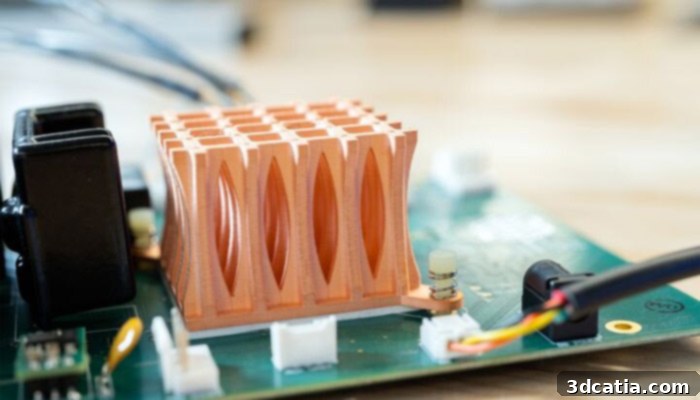
A 3D printed heat sink | Credits: Markforged
The Future is Bright for Copper Additive Manufacturing
The introduction of pure copper 3D printing on Markforged’s Metal X is more than just a new material offering; it’s a significant leap forward for industrial additive manufacturing. It addresses a long-standing challenge in the industry, making a critical material accessible for complex, high-performance applications that demand the absolute best in electrical and thermal conductivity. As industries continue to push for greater efficiency, miniaturization, and customization, the ability to rapidly produce pure copper parts will fuel innovation in areas from electric vehicles and advanced electronics to aerospace and custom industrial tooling.
This development empowers engineers and designers to rethink component design, no longer constrained by the limitations of traditional manufacturing methods or the compromises of alloy materials. The economic benefits, combined with the unparalleled design freedom, position Markforged at the forefront of this material revolution. Companies can now leverage the full potential of additive manufacturing to create more efficient, lighter, and more cost-effective products, ultimately driving technological progress across a multitude of sectors. To learn more about this exciting new copper material and its capabilities, visit the official Markforged website.
What are your thoughts on Markforged’s groundbreaking pure copper offering for the Metal X? How do you envision this impacting your industry or potential applications? Share your insights in a comment below or join the conversation on our Facebook and Twitter pages! Don’t miss out on the latest advancements in additive manufacturing; sign up for our free weekly Newsletter to get all the news delivered straight to your inbox!