
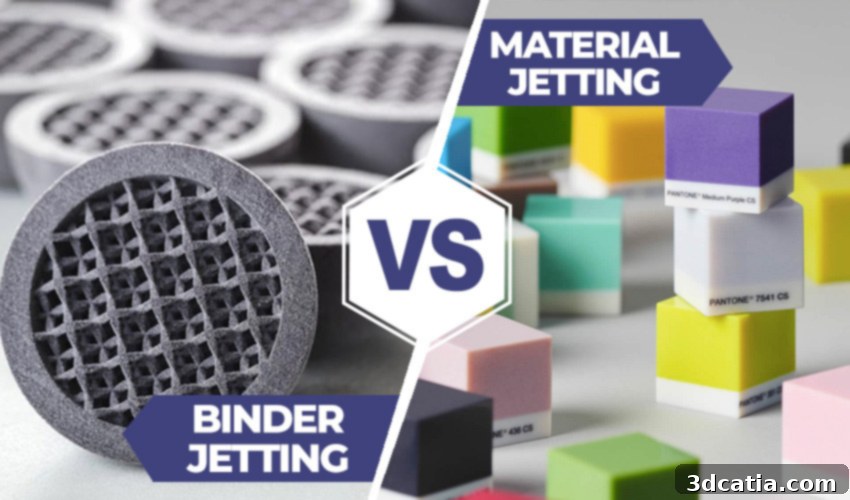
Material Jetting vs. Binder Jetting: A Comprehensive Comparison of 3D Printing Technologies
Additive manufacturing, commonly known as 3D printing, encompasses a vast array of processes, each with unique methodologies, material compatibilities, and application strengths. While many of these technologies share fundamental principles, such as building objects layer by layer, discerning the nuances between them is crucial for selecting the optimal process for a given task. Material Jetting (MJ) and Binder Jetting (BJ) are two such distinct additive manufacturing techniques that, despite some surface-level similarities, operate on fundamentally different principles and excel in different areas. Both involve jetting a material onto a build plate or powder bed, yet their approaches to material deposition and solidification set them apart significantly. In Material Jetting, liquid photopolymer droplets are precisely deposited and subsequently cured by ultraviolet (UV) light, creating highly detailed, solid layers. Conversely, Binder Jetting involves jetting a liquid binding agent onto a thin layer of powder material, selectively bonding the particles together. This article aims to provide an in-depth comparison of these two prominent 3D printing technologies, exploring their operational mechanisms, historical development, unique characteristics, compatible materials, typical applications, leading manufacturers, and associated costs, to help identify which technique is best suited for specific industrial and commercial needs.
To truly appreciate the advancements and differences between Material Jetting and Binder Jetting, it’s essential to understand their origins and evolution within the additive manufacturing landscape. Material Jetting’s roots trace back to 1999 when it was patented by Objet Ltd. Over time, as the technology matured and its capabilities became more recognized, Objet Ltd. was acquired by Stratasys in 2012. This acquisition led to the popularization of the term PolyJet, which is Stratasys’s proprietary Material Jetting technology, becoming one of the most recognized brands in the sector. This history highlights the continuous innovation and consolidation within the 3D printing industry. Binder Jetting, on the other hand, began its journey earlier, with initial development work initiated by the Massachusetts Institute of Technology (MIT) in 1993. This foundational research was quickly commercialized by Z Corporation, a key player in early 3D printing, which was later acquired by 3D Systems in 2012. For metal applications specifically, ExOne made significant strides, inventing and launching the first Metal Binder Jetting machine in 1996, further diversifying the applications of this powder-based technique. These distinct timelines and corporate trajectories underscore the unique paths each technology took to reach its current state of sophistication and market presence.
Core Processes: How Material Jetting and Binder Jetting Work
Understanding the underlying mechanisms of Material Jetting and Binder Jetting is key to grasping their capabilities and limitations. While both involve a “jetting” action, the nature of the jetted material and the solidification process are fundamentally different.
How Material Jetting Works: Precision Droplet Deposition
Material Jetting operates on a principle highly analogous to traditional 2D inkjet printing, but in three dimensions. Instead of ink on paper, it precisely deposits microscopic droplets of a liquid photopolymer (photosensitive resin) onto a build platform. The process typically begins with a CAD model of the part being sliced into hundreds or thousands of thin digital layers. The Material Jetting machine then utilizes multiple printheads, similar to those found in conventional inkjet printers, to jet tiny droplets of resin. These printheads often employ piezoelectric technology, where electrical pulses deform ceramic elements, expelling precise volumes of resin through minuscule nozzles. Once a layer of these resin droplets is deposited on the build plate, an integrated UV light source immediately passes over the layer, curing and solidifying the photopolymer. This rapid curing prevents the liquid resin from flowing and ensures precise layer adhesion. After one layer is complete and hardened, the build platform lowers by a minuscule increment, typically ranging from 16 to 32 microns, and the process repeats until the entire object is formed. The ability to use multiple printheads simultaneously is a hallmark of Material Jetting, allowing for the deposition of different materials or colors in a single pass, significantly enhancing both speed and functional versatility.
A significant aspect of Material Jetting, much like stereolithography (SLA) or digital light processing (DLP), is the requirement for support structures. These supports are crucial for intricate geometries, overhangs, and bridging features to prevent deformation during printing. Fortunately, Material Jetting often uses a soluble support material, jetted from a separate printhead, which can be easily dissolved and removed after printing, minimizing manual post-processing effort and preventing damage to delicate features. Beyond standard Material Jetting, variations like NanoParticle Jetting, patented by Xjet, introduce a novel approach. Here, nanoparticles of metal or ceramic powder are suspended in a liquid and jetted. Upon deposition, heat causes the liquid to evaporate, leaving behind dense metal or ceramic parts. Another variation, Drop-On-Demand (DOD) printing, also uses multiple printheads, one for the build material and another for supports. The key distinction of DOD is its ability to deposit highly viscous materials and its non-linear deposition strategy, only placing material where it’s needed, making it suitable for applications like creating high-precision wax patterns for investment casting.
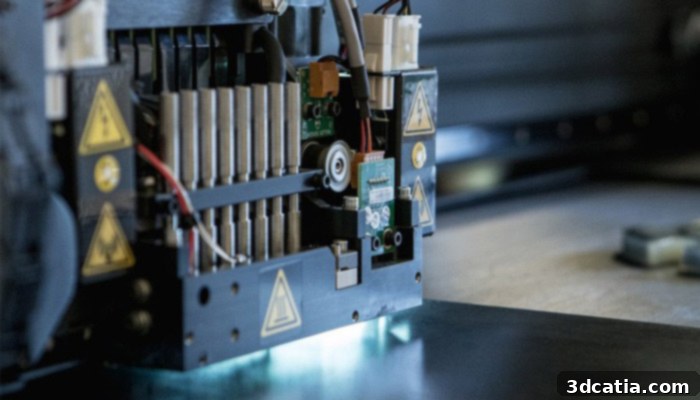
Material jetting multiple print heads (Photo Credit: Stratasys)
How Binder Jetting Works: Powder Bed Fusion with a Binder
Binder Jetting fundamentally differs from Material Jetting by operating within a powder bed. The process begins with a thin layer of powdered material – which can range from metals and ceramics to sand or even polymers – being spread across the build platform by a roller or blade. Following this, printheads precisely jet a liquid binding agent onto specific areas of the powder layer, according to the cross-sectional data of the 3D model. This binder acts as an adhesive, chemically bonding the powder particles together to form a solid cross-section of the part. Crucially, the unbonded powder surrounding the printed areas remains loose and acts as a natural support for subsequent layers. This self-supporting nature is a significant advantage, eliminating the need for artificially generated support structures and enabling the printing of complex internal geometries and nesting multiple parts within a single build volume, maximizing efficiency. Once a layer is printed, the build platform lowers, a fresh layer of powder is spread, and the process repeats until the entire part is formed.
After the printing phase is complete, the “green part” (an unsintered, fragile object) is embedded in a bed of loose powder. This unbound powder must be carefully removed through various post-processing steps, such as vacuuming, brushing, or air blasting. For many materials, especially metals, additional post-processing is mandatory to achieve desired mechanical properties. Metal binder-jetted parts, for instance, typically undergo debinding (to remove the binder) and then sintering or infiltration processes in a furnace. Sintering involves heating the part to a temperature below its melting point, causing powder particles to fuse and densify. Infiltration involves filling the pores of the part with a secondary, lower-melting-point material (e.g., bronze into steel) to improve strength and reduce porosity. These steps introduce considerations such as part shrinkage and potential deformations that must be accounted for during design. Color can also be integrated into Binder Jetting, as specialized color binders can be jetted onto the powder, resulting in full-color finished parts, particularly useful for visual models. It’s also worth noting that while often compared, HP’s Multi Jet Fusion (MJF) technology, which uses a fusing agent, detailing agent, and an infrared lamp to fuse powder, is a distinct process and not a direct subset of Binder Jetting, though it shares the powder bed principle.
Key Characteristics and Performance Comparison
The distinct operational mechanisms of Material Jetting and Binder Jetting lead to vastly different characteristics in terms of part quality, material properties, and suitability for various applications. Understanding these nuances is paramount for informed decision-making.
Material Jetting Characteristics: Precision, Aesthetics, and Visual Fidelity
Material Jetting is celebrated for its exceptional precision, ultra-fine detail resolution, and superior surface finish, making it a frontrunner for applications where aesthetic quality is paramount. The ability to jet multiple photopolymers simultaneously allows for the creation of multi-color, multi-material, and even transparent parts within a single print. This versatility enables the production of highly realistic prototypes, functional assemblies with varying durometers, and complex anatomical models that accurately mimic human tissues. The resulting surface finish is typically very smooth, often eliminating the need for extensive post-finishing processes, and can be varied between matte and glossy effects. Furthermore, the use of multiple printheads contributes to a relatively high printing speed, particularly for complex geometries that might otherwise be time-consuming with other resin-based technologies. This makes MJ an efficient choice for rapid prototyping and iterative design cycles where visual and tactile accuracy are crucial.
However, Material Jetting does come with certain limitations. Like stereolithography, it inherently requires the use of support structures, which must be removed post-printing. While soluble supports simplify this step, it still adds a processing stage. The photopolymer resins used are photosensitive, meaning printed parts can degrade or yellow over time if exposed to prolonged UV light. A more significant drawback for many engineering applications is the mechanical properties of MJ parts. Generally, parts produced by Material Jetting are quite brittle and do not exhibit high strength, impact resistance, or thermal stability. This limits their use primarily to visual and aesthetic prototyping, concept models, and non-functional parts rather than end-use components subjected to significant mechanical stress. Lastly, the build volumes of Material Jetting machines are typically modest, often not suited for creating very large parts, though advancements are continually pushing these boundaries.
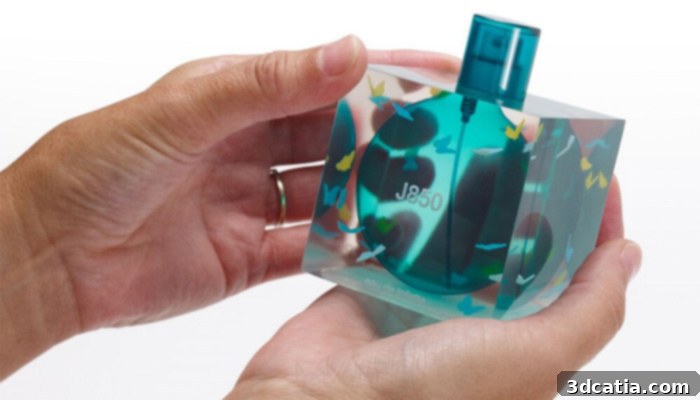
Material Jetting offers transparency and multiple details (Photo Credit: Stratasys)
Binder Jetting Characteristics: Material Versatility, Scalability, and Cost-Efficiency
Binder Jetting offers a distinct set of advantages, primarily centered around its material versatility and scalability. One of its most compelling features is the elimination of dedicated support structures, as the un-bonded powder bed inherently supports the part during printing. This allows for the efficient use of the entire build volume, enabling the nesting of multiple parts and the creation of larger components, particularly with materials like sand and ceramics. The process occurs at room temperature, which significantly reduces internal stresses and thermal distortion, resulting in parts with excellent dimensional accuracy and minimal warping—a common challenge in other high-temperature 3D printing methods. While multi-color printing is possible with specialized binders, it is not as central a feature or as visually vibrant as in Material Jetting.
However, the mechanical properties of binder-jetted parts are highly dependent on the chosen material and subsequent post-processing. While the “green parts” are fragile, post-processing steps like sintering or infiltration can yield functional components with medium mechanical properties and often significant porosity. This porosity can be a drawback for applications requiring high density or hermetic sealing, though it can also be an advantage for lightweight structures or specific filtration applications. Post-processing, especially for metal parts, is a complex and critical phase, involving debinding and high-temperature sintering, which introduces considerations like part shrinkage (up to 20% or more) and potential deformations, requiring careful design compensation. For metal binder jetting (MBJ), the process is generally more cost-effective than laser-based metal additive manufacturing (like DMLS or SLM) due to lower capital equipment costs and faster build times, making it attractive for higher-volume production of certain metal parts. MBJ also often produces parts with better surface roughness compared to laser powder bed fusion, reducing the need for extensive surface finishing.
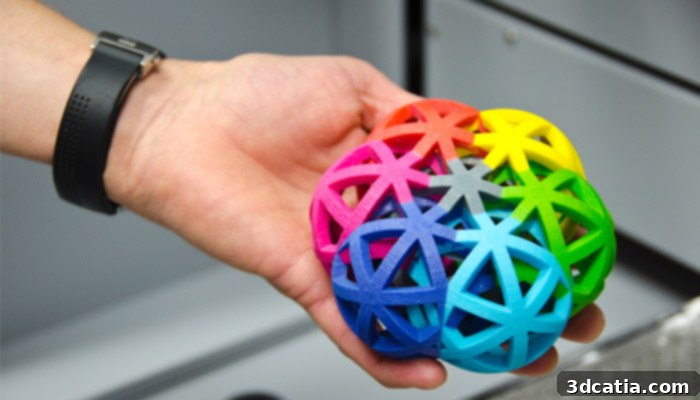
Binder jetting can also produce colored parts though in a different manner to material jetting (Photo Credit: Joseph Forslund/Lund University)
While MBJ offers advantages in cost and part size flexibility, it’s important to recognize that the final mechanical properties, particularly tensile strength and ductility, may not always match those achieved by fully dense, laser-sintered metals or traditional manufacturing methods. The need for debinding and sintering also leaves behind tiny voids where the binder once was, which can be filled through infiltration, but this results in a composite material rather than a monolithic one. Consequently, MBJ is not always suitable for end-use parts requiring the highest mechanical performance but excels in producing intricate metal components, prototypes, or parts where cost and design freedom are prioritized over ultimate strength.
Material Landscape: Photopolymers vs. Powders
The choice of materials is a fundamental differentiator between Material Jetting and Binder Jetting, directly influencing their applications and the properties of the final printed objects.
Materials for Material Jetting: The World of Photopolymers
Material Jetting technologies are exclusively compatible with photopolymers, which are liquid resins that cure and harden when exposed to specific wavelengths of UV light. The range of photopolymers available has expanded significantly, offering diverse mechanical and aesthetic properties. Common options include rigid opaque resins that mimic engineering plastics like ABS and PLA, providing excellent detail and smooth finishes for conceptual models and functional prototypes. Flexible resins are also widely used to create rubber-like parts with varying durometers, ideal for gaskets, seals, or ergonomic prototypes. Transparent resins allow for the production of clear components, useful for light pipes, lenses, or fluid flow analysis models. Furthermore, advanced resins include biocompatible materials for medical applications, high-temperature resistant resins for functional testing, and even composite-like materials that combine properties. The ability to jet different photopolymers in a single build, known as multi-material printing, allows for the creation of parts with varying colors, textures, and Shore hardness values, significantly enhancing the functionality and realism of prototypes.
Materials for Binder Jetting: Metals, Ceramics, Sands, and Beyond
Binder Jetting stands out for its remarkable versatility in material compatibility, primarily utilizing powdered forms of various substances. The most prominent materials include a wide array of metals and ceramics, as well as sand, and increasingly, conventional polymers. For metals, common options include stainless steels (e.g., 316L, 17-4PH), tool steels, copper, bronze, and nickel alloys. Titanium alloys are also gaining traction. These metals, once printed and sintered, produce functional parts suitable for various industrial applications where strength and durability are required. Ceramics, such as alumina and zirconia, are also frequently used, leading to parts with high hardness, thermal resistance, and chemical inertness. The ability to print with sand is particularly impactful for the foundry industry, where it’s used to produce highly complex sand molds and cores for metal casting, offering significant advantages in speed and design freedom over traditional methods. In recent years, Binder Jetting has also extended its compatibility to conventional polymers like ABS or PLA, offering an alternative for rapid prototyping with these familiar materials. Uniquely, Binder Jetting has even found niche applications with unconventional materials, such as sugar. For example, The Sugar Lab demonstrates how this technology can be adapted to create intricate edible structures, showcasing its adaptability beyond traditional engineering materials.
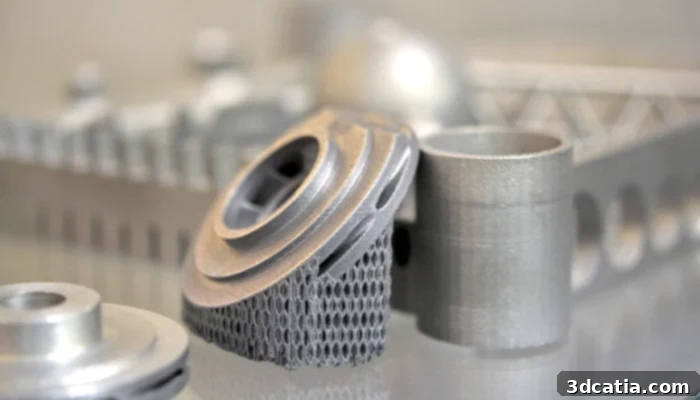
A 3D printed part from metal with the Binder Jetting process (Photo Credit: Kreos)
Applications: Where Each Technology Shines
The distinct characteristics and material compatibilities of Material Jetting and Binder Jetting naturally lead them to excel in different application areas, catering to specific industry needs.
Material Jetting Applications: Precision Prototypes and Visual Models
Thanks to its unparalleled ability to create parts with exceptional detail, smooth surfaces, and multiple colors, Material Jetting has found a strong foothold in sectors demanding high visual fidelity and aesthetic realism. The medical sector is a prime example, where MJ is extensively used to create highly accurate anatomical models. These models are invaluable tools for surgeons, allowing them to practice complex procedures in a risk-free environment during the preoperative phase, thereby improving patient outcomes. They also serve as effective educational aids, enabling doctors to explain medical conditions to patients using tangible, personalized physical models. Beyond medicine, Material Jetting’s main interest lies in the manufacturing of high-fidelity prototypes and concept models across various industries. Its capacity for quickly producing precise, visually accurate parts makes it ideal for design verification, form and fit testing, and creating realistic product mock-ups before committing to mass production. Industries like consumer electronics, automotive design, and even entertainment leverage MJ for rapid iteration and visualization of complex designs.
Binder Jetting Applications: Functional Parts, Tooling, and Foundry
Binder Jetting’s versatility with various powders positions it for a broad spectrum of industrial applications, particularly those requiring functional components or specialized tooling. The foundry industry is one of its most significant beneficiaries. Binder Jetting excels at manufacturing complex sand molds and cores directly from CAD data, eliminating the need for traditional pattern making. This drastically reduces lead times and costs for producing intricate metal castings, making it particularly appreciated for short production runs or custom, one-off parts. Beyond foundry, Binder Jetting is increasingly used to produce functional metal parts for aerospace, automotive, and industrial machinery sectors. For instance, the partnership between the US Army and ExOne exemplifies its strategic importance, with ExOne developing mobile 3D printing plants to allow troops to rapidly replace defective parts in the field, showcasing its utility for on-demand manufacturing in demanding environments. The film industry also utilizes Binder Jetting to create various props and accessories with intricate details and textures. While less common, its ability to work with fine powders also extends to the jewelry sector for creating molds or direct metal components, offering designers new levels of geometric freedom.
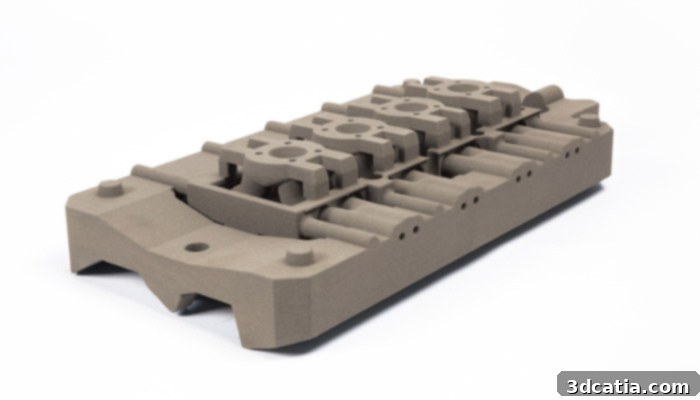
3D-printed foundry molds. (Photo Credits: Voxeljet)
Leading Manufacturers and Market Landscape
Both Material Jetting and Binder Jetting technologies have established ecosystems of manufacturers, each contributing to the innovation and accessibility of these advanced 3D printing solutions.
Material Jetting Manufacturers: Pioneers and Innovators
As previously mentioned, Objet Ltd. pioneered the Material Jetting process in 1999. Following its acquisition by Stratasys in 2012, Stratasys became a dominant force, developing and marketing its proprietary Material Jetting technology under the brand name PolyJet. Stratasys offers a wide range of PolyJet systems, from desktop models to large industrial machines, known for their multi-material and multi-color capabilities. While Stratasys is often considered the market leader, other notable companies have also made significant contributions. Japanese manufacturer Mimaki, renowned for its 2D inkjet printers, has successfully transitioned its expertise into 3D printing with machines like the 3DUJ-553, which utilize a similar process to create full-color 3D models. Israeli company XJet has innovated with its NanoParticle Jetting (NPJ) technology, a variation of Material Jetting that jets liquid droplets loaded with metal or ceramic nanoparticles, enabling the production of dense, high-performance parts. Additionally, 3D Systems, another additive manufacturing giant, offers its own Material Jetting process, known as MultiJet Printing (MJP), further diversifying the options available in the market.
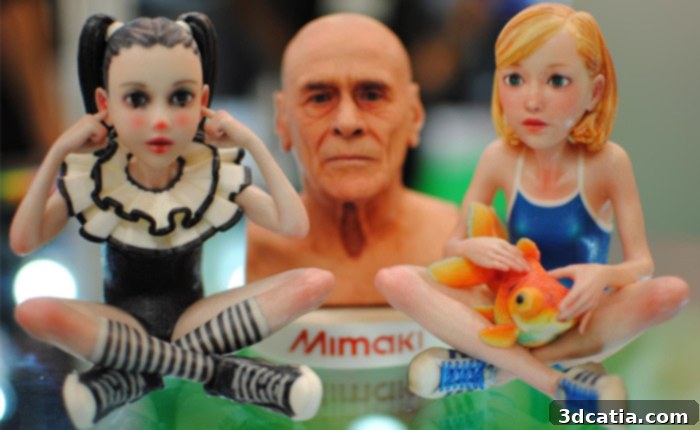
The manufacturer Mimaki has developed a range of Material Jetting machines.
Binder Jetting Manufacturers: Industrial Solutions and Specialization
Emerging from MIT’s research in 1993 and later commercialized by Z Corporation, the Binder Jetting landscape is also populated by several key players who have specialized in different aspects of the technology. 3D Systems, after acquiring Z Corporation in 2012, continues to be a major force in Binder Jetting, particularly with its ColorJet Printing (CJP) technology, which focuses on producing full-color models using ceramic-based powders. Pennsylvania and Germany-based ExOne is a global leader in industrial Binder Jetting, with a strong focus on printing with metal and sand. ExOne’s machines are widely used for producing complex metal parts and large-scale sand molds for the foundry industry. Across the Atlantic, Digital Metal, a subsidiary of Höganäs, has specialized exclusively in high-precision metal binder jetting, known for its ability to produce intricate components with excellent surface finishes. German company Voxeljet is another prominent manufacturer, primarily leveraging Binder Jetting for industrial applications involving plastics (e.g., PMMA for investment casting patterns) and ceramics, offering some of the largest build volumes in the industry. These manufacturers collectively drive the innovation and adoption of Binder Jetting across diverse industrial sectors.
Cost Considerations: Investment and Operational Expenses
The financial investment for both Material Jetting and Binder Jetting 3D printers is substantial, typically placing them in the realm of industrial-grade equipment rather than consumer or prosumer tools. The initial purchase price for these advanced machines can range from tens of thousands to several hundred thousand dollars, depending on factors such as build volume, speed, multi-material capabilities, and manufacturer. It is common practice for manufacturers to provide quotes upon request, as configurations, service contracts, and specific features can significantly impact the final price. For illustrative purposes, an entry-level professional Material Jetting system like Stratasys’s J5 MediJet might start around $60,000, while a more advanced system such as 3D Systems’ ProJet MJP 5600, offering larger build volumes and multi-material printing, could exceed $100,000. These price differences often reflect not only print volume but also throughput capabilities, material handling systems, and included software packages.
Beyond the initial capital expenditure, the total cost of ownership for Material Jetting and Binder Jetting technologies includes significant operational expenses. Material costs are a primary factor. Photopolymer resins for Material Jetting can be quite expensive, especially specialized or multi-material options. Similarly, fine metal powders and binders for Binder Jetting represent a substantial ongoing cost. The type of material chosen heavily influences this; for example, printing functional parts from specialized metal alloys will inherently be more expensive than using conventional polymers or sand. Additionally, post-processing equipment (e.g., UV curing units for MJ, debinding and sintering furnaces for MBJ, powder removal stations for BJ) and their associated energy consumption, maintenance, and skilled labor requirements contribute to the overall operational budget. Businesses considering these technologies must conduct a thorough cost-benefit analysis, factoring in production volume, part complexity, desired mechanical properties, and the value added by these advanced manufacturing capabilities to justify the significant investment.
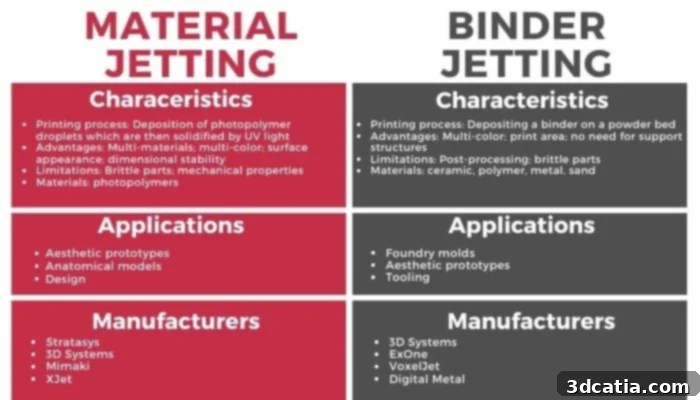
In summary, both Material Jetting and Binder Jetting offer compelling advantages in the additive manufacturing landscape, but they cater to distinct needs. Material Jetting excels in producing highly detailed, multi-color, multi-material prototypes and visual models with superior surface finishes, albeit with mechanical limitations. Binder Jetting, conversely, shines with its material versatility, scalability, and cost-effectiveness for producing functional metal and ceramic parts, especially for tooling and end-use components requiring post-processing. The choice between these two powerful technologies ultimately depends on the specific application requirements, desired material properties, production volume, and budget considerations.
Do you use Material Jetting or Binder Jetting in your operations? We’d love to hear about your experiences and insights. Share your thoughts in a comment below or join the conversation on our Facebook and Twitter pages. Don’t forget to sign up for our free weekly newsletter, with all the latest news in 3D printing delivered straight to your inbox!