

Revolutionizing 3D Printing: Enhancing Part Strength Through Magneto-Assisted Fiber Alignment
A groundbreaking study from the Institute for High Performance Materials at Florida State University, in collaboration with the FAMU-FSU College of Engineering, has unveiled a transformative technique for additive manufacturing. Researchers have discovered that by employing precisely controlled magnetic fields in the immediate vicinity of a 3D printer, they can fundamentally alter and optimize the alignment of reinforcing fibers within the printed part. This pivotal discovery paves the way for the production of significantly stronger, more durable, and higher-performance components. For instance, the strategic integration of carbon fibers into a conventional polymer matrix typically enhances the final part’s strength; however, this new methodology promises to unlock unprecedented levels of mechanical integrity. The implications of this research are particularly profound and exciting for various demanding engineering applications, from aerospace to automotive and medical sectors, where material performance is paramount.
The concept of composite 3D printing has garnered considerable attention in the additive manufacturing landscape for its ability to create parts from fiber-reinforced materials. These composites frequently incorporate carbon fibers, but also commonly utilize glass or aramid fibers, chosen for their superior strength-to-weight ratios and stiffness. In this process, fibers of varying lengths are meticulously added to the material’s matrix—often a polymer like PLA—with the explicit aim of achieving enhanced mechanical properties that far surpass those of unreinforced plastics. However, the true potential of composite 3D printing has often been limited by the random or sub-optimal orientation of these fibers during the extrusion process. Madhuparna Roy, a recent engineering PhD graduate, and Tarik Dickens, an associate professor of industrial and manufacturing engineering, delved into this critical challenge. Their extensive research led to the remarkable discovery that an applied magnetic field could precisely control and optimize the placement of these reinforcing fibers within the polymer matrix, thereby dramatically improving the final structural integrity and overall strength of the printed component.
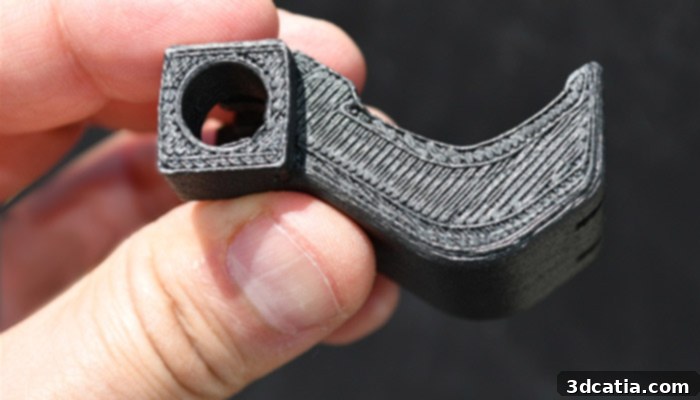
Carbon fiber, renowned for its exceptional strength and lightweight properties, is the most widely utilized reinforcing fiber in advanced 3D printing applications, significantly enhancing material performance.
Unlocking Enhanced Performance with Magneto-Assisted 3D Printing
The innovative technique developed by the research team has been aptly named “magneto-assisted printing.” This sophisticated process involves the strategic application of a targeted magnetic field positioned directly adjacent to the 3D printer’s nozzle. This magnetic field provides a powerful, external influence that enables researchers to precisely manipulate and orient the reinforcing fibers within the composite material. Crucially, this method allows for the creation of parts where the fibers are oriented perpendicular to the direction of the nozzle’s flow—a significant departure from traditional 3D printing, where extruded fibers typically align parallel to the extrusion path due to shear forces within the print head. This ability to control fiber alignment offers an unparalleled degree of design flexibility and material optimization. Madhuparna Roy emphasizes the importance of this advancement, stating, “Traditional 3D printed materials, particularly those produced via fused deposition modeling (FDM), inherently possess anisotropic properties and are not entirely solid due to the layered deposition of plastic. The fundamental gap in current research has been how to consistently and significantly improve these mechanical properties. By enhancing mechanical properties through controlled fiber alignment, we unlock the potential to create robust solutions for an extensive array of applications, precisely tailored to their specific performance requirements.” This controlled orientation is vital because the mechanical strength of composite materials is heavily dependent on the direction in which their reinforcing fibers are aligned relative to the applied stress. By orienting fibers strategically, engineers can design parts that are far stronger and more resilient in critical load-bearing directions.
The comprehensive series of tests conducted by the scientists meticulously analyzed several key parameters influencing the efficacy of this magneto-assisted alignment. These crucial factors included print speed, the strength of the applied magnetic field, and even the geometric configuration of the nozzle. The results provided valuable insights into optimizing the process. A significant finding was the direct correlation between the viscosity of the 3D printing material and the required magnetic field strength: highly viscous materials, which inherently resist internal flow and rearrangement, necessitate a stronger magnetic field to effectively reorient the embedded magnetic fibers. Conversely, the extrusion speed was identified as another critical variable. The research demonstrated that a higher extrusion speed generally leads to less accurate and less complete realignment of the fibers. This is because the fibers spend less time under the influence of the magnetic field as they pass through the nozzle, limiting the magnetic forces’ ability to overcome the viscous drag and align the fibers. Therefore, to achieve optimal fiber alignment and, consequently, superior mechanical properties in the final printed part, it is imperative that both the magnetic field strength and the extrusion speed are meticulously controlled and fine-tuned in conjunction with the specific material properties. Understanding this intricate interplay between material characteristics, magnetic field parameters, and printing dynamics is essential for unlocking the full potential of magneto-assisted 3D printing and translating it into practical, high-performance applications.

Madhuparna Roy, who spearheaded this innovative research, highlights the critical role of magnetic fields in precisely controlling and optimizing fiber alignment within 3D printed composite materials.
Looking ahead, Madhuparna Roy articulates the expansive vision for this technology: “There remain numerous avenues for further exploration, particularly concerning the broader spectrum of materials and the types of printers that can be effectively integrated with this technique. For example, our ongoing research is actively investigating the utilization of plastics that contain finely dispersed metal particles. The ultimate goal is to synergistically combine two distinct and major groups of 3D printing materials—polymers and magnetically responsive additives—to engineer novel composite materials. These new materials are envisioned to provide not only enhanced structural performance but also additional functionalities, opening up unprecedented possibilities for the manufacture of virtually any part with tailored properties.” This forward-thinking approach suggests that future iterations of magneto-assisted printing could extend beyond mere mechanical reinforcement, potentially enabling parts with integrated electrical conductivity, thermal management capabilities, or even active sensing elements. The ability to precisely control the internal microstructure of 3D printed objects on such a fundamental level represents a paradigm shift in additive manufacturing, moving beyond simple geometric freedom to profound material customization and property enhancement. This opens up opportunities for designing ‘smart’ materials and components that can adapt or respond to their environment, pushing the boundaries of what 3D printing can achieve in high-tech industries.
It is unequivocally clear that composite materials are rapidly gaining prominence and popularity within the additive manufacturing sector. Their inherent ability to offer superior strength, stiffness, and lighter weight compared to traditional unreinforced plastics is dramatically broadening the field of possibilities for manufacturers across diverse industries. The integration of advanced techniques like magneto-assisted printing takes this potential even further, enabling the creation of parts with previously unattainable levels of performance and reliability. This innovation allows engineers to design components that are not only structurally sound but also optimized for specific load cases, reducing material waste and improving overall product lifespan. As the demand for high-performance, custom-manufactured parts continues to grow, such advancements in composite 3D printing will play a crucial role in shaping the future of industrial production and product development. You can delve deeper into this fascinating research and its implications by finding more information HERE. We invite you to share your thoughts, insights, or questions in the comments section below, or engage with us on our Facebook and Twitter pages. Don’t forget to sign up for our free weekly Newsletter to stay updated on the latest innovations and trends in the world of 3D printing!