
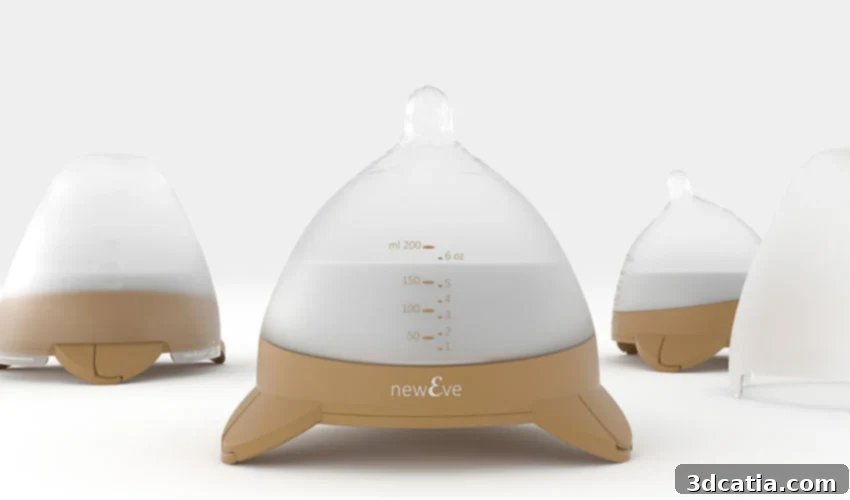
Revolutionizing Infant Feeding: The ‘New Eve’ Anatomical Baby Bottle Powered by 3D Printing and Advanced Scanning
The world of newborn and infant accessories is undergoing a profound transformation, largely driven by the groundbreaking capabilities of 3D printing and sophisticated 3D scanning technologies. This technological revolution is enabling unprecedented levels of personalization and functionality, moving beyond conventional designs to create products that genuinely cater to the unique needs of infants and parents alike. One of the most remarkable innovations emerging from this dynamic industry shift is the ‘New Eve’ milk dispenser, a pioneering design that promises to redefine the infant feeding experience.
Conceived by the visionary designer Beata Nikolajczyk, the ‘New Eve’ is not just another baby bottle; it’s a meticulously crafted, personalized milk dispenser ingeniously shaped to mimic the female breast. This innovative product has garnered significant acclaim, earning numerous awards in various design and technology competitions. Its core purpose is to replicate the natural feeding experience, providing comfort and familiarity in situations where direct breastfeeding may not be feasible or possible. The conceptualization and development of the ‘New Eve’ were rigorously supported by extensive research, backed by the financial resources of the Ministry of Science and Higher Education in Poland, underscoring its foundation in scientific inquiry and practical application.
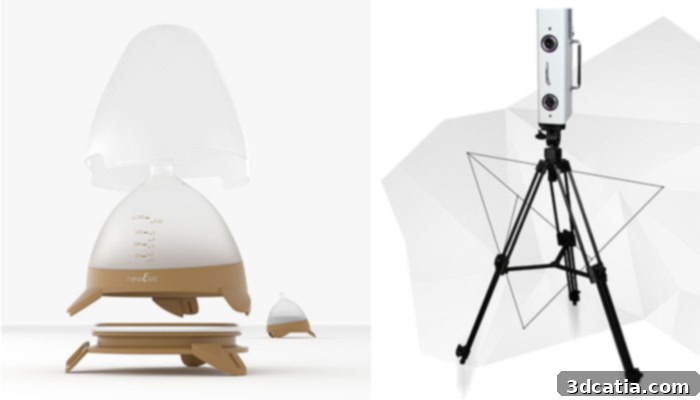
The success of the ‘New Eve’ bottle hinges on the precision of modern 3D scanning technology. To truly replicate the natural breast, which is far from a perfectly smooth or symmetrical object, required advanced tools capable of capturing intricate details. The SMARTTECH scanner, utilized in this project, employs structured light technology—a method renowned for its exceptional accuracy and precision in capturing complex geometries. This cutting-edge scanner boasts an impressive capability, able to capture the surface data of an object measuring 300×200 mm in an astonishing 0.2 seconds. This speed and accuracy were absolutely critical for meticulously reproducing the subtle irregularities and contours inherent to the female breast, ensuring that the anatomical bottle would offer an authentic tactile and functional experience.
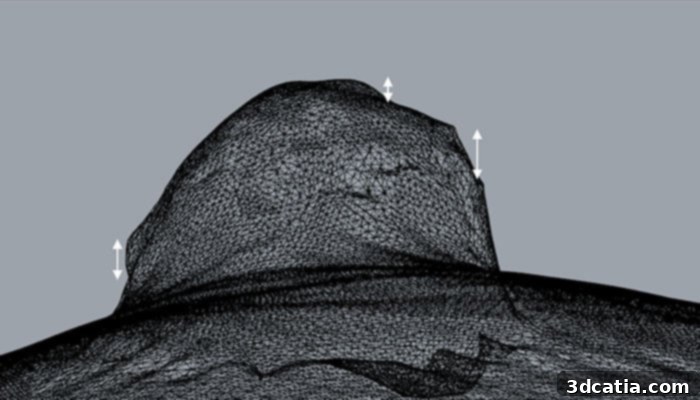
The meticulously reproduced nipple surface on the ‘New Eve’ anatomical baby bottle. | Credits: SMARTTECH
An Anatomical Baby Bottle: The Future of Infant Feeding Solutions?
At its essence, 3D scanning technology captures the physical world and translates it into a detailed digital model. This process begins by obtaining a “cloud of points,” where each point represents a specific coordinate on the surface of the scanned object. From these millions of individual points, a complex triangle mesh is meticulously constructed. This mesh then forms the digital blueprint, accurately reflecting the object’s intricate shape and surface topography through a vast network of tiny triangles. For the ‘New Eve’ project, this sophisticated process allowed for an unprecedented level of detailed analysis. It enabled precise calculations of the examined breast surface, including the minute indentations, subtle inequalities, and unique textures present on the nipple and areola surfaces. Furthermore, the digital model provided an enlarged, highly detailed view of the nipple-areola complex, allowing designers to study and replicate features that are crucial for a natural feeding experience, such as shape, elasticity zones, and overall contour.
The journey to create this innovative anatomical baby bottle was deeply rooted in user-centric design and extensive research. It commenced with a comprehensive questionnaire distributed to mothers who were naturally breastfeeding. This crucial survey was widely shared across social media platforms and made accessible through various charitable institutions, ensuring a broad and representative sample. The study engaged 100 women, whose breast sizes and shapes were carefully analyzed based on the collected data. This involved capturing precise measurements and visual information from two critical perspectives: a front view to assess overall shape and dimensions, and a cross-section view to understand the internal contours and projection of the nipple and areola. This data-driven approach ensured that the ‘New Eve’ bottle’s design was based on real-world anatomical variations, making it genuinely adaptable and realistic.
Beyond merely replicating the anatomical shape, the ‘New Eve’ bottle goes a step further in its commitment to mimic the natural feeding experience. Understanding that temperature plays a vital role in an infant’s acceptance of feeding, the bottle integrates a sophisticated heating element. This innovative feature allows the dispenser to simulate the warmth of a natural breast, creating an even more authentic and comforting sensation for the newborn. The material engineering behind the ‘New Eve’ is equally impressive. Its construction utilizes a material with variable thickness, a design choice critical to its functionality. The section closest to the nipple is deliberately thinner and more flexible, mirroring the natural elasticity and responsiveness of a mother’s breast during feeding. In contrast, the material at the base of the bottle is thicker, serving a dual purpose: providing structural integrity and aiding in the efficient dissipation of heat, preventing any uncomfortable warmth accumulation. These thoughtful design elements, combined with the incredibly accurate natural shape made possible by comprehensive 3D scans of women’s breasts, are precisely what brought this groundbreaking anatomical baby bottle to life in such a realistic and effective manner.
The profound implications of technologies like 3D printing and structured light scanning extend far beyond this single product. They pave the way for a new era of personalized healthcare and consumer products, especially in sensitive areas like infant care. For mothers who may face challenges with direct breastfeeding—whether due to medical conditions, work schedules, or simply the need for flexibility—the ‘New Eve’ bottle offers a compelling solution. It provides an alternative that prioritizes the infant’s comfort and developmental needs by closely replicating the most natural feeding experience possible. This innovation reduces the psychological and physical disconnect that can sometimes arise from using conventional bottles, fostering a sense of security and familiarity for the baby.
Looking ahead, the potential for 3D printing in pediatric products is immense. Imagine custom-fitted baby carriers, ergonomically designed pacifiers tailored to an infant’s specific palate, or even personalized medical devices for newborns, all created with unparalleled precision and comfort. The ‘New Eve’ anatomical baby bottle stands as a testament to what’s achievable when advanced manufacturing technologies are coupled with empathetic, research-driven design. It highlights how digital fabrication can bridge the gap between biological forms and functional products, offering solutions that are not only innovative but also deeply human-centered.
What are your thoughts on this revolutionary anatomical baby bottle and the role of 3D printing in personalized infant care? We invite you to share your insights and comments below, or connect with us on our Facebook and Twitter pages. Stay updated on all the latest developments in additive manufacturing by signing up for our free weekly Newsletter, delivering the most important 3D printing news straight to your inbox!