
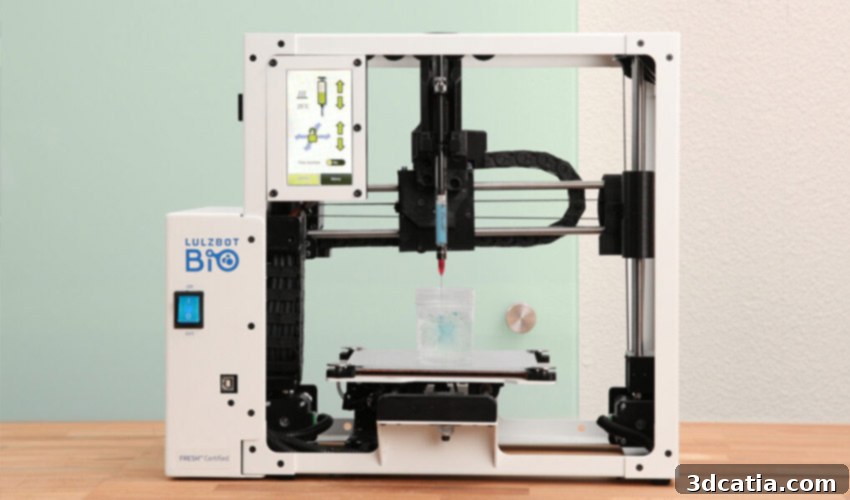
Revolutionizing Bioprinting: LulzBot Bio Unveils Open-Source FRESH Technology for Functional Tissue Creation
The world of regenerative medicine and tissue engineering witnessed a significant leap forward with the recent availability of the LulzBot Bio bioprinter for pre-order. This groundbreaking open-source Fluid Deposition Fabrication (FDF) bioprinter is the culmination of a pivotal collaboration announced last June between Aleph Objects, the manufacturer of LulzBot 3D printers, and FluidForm. Their ambitious long-term goal: to develop advanced bioprinting hardware capable of creating real, functional human tissues and organs. FluidForm’s innovative contribution lies in its proprietary technology, known as FRESH (Freeform Reversible Embedding of Suspended Hydrogels). This ingenious method facilitates the precise bioprinting of bioinks and other delicate soft materials, addressing long-standing challenges in the field. The potential of this technology was powerfully demonstrated when, at the beginning of August, researchers from Carnegie Mellon University utilized FluidForm’s FRESH technology to successfully bioprint parts of a human heart, bringing humanity one step closer to the creation of functional 3D printed organs and revolutionizing how we approach complex medical problems.
The LulzBot Bio is not just another 3D printer; it represents a paradigm shift in bioprinting accessibility and capability. Scheduled to begin shipments in November, this innovative bioprinter empowers researchers and innovators to work with an unprecedented range of biomaterials. Its core strength lies in its ability to enable the bioprinting of challenging substances like unmodified collagen, a critical component of the human extracellular matrix, alongside various other bioinks and soft materials. This versatility is crucial for advancing research in tissue engineering, drug discovery, and regenerative medicine. The open-source nature of the LulzBot Bio further democratizes this advanced technology, encouraging collaboration and rapid innovation within the scientific community. By providing an adaptable and accessible platform, Aleph Objects and FluidForm are fostering an environment where breakthroughs can happen faster, and complex biological structures can be explored with greater freedom and precision.
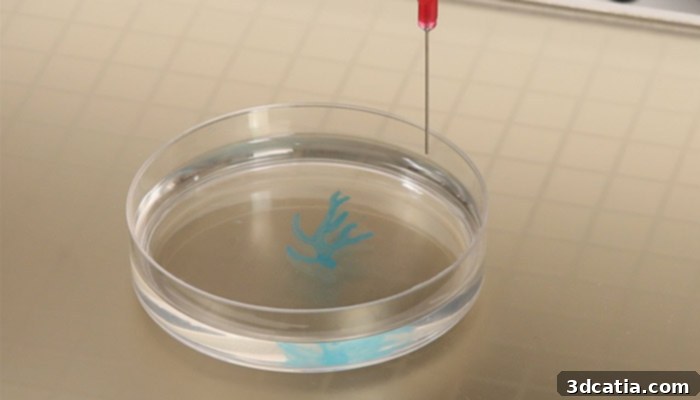
A 3D printed artery structure on the new LulzBot Bio, optimized for FRESH printing | Credits: LulzBot
The success demonstrated by Carnegie Mellon University researchers during the summer underscored the transformative benefits of the FRESH process. Their achievement in bioprinting complex heart valves from unmodified collagen was a significant milestone. The key innovation behind FRESH technology lies in its use of a temporary support gel. This gel acts as a dynamic printing medium, encapsulating the extruded biomaterial as it is deposited. By immediately surrounding and supporting the delicate bioinks, the gel effectively minimizes the risk of deformation and collapse, which are common challenges when printing with extremely soft and fluid materials. This allows for the creation of intricate and high-resolution scaffolding structures right from the initial stages of the printing process. Once the bioprinted part is complete and its structural integrity is established, the support gel can be easily removed by heating, leaving behind the precise, three-dimensional biological construct. This reversible embedding technique ensures that the printed tissues maintain their intended complex geometries and structural integrity, paving the way for more accurate and functional tissue models. The ability to print such complex structures, like the artery shown in the image, is critical for developing vascularized tissues and eventually, whole organs.
Working with unmodified collagen has historically presented a formidable challenge in bioprinting due to its inherent fluid nature and inability to maintain a stable shape without extensive chemical cross-linking or high concentrations, both of which can compromise its biological functionality and biocompatibility. However, unmodified collagen is highly desirable as a biomaterial because it is the most abundant protein in the human body’s extracellular matrix (ECM), providing structural support to tissues and playing a vital role in cell adhesion, growth, and differentiation. The FRESH technique brilliantly overcomes these limitations by providing immediate mechanical support to the collagen during the printing process, preserving its native biological properties while enabling the fabrication of complex, high-resolution structures. This breakthrough opens up entirely new avenues for applications in the bioprinting field, allowing researchers to create more physiologically relevant tissue models. While unmodified collagen is a primary focus, the long-term aim of Aleph Objects is to significantly expand the range of compatible soft materials. This includes critical biomaterials such as alginate, a natural polysaccharide often used for hydrogel formation and cell encapsulation; fibrin, a protein crucial for blood clotting and wound healing, which can promote cell adhesion and proliferation; and hyaluronic acid, a glycosaminoglycan found naturally in connective tissues, known for its hydrating properties and role in cell migration and tissue repair. Expanding compatibility to these materials will dramatically increase the scope and utility of the LulzBot Bio, enabling the creation of diverse and complex biological constructs. Grant Flaharty, CEO and President of Aleph Objects, emphasized the critical importance of the LulzBot Bio’s open-source property in a rapidly evolving scientific landscape: “For researchers, you don’t know what materials or processes you’ll be using in six months, let alone one year from now, so you need hardware that can be adjusted quickly and easily, without proprietary restrictions.” This philosophy is central to LulzBot’s mission, fostering an environment of innovation, customization, and collaborative advancement that is vital for pushing the boundaries of bioprinting research. The open-source approach not only allows for material and process flexibility but also invites the global scientific community to contribute to the printer’s development, sharing improvements and expanding its capabilities beyond what a single company could achieve.
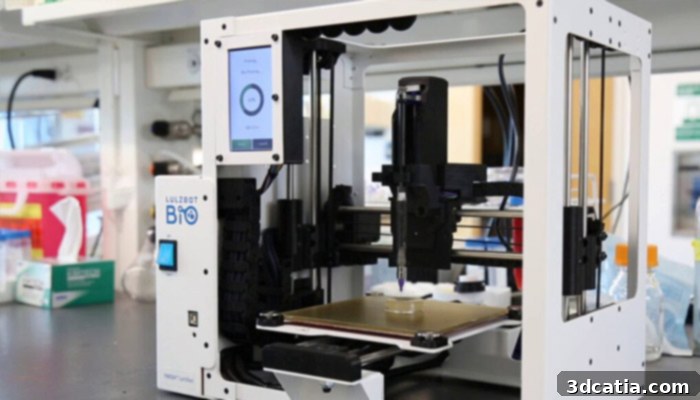
The Lulzbot Bio
The LulzBot Bio is designed to meet the diverse and exacting needs of numerous high-stakes sectors, including biotechnology, pharmaceuticals, cosmetics, medical devices, and the broader life sciences. Its versatility and precision make it an indispensable tool for a wide array of applications. In biotechnology, it can accelerate the development of complex cellular models and scaffolds for tissue engineering. For pharmaceutical companies, the LulzBot Bio offers a powerful platform for preclinical testing, enabling the creation of human-relevant tissue constructs for more accurate drug screening, toxicity testing, and disease modeling. This could significantly reduce reliance on animal testing and accelerate the drug discovery process. The cosmetics industry can leverage it for ethical product testing on bioprinted skin models, ensuring safety and efficacy without animal involvement. In the medical devices sector, researchers can prototype and test novel biocompatible implants and tissue patches. Within life sciences research, it opens new frontiers for studying cellular interactions, developmental biology, and disease progression in a controlled 3D environment, leading to deeper insights into human health and pathology. Beyond these immediate applications, the long-term vision for the LulzBot Bio is even more profound: to facilitate the ultimate creation of personalized, patient-specific tissues and even entire functional organs for transplantation, thereby addressing the critical global shortage of donor organs. This commitment to open-source innovation, combined with its advanced capabilities, positions the LulzBot Bio as a pivotal technology in driving the future of regenerative medicine and improving human health globally.
The introduction of the LulzBot Bio, with its cutting-edge FRESH technology and open-source foundation, marks a transformative moment for bioprinting and regenerative medicine. This collaboration between Aleph Objects and FluidForm promises to democratize access to advanced bioprinting capabilities, enabling researchers worldwide to push the boundaries of what’s possible in creating functional human tissues. From drug discovery and disease modeling to the eventual promise of organ transplantation, the LulzBot Bio is set to accelerate breakthroughs and revolutionize patient care. Its flexibility, precision, and commitment to open science will undoubtedly foster an unprecedented era of innovation in biomedical research.
What are your thoughts on this revolutionary open-source bioprinting hardware and its potential impact on medical science? We invite you to share your insights and comments below, or join the conversation on our Facebook and Twitter pages! Don’t miss out on the latest advancements and news in the dynamic world of 3D printing; make sure to sign up for our free weekly Newsletter, delivered straight to your inbox.