
Revolutionizing Industries: A Deep Dive into Cutting-Edge 3D Printing Innovations Across Healthcare, Construction, and Aerospace
The landscape of manufacturing and innovation is continuously reshaped by advancements in 3D printing, also known as additive manufacturing. This transformative technology, once confined to rapid prototyping, has evolved into a powerhouse capable of producing end-use parts, intricate medical implants, sustainable building components, and high-performance aerospace tools. Its ability to create complex geometries, enable mass customization, and significantly reduce material waste makes it an indispensable tool for forward-thinking companies worldwide. From enhancing patient care with personalized medical solutions to building more sustainable futures and propelling the aerospace industry to new heights, 3D printing is at the forefront of innovation. This week, we explore five compelling video showcases that highlight how companies are leveraging these cutting-edge capabilities to push boundaries across diverse sectors, proving that the potential of additive manufacturing is truly limitless.
Join us as we journey through groundbreaking innovations, starting with life-changing medical implants, moving to eco-conscious construction methods, revolutionizing dental lab workflows, and culminating in advanced applications for the demanding aerospace sector. Each story underscores the power of 3D printing to deliver solutions that were once considered impossible, paving the way for a more efficient, sustainable, and personalized future.
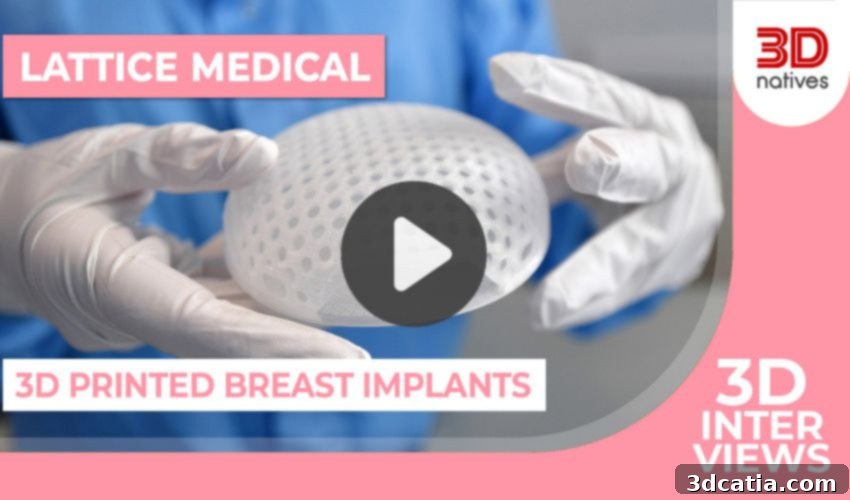
1. Pioneering Soft Tissue Regeneration: Lattice Medical’s 3D Printed Implants
In a significant leap for medical science and patient well-being, French company Lattice Medical is leveraging the precision of 3D printing to create innovative implants designed for soft tissue regeneration. During Breast Cancer Awareness Month, the 3Dnatives team had the exclusive opportunity to visit Lattice Medical’s headquarters. Our visit provided an in-depth look into their pioneering work and allowed us to interview Julien Payen, CEO and co-founder, to understand the intricate workings and profound mission behind their products. At the heart of their innovation is MATTISSE, a revolutionary breast bioprosthesis. This remarkable product is not merely an implant but a sophisticated blend of advanced biomaterials, cutting-edge tissue engineering principles, and precise 3D printing technology. MATTISSE is engineered to guide the body’s natural regenerative processes, encouraging the growth of new, healthy tissue to reconstruct the breast. This approach offers a more natural and integrated solution for patients undergoing breast reconstruction, moving beyond traditional silicone implants towards personalized, biologically harmonious alternatives. The implications for patient recovery and quality of life are immense, offering hope and dignity to those who have undergone mastectomy. Lattice Medical’s dedication to innovation in biomimetic solutions exemplifies the profound impact 3D printing can have on human health. Watch our exclusive interview to delve deeper into this life-changing technology and understand how MATTISSE is setting a new standard in regenerative medicine.
2. Aectual: Transforming Waste into Beautiful, Sustainable 3D Printed Construction
The construction industry faces increasing pressure to adopt more sustainable practices, and Dutch company Aectual is leading the charge with its innovative approach to 3D printing interior elements. As an architecture and interior firm, Aectual is not just focused on aesthetics but also on fundamentally rethinking how building components are produced, emphasizing environmental responsibility. Their core innovation lies in employing a truly circular loop for their production processes. This means that virtually all filament waste generated from one 3D printing job is diligently collected, processed, and recycled back into new filament for subsequent projects. This closed-circuit system dramatically reduces landfill waste and minimizes the demand for virgin materials, making their operations remarkably eco-efficient. Aectual’s ability to turn what would traditionally be considered waste into beautiful, functional interior structures showcases the immense potential of 3D printing in fostering a circular economy within the built environment. Beyond sustainability, 3D printing allows Aectual to create highly customized, intricate, and structurally optimized interior elements that would be difficult or impossible to achieve with conventional manufacturing methods. From floors and wall panels to intricate furniture, their designs are not only visually striking but also contribute to a reduced carbon footprint. Learn more about the company’s pioneering work, the challenges it navigates in implementing such an advanced circular system, and its visionary outlook for the future of sustainable architecture and 3D printing in this insightful video.
3. Formlabs and Kreimer Dentallabor: Revolutionizing Dental Workflows with 3D Printing
The dental industry has undergone a significant digital transformation in recent years, with 3D printing emerging as a pivotal technology for enhancing precision, efficiency, and patient outcomes. Kreimer Dentallabor, a prominent full-service dental laboratory specializing in digital workflows, exemplifies this shift. Their journey into additive manufacturing began in 2016 with the investment in their first 3D printer, a decision that has since reshaped their entire operation. Today, the lab’s twelve highly skilled technicians are heavily reliant on 3D printing technology, utilizing it to produce approximately 300 dental units per month. This impressive output is a testament to the productivity and reliability that 3D printing brings to a demanding field. Formlabs, a leader in desktop stereolithography (SLA) 3D printers, has been instrumental in enabling labs like Kreimer Dentallabor to achieve such efficiency. Dental 3D printers allow for the rapid and precise creation of a wide range of applications, including highly accurate models for aligners, surgical guides for implant placement, temporary crowns and bridges, custom trays, and even durable permanent restorations. This capability dramatically streamlines the traditional analog workflows, reducing lead times, minimizing human error, and offering greater customization for each patient. For Kreimer Dentallabor, this translates into faster turnaround times, improved cost-effectiveness, and the ability to deliver higher quality, custom-fit dental appliances. Watch this insightful video from Formlabs to learn more about how the integration of 3D printing has fundamentally transformed the game for this forward-thinking dental laboratory, demonstrating the profound impact of digital fabrication on modern dentistry.
4. Laser Lines and Stratasys: Advancing Aerospace with Additive Manufacturing
The aerospace industry, with its stringent demands for lightweight yet incredibly strong components, complex geometries, and rigorous safety standards, has found a powerful ally in additive manufacturing. As the longest-standing partner of Stratasys in the UK, Laser Lines possesses an unparalleled understanding of how 3D printing is not just a passing trend but a foundational technology for the future of aerospace. Additive manufacturing offers unique advantages that conventional methods simply cannot match in this sector. It enables engineers to design parts with optimized internal structures, reducing weight without compromising strength, which directly translates to significant fuel savings and increased payload capacity for aircraft and spacecraft. Furthermore, the ability to produce highly complex, consolidated parts in a single print run eliminates the need for multi-part assemblies, simplifying supply chains and reducing manufacturing time. Laser Lines, leveraging Stratasys’s advanced FDM (Fused Deposition Modeling) and PolyJet technologies, is at the forefront of producing a diverse range of components for critical aerospace applications. These can include anything from specialized tooling and fixtures used in manufacturing, to functional prototypes for testing, and even flight-ready interior aircraft components like ducting, brackets, and custom trim. Their facilities showcase the intricate processes and cutting-edge equipment involved in bringing these high-performance parts to life, meeting the exacting requirements of the aviation and space industries. Check out this video to gain an exclusive look at the advanced parts they produce, get an inside glimpse of their state-of-the-art facilities, and discover more about how 3D printing is perpetually pushing the boundaries of what’s possible in aerospace.
5. Aibuild’s Breakthrough: LFAM for Aerospace-Grade Composite Tools
Large-Format Additive Manufacturing (LFAM) holds immense promise for producing substantial industrial components, but its application in specific high-stakes sectors like aerospace has faced unique hurdles. One such significant challenge for creating aerospace-grade composite tools using LFAM has been thermal expansion during the critical autoclave curing processes. The substantial size of LFAM-printed tools, combined with the extreme heat and pressure of autoclaves, often leads to undesirable deformation and inconsistent part quality, effectively limiting their widespread adoption in aerospace. Addressing this complex issue head-on, London-based software company Aibuild has developed a revolutionary software upgrade as part of their innovative ZETTAS (Zero Expansion Thermoplastic Tooling at Scale) project. This cutting-edge solution dives deep into the physics of material behavior during printing and post-processing, specifically targeting the control of thermal expansion. Aibuild’s software intelligently optimizes the additive manufacturing process by ensuring that “layers are conformal to the surface across all regions, enabling a single expansion factor to be applied.” This highly sophisticated approach means that the printed composite tools exhibit a uniform and predictable response to thermal changes, significantly mitigating the risks of warping and ensuring the structural integrity required for aerospace applications. The implications of Aibuild’s breakthrough are transformative. It unlocks the full potential of LFAM for producing large, highly accurate, and durable composite tools, reducing both lead times and manufacturing costs for aircraft and spacecraft components. This innovation not only solves a long-standing engineering problem but also paves the way for new possibilities in design freedom and efficient production within the demanding aerospace supply chain. Watch the video to see how Aibuild is revolutionizing the production of critical tooling for the aerospace industry.
The Future is 3D Printed: A Glimpse into Tomorrow’s Innovations
As we’ve explored through these five captivating innovations, the world of 3D printing is continuously expanding its horizons, offering unprecedented solutions across vital sectors. From Lattice Medical’s personalized soft tissue regeneration implants that promise a new era in reconstructive surgery, to Aectual’s groundbreaking circular economy model in construction that redefines sustainability, and Formlabs’ transformative impact on dental lab productivity, additive manufacturing is proving its versatile and indispensable nature. Furthermore, the critical contributions of Laser Lines in providing robust aerospace components and Aibuild’s ingenious software solution for large-format composite tooling demonstrate the technology’s capability to meet the most rigorous industrial demands. These examples are just a snapshot of the dynamic evolution occurring within the 3D printing landscape, highlighting its immense potential to drive efficiency, foster sustainability, and enable complex designs that were previously unimaginable. The future promises even more integration of 3D printing into daily life and industry, pushing boundaries in every field imaginable.
What do you think of these incredible innovations, particularly Lattice Medical’s pioneering implants for soft tissue regeneration? We would love to hear your thoughts and insights! Share your comments below or engage with us on our LinkedIn, Facebook, and Twitter pages. To stay at the forefront of this rapidly evolving industry and receive the latest 3D printing news directly to your inbox every week, don’t forget to sign up for our free weekly newsletter here. You can also explore all our in-depth video content and more incredible stories of innovation on our dedicated YouTube channel. Join our community and be a part of the conversation shaping the future of additive manufacturing!