Applications
XB-1 Supersonic, aircraft with 21 components 3D printed by VELO3D
The US-based aerospace manufacturer, Boom Supersonic, rolls out the XB-1 aircraft model. The airplane features 21 titanium 3D printed components produced by the metal AM solution provider VELOD3D. Earlier this year, VELO3D raised $28 million for the product portfolio expansion, b
- 3 min read
- Applications
- Six more stories
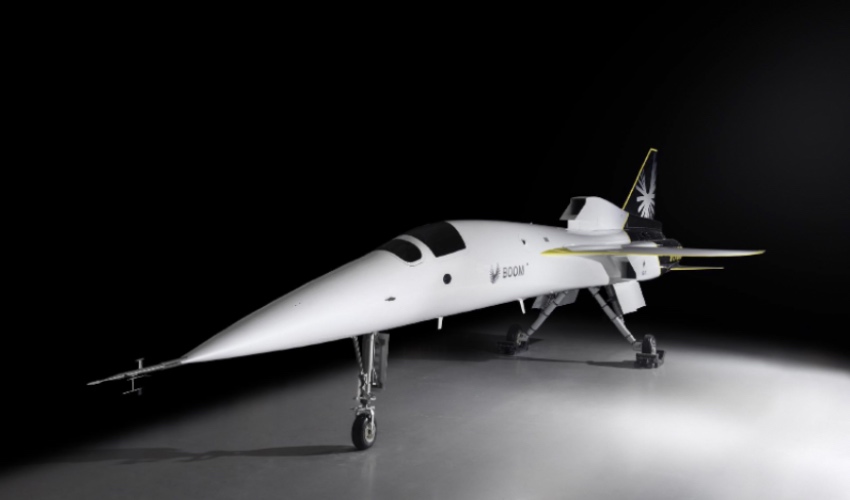
The US-based aerospace manufacturer, Boom Supersonic, rolls out the XB-1 aircraft model. The airplane features 21 titanium 3D printed components produced by the metal AM solution provider VELOD3D. Earlier this year, VELO3D raised $28 million for the product portfolio expansion, bringing the total amount to $138 million. The company’s Sapphire 3D printer is capable of producing incredibly detailed metal 3D printed parts – an important reason for Boom Supersonic to partner with them, since, in fact, all of the 21 components were manufactured with the Sapphire AM system.
The growth is exponential when it comes to the integration of additive manufacturing technologies in aeronautics, as more and more companies invest in the advanced manufacturing methods. Usually, only a few elements of the vehicle are fabricated or repaired with 3D printing – as it was the case with Honeywell, who additively manufactured a critical engine component for Dassault Falcon 20G maritime aircraft. However, with the recent announcement by VELO3D and Boom Supersonic, we can see that it is in fact possible to have as many as 21 parts created with 3D printing. Why did the aircraft manufacturer decide to opt for AM for the production of that many plane parts?
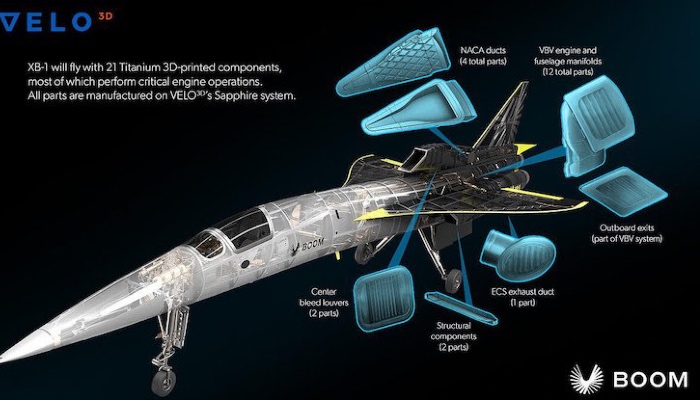
Image credits: VELO3D
Boom Supersonic is looking to develop aircrafts capable of supersonic flight in order to shorten the time it takes to travel by air. In fact, the company aims to fly dozens of passengers per plane at a time at speeds of around 1,500 miles per hour. In this context, Boom Supersonic has turned to 3D printing technologies in order to tackle more complex geometries and reduce the weight of components. The Founder and CEO of VELO3D, Benny Buller, explained, “Aviation hardware is especially difficult to manufacture with 3D metal printing, due to challenging aerodynamic designs that must be balanced with superior durability and high-temperature requirements. VELO3D’s technology allows the production of lightweight, complex designs for mission-critical applications in the toughest operating conditions. Our partnership with Boom is truly an advancement for the metal AM industry, and XB-1 supersonic aircraft is a game-changer for the aviation industry.”
More from the desk
Six other notes from the rest of the bench.
 Guides#Working3D: Six Questions for Manager of 3D at Children’s Hospital3D printing has had a profound impact on the medical community, and one area where the technology is really showing its usefulness is in pediatrics. Children have more variable anatomy than adults because their bodies are still developing, so when…
 NewsOpen-source 3D Printing Measures the Impact of Cannabis on LungsScientists at Canadian McMaster University and the University of Waterloo recently used 3D printing to look at the impact of cannabis on human lungs. In order to do this, they created an open-source 3D printed device that “breathes” like a…
 Guides#Working3D: Six Questions to Understand the Job of R&D EngineerWith the rise of industrial additive manufacturing, many companies are looking to hire profiles specialized in these new technologies, capable of fully making the most of its advantages. This is what we have seen on our dedicated job board, where…
 PrintersThe First-Ever Chip-Based 3D Printer Can Fit in the Palm of Your HandLast week, researchers from MIT and the University of Texas at Austin announced a significant advancement in 3D printing technology with the first-ever chip-based 3D printer. This device, which is no larger than a coin, represents a significant leap in…
 Applications3DExpress: Novel 3D Printed Skin with Simulated Blood for Surgical TrainingIn this week’s 3DExpress, we highlight notable developments in the medical sector. In the United States, researchers at the University of Minnesota have successfully 3D printed a new type of skin model to advance surgical training. In Germany, a hospital…
 NewsTop 5: The World’s First 3D Printed Concrete ParkHello everybody and happy Sunday! We hope you are enjoying the end of October. For your top 5 videos this week, we have collated a list of some of the most exciting projects and talks, including the world’s first 3D…