News
Using 3D Printing in the Fight Against Fast Fashion
When it comes to the environmental concerns plaguing our planet, the textile industry is quickly coming under scrutiny as one of the worst offenders. The rapid change in fashion trends, the constantly appearing new collections and the growing consumption of…
- 3 min read
- News
- Six more stories

When it comes to the environmental concerns plaguing our planet, the textile industry is quickly coming under scrutiny as one of the worst offenders. The rapid change in fashion trends, the constantly appearing new collections and the growing consumption of clothing are leading to an enormous amount being produced worldwide. So-called fast fashion ultimately means that huge quantities of textiles end up in the bin every day, and more and more clothing is being produced. To address this, both environmentalists and new governmental directives are calling for the global textile value chain to be made more resource-efficient and sustainable. Now, in order to counteract the vicious circle of throwing away and buying new textiles and to promote local production and the circular economy, a team of researchers at the University of Art and Design Linz has dedicated itself to the problem, using innovative materials and technologies such as 3D printing to make clothing.
As part of their artistic-scientific PEEK project “Fashion and Robotics,” the researchers are developing new approaches for more sustainable fashion production. The project, which is funded by the Austrian Science Fund (AWF), combines the development of organic fabrics that grow three-dimensionally from a nutrient solution, robots for repairing holes in clothing and AI to streamline factories. The team’s research focused primarily on a fundamentally new approach to the production process using innovative technologies such as 3D printing and new materials, rather than optimizing the traditional process.
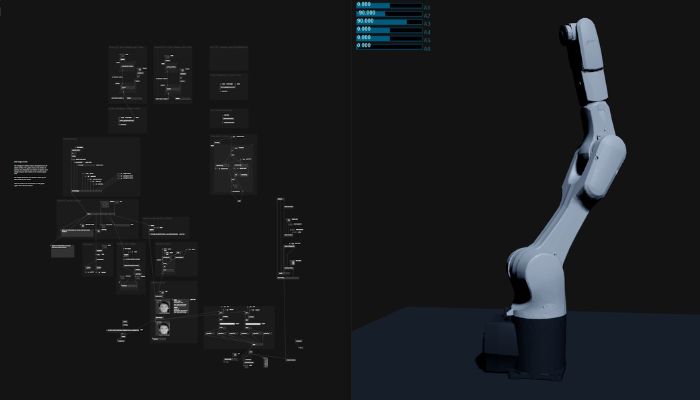
Photo Credits: Fashion Robotics
Innovative Clothing Production and Repair With 3D Printing
In the first stage of the research project, the researchers produced an item of clothing with the help of robots that used 3D printing. In addition, the interdisciplinary team developed robotic arms that are capable of three-dimensional cutting or sewing. The next step was to develop electrospinning. This technology was intended to replace conventional “darning” with an innovative, more sustainable process. According to Braumann, in this, a polymer is sprayed onto the torn area of a garment in a high-voltage field by a robotic arm, forming nanofibers that bond with the textile.
More from the desk
Six other notes from the rest of the bench.
 MaterialsCould Cellulose Fibers Be Used As Reinforcement Material for Composite 3D Printing?The German Institute of Textile and Fiber Research recently launched a research project to develop an innovative 3D printing method for composite materials. The goal is to produce components reinforced with bio-based and sustainable fibers such as cellulose fibers. The…
 Applications#3DExpress: UK MOD Outlines Additive Manufacturing Adoption With New Advanced Manufacturing Strategy PaperThis week has been full of news in the field of additive manufacturing. We’ll start this latest edition of #3DExpress by talking about the new Advanced Manufacturing Strategy unveiled by the UK Ministry of Defence before turning to the newest…
 MaterialsAll You Need to Know About ABS for 3D PrintingABS or Acrylonitrile Butadiene Styrene is a thermoplastic polymer that is quite common for industrial applications. It is known especially for its high impact resistance at low temperatures and for creating lightweight parts. Adding to that, ABS plastic is also…
 GuidesThe Top Projects That Use 3D Printing For Environmental RestorationAcross the world, designers, engineers, researchers, and artists are turning to 3D printing as a powerful tool for environmental restoration and regenerative manufacturing. Once viewed primarily as a prototyping technology, additive manufacturing is now enabling solutions that su
 NewsTop 5 Videos: 3D Printing Users’ Perspectives on the AM IndustryWelcome to our compilation of this week’s most compelling 3D printing highlights. We kick off this week’s edition with our very own video, presenting different 3D printing users in various sectors and uncovering their visions and insights on the industry…
 NewsHP’s Digital Manufacturing Report shows increased interest in 3D printing globallyLast October, HP unveiled its Digital Manufacturing Report, a study conducted among 2,175 decision-makers around the world ( across 3 continents and 9 geographic areas to be precise). After the recent publication of its French study, we decided to look…