Applications
Uniformity Labs Has Designed a 3D Printed Metal Roll Cage for a Solar-Powered Car
Uniformity Labs is a company specializing in manufacturing parts via 3D printing. Recently, they produced an ultra-low-porosity aluminum alloy (AISi10Mg) automotive component for a solar-powered race car. The part in question is a 3D printed roll cage that was made…
- 3 min read
- Applications
- Six more stories

Uniformity Labs is a company specializing in manufacturing parts via 3D printing. Recently, they produced an ultra-low-porosity aluminum alloy (AISi10Mg) automotive component for a solar-powered race car. The part in question is a 3D printed roll cage that was made using selective laser sintering (SLS) on an SLM machine. Thanks to topological optimization, the part was designed to ensure the best strength while reducing the amount of metal powder used. The car is expected to compete in the Bridgestone World Solar Challenge, a car race in the Australian outback for solar-powered vehicles.
Once again, additive manufacturing has proven itself in the automotive sector. Prized for its ability to design custom parts that are both lighter and less expensive, parts made with AM do not require the creation of specific tools or molds, resulting in shorter manufacturing times. In this specific case, Uniformity Labs chose to turn to metal additive manufacturing and more specifically an AlSi10Mg aluminum alloy that was developed by the company.
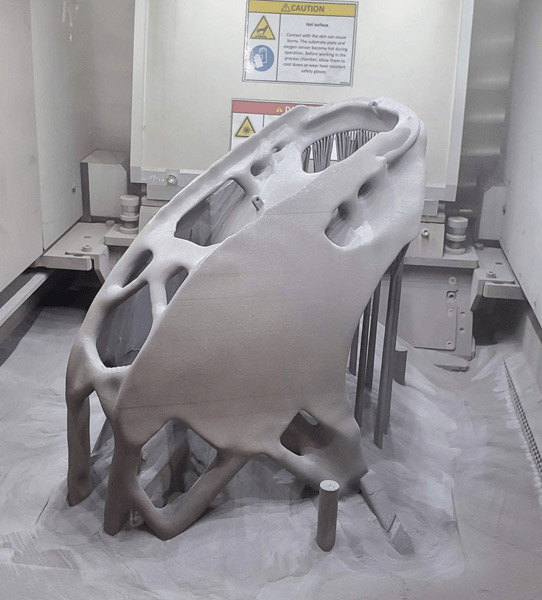
The roll cage (photo credits: Uniformity Labs)
A 3D printed roll cage
The California-based company created a roll cage for a solar-powered car, a part that provides protection for the vehicle’s passengers. Printed on an SLM Dual Laser machine, it was made of aluminum with a layer thickness of 30 microns to provide the best possible surface appearance. Adam Hopkins, founder and CEO of Uniformity Labs, stated, “Our ultra-low porosity AlSi10Mg and print processes allowed the car development team to create a better part quickly, cheaply, and optimized for the necessary weight and safety parameters. It’s easy to see how the processes used, and benefits afforded to the roll-cage production can apply to the creation of complex parts for use in mainstream industries such as aviation, auto, and consumer electronics. That’s what our technology is all about.”
More from the desk
Six other notes from the rest of the bench.
 ApplicationsParticle3D is creating tailor-made 3D printed bone implantsThe Danish company, Particle3D, uses a proprietary technology to create 3D printed bone implants that are tailored to a patient’s body. Additionally, the implants are porous and degradable which means that they fuse to a patient’s skeleton before disappearing. Founded…
 NewsAdditive manufacturing is gradually growing in the Oil industryThe consulting firm GlobalData recently published a study on additive manufacturing in the Oil & Gas industry, which reveals that the sector is expected to reach $32 billion worldwide by 2025, and over $60 billion by 2030. These are very…
 NewsIndustrial ceramic AM will grow into $4.8 billion revenue opportunity by 2030The market research firm SmarTech Analysis has issued a new report on the ceramic 3D printing market – Ceramics Additive Manufacturing Part Production: 2019-2030 – which identifies the most commercially important additive manufacturing technologies, material types and
 News#3DExpress: 3D Printed Eggs Help Save Endangered BirdsIt’s finally the weekend! And once again, we want to share with you some of the interesting tidbits from the 3D printing news from the week in our new format, #3DExpress. This time, check out an initiate to help save…
 NewsDanit Peleg unveils her fully 3D printed, customizable jacketCoco Chanel once said: “In order to be irreplaceable, one must always be different”. If there is a designer who has built their work around this saying it is Danit Peleg. Daring to be different, this young Israeli designer has just unveiled…
 ApplicationsFluorescent 3D Printed Rings, a Promise for Tomorrow’s Implants?The term for discoveries made by chance is “serendipity”. Some of the most remarkable scientific breakthroughs include radioactivity, X-rays and the discovery of penicillin. Recently, this same serendipity led to a new breakthrough in additive manufacturing. Two researchers from