News
Additive manufacturing is gradually growing in the Oil industry
The consulting firm GlobalData recently published a study on additive manufacturing in the Oil & Gas industry, which reveals that the sector is expected to reach $32 billion worldwide by 2025, and over $60 billion by 2030. These are very…
- 3 min read
- News
- Six more stories

The consulting firm GlobalData recently published a study on additive manufacturing in the Oil & Gas industry, which reveals that the sector is expected to reach $32 billion worldwide by 2025, and over $60 billion by 2030. These are very encouraging forecasts for an industry that turned to 3D printing technologies very early on, despite a rather slow adoption rate. The report states that the development of metal 3D printing is feeding innovation for players of this market – usually dominated by polymers.
The Oil industry covers a wide spectrum of activities, from exploration to energy storage, drilling, extraction, distribution and refining. All these activities involve certain requirements, in terms of safety, environment, hygiene, etc., prompting the players in the sector to propose appropriate solutions. Additive manufacturing could be part of the answer. Ravindra Puranik, Oil & Gas analyst at GlobalData, says: “Due to stricter environmental standards, volatile oil prices and ever-increasing competition, companies are increasingly interested in designing complex equipment to achieve operational efficiency. The ability to produce complex components that would otherwise be impossible to manufacture with conventional processes makes 3D printing an essential technology.”
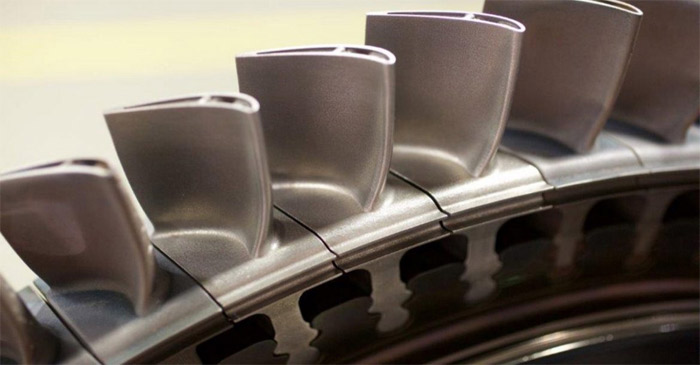
3D printed turbine blades | Credits: Siemens
Why is the Oil industry turning to additive manufacturing?
According to the report, the main benefit of 3D printing is the reduction in the time it takes to produce complex prototypes. 3D printing was quickly used for prototyping in this industry, mainly using polymers. It should be added that the development of high-performance thermoplastics is particularly appreciated by this market because they are materials that have a high chemical resistance, but also heat resistance and great strength. The study points out that metal additive manufacturing has greatly contributed to market growth – for some applications, it is a more relevant technology. In particular, it’s used to design functional products as components of complex machines. Thanks to 3D printing, innovative shapes and complex geometries can be obtained with fewer parts, thus reducing assembly time, improving performance and reducing emissions.
More from the desk
Six other notes from the rest of the bench.
 NewsChanel creates brush using 3D Printing !Chanel, one of leading luxury brands in the world has entered into 3D printing. In recent times 3D printing has been enabling fashion houses and individual designers to print their jewelry and other fashion related items through 3D printing technologies.…
 ApplicationsUS Navy Opens Additive Manufacturing Center of ExcellenceThe US Navy has opened its Additive Manufacturing Center of Excellence in a formal ceremony featuring the Virginia Governor and the Office of the Secretary of Defense, as well as Navy officials and industry partners. The Center will be based…
 MaterialsRUSAL America announces the expansion of aluminium AM powdersYesterday, RUSAL America announced the expansion of its aluminium product offerings to include additive manufacturing powders. The new powders will comprise four traditional Al-Si based casting alloys and five specialty alloys designed for use in the aerospace and automotive indu
 MaterialsHow Pereira 3D Is Making Clarinets More AffordableWhile many wish to explore their musicality by taking up a skill like playing an instrument, oftentimes the prohibitive costs of acquiring and maintaining instruments, such as the clarinet with its different accessories and variations, can keep many from taking…
 NewsPainting vs. Dyeing: Which Coloring Method to Choose for 3D Printing?A wide variety of technologies can be found in the field of additive manufacturing including those able to directly 3D print parts in color. However, this is not the cast for all and most of them tend to create parts…
 NewsUltimaker partners with America Makes to increase female representation in STEMUltimaker has announced a donation of more than twenty 3D printers on International Women’s Day in partnership with a leading American organization for additive manufacturing and 3D printing technology research, discovery, creation and innovation, America Makes. As the market lea