News
Solar Gate: The First 4D-Printed Adaptive Façade System
Indoor comfort generally requires a high energy input, which means that buildings account for a significant proportion of global carbon emissions. In 2020, for example, single-family homes consumed an average of 864 petajoules of heating energy, an enormously high figure.…
- 3 min read
- News
- Six more stories
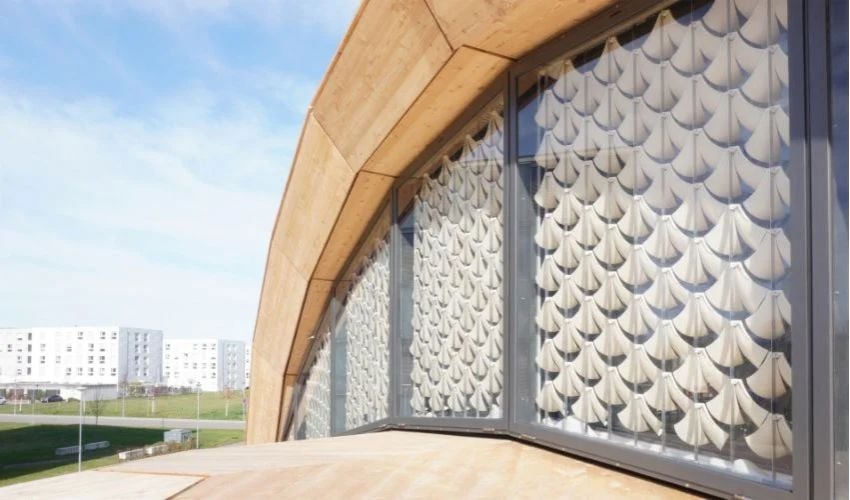
Indoor comfort generally requires a high energy input, which means that buildings account for a significant proportion of global carbon emissions. In 2020, for example, single-family homes consumed an average of 864 petajoules of heating energy, an enormously high figure. Researchers at the Universities of Stuttgart and Freiburg have now developed a promising solution to reduce this energy requirement for heating and cooling: a self-sufficient façade system that adapts independently to changes in the weather thanks to 4D printing. What’s more, the project is biomimetic, which means it was inspired by nature.
Solar Gate is the world’s first adaptive shading system that works depending on the weather and does not require energy from an electrical drive. The pine cone, whose scales open and close in response to changes in humidity or temperature without consuming metabolic energy, served as a model. Based on this principle, the team reproduced the direction-dependent structure of cellulose in plant tissue using 3D printers.
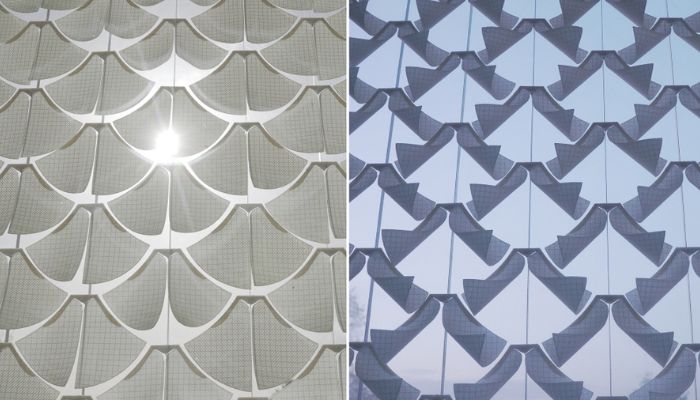
Thanks to bio-inspired 4D printing and cellulose materials made from renewable raw materials, the team has developed a system that automatically adapts to changes in the weather. (Photo credit: ICD/IntCDC University of Stuttgart)
“Weather-responsive architectural façade systems usually rely on complex technical devices. Our research investigates how we can harness the responsiveness of the material itself through computer-based design methods and additive manufacturing. We have developed a shading system that opens and closes independently depending on weather conditions, without the need for any operating energy or mechatronic elements. The biomaterial structure itself is the machine,” explains Professor Achim Menges, Head of the Institute for Computer-Based Design and Construction and spokesperson for the Cluster of Excellence Integrative Computer-Based Design and Construction for Architecture at the University of Stuttgart.
More from the desk
Six other notes from the rest of the bench.
 NewsA Bridge Incorporating a 3D Printed Concrete Staircase has Been Inaugurated in ScotlandOne of the largest 3D printing structure to date in the UK is finally opening. In Glasgow, the Sighthill Bridge has opened over the M8 freeway, one of the busiest roads in Scotland. To clarify, this structure is not entirely…
 MaterialsHarvard researchers develop multinozzle 3D printer that can switch between 8 inksYou might be aware that most commercial extrusion-based 3D printers are only able to build objects from a single material at a time. And when they do allow for multiple materials and colors to be used, the process is slow.…
 ApplicationsUC Berkeley’s SpaceCAL 3D Printer Demonstrates Success in OrbitA team of UC Berkeley researchers, spearheaded by Ph.D. student Taylor Waddell, has achieved a significant milestone in additive manufacturing with the development of the SpaceCAL 3D printer. Launched into suborbital space aboard the VSS Unity on June 8th as…
 NewsThe impact of 3D printing on supply chainsToday, many industries are hugely reliant on production and supplies from China and Southeast Asia, particularly in sectors like manufacturing and logistics. During the global health pandemic, broken supply chains affected the activities of companies in many industrial sectors. M
 News5 Real-World Applications of 3D Printing We Saw at RAPID + TCT 2026One of the most common questions surrounding additive manufacturing is also one of the simplest: what is 3D printing actually being used for today? Not in research labs or concept demonstrations, but in real-world applications delivering tangible results. To answer…
 NewsNew droplet-based 3D printing techniqueA new 3D printing technique has been developed by the researchers from the University of California, Davis. The paper detailing the approach was published in the Proceedings of the National Academy of Sciences of the United States, one of the…