News
A Bridge Incorporating a 3D Printed Concrete Staircase has Been Inaugurated in Scotland
One of the largest 3D printing structure to date in the UK is finally opening. In Glasgow, the Sighthill Bridge has opened over the M8 freeway, one of the busiest roads in Scotland. To clarify, this structure is not entirely…
- 3 min read
- News
- Six more stories
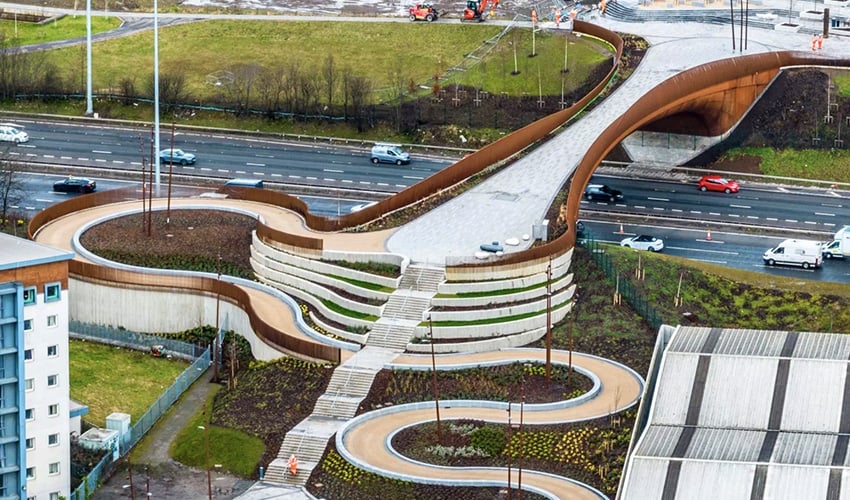
One of the largest 3D printing structure to date in the UK is finally opening. In Glasgow, the Sighthill Bridge has opened over the M8 freeway, one of the busiest roads in Scotland. To clarify, this structure is not entirely 3D printed. In fact, companies BAM and Weber Beamix used 3D printing technology to integrate the concrete staircase into the bridge. The purpose of the project was to connect Glasgow’s city center and the Sighthill neighborhood. The staircase was installed in 2021, however, the city is only celebrating the opening of the bridge recently.
This is not the first time additive manufacturing has been leveraged for bridge construction projects. In fact, the Netherlands has seen a few initiatives where this technology has been used to build these public structures. In the center of Amsterdam, MX3D participated in the creation of a 3D printed bridge. A little further south, in the city of Nijmegen, one of the longest 3D printed bridges for cyclists was inaugurated. This project in particular was also led by BAM and Weber Beamix.
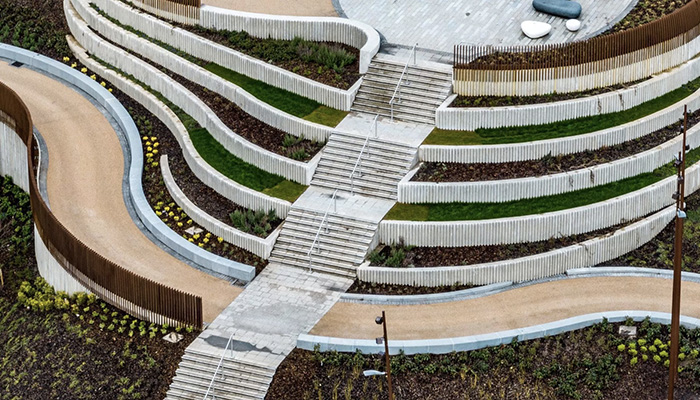
The 3D printed staircase by BAM and Weber Beamix (photo credits: BAM)
Manufacturing the 3D Printed Staircase
BAM provided the 3D printing expertise for the construction of the bridge. Its printer consists of a robotic arm equipped with a nozzle capable of extruding a concrete mortar mixture. This allowed the machine to deposit the material layer by layer, with a thickness of about 5 mm. The company claims that 3D printing the steps allowed for precise shapes that would be complicated to achieve with traditional manufacturing techniques. It’s also known that the technology has helped reduce material (50 percent), as well as waste, by up to 40 percent. “The project has pushed the boundaries of what’s possible within construction, using cutting-edge digital techniques and collaboration from everyone involved. We are proud to leave a sustainable legacy that will benefit the north of Glasgow for years to come”, explains Ian Steele, BAM’s contract manager.
More from the desk
Six other notes from the rest of the bench.
 NewsDesigner Iris van Herpen Unveils First 3D Printed Wedding DressIs it possible to walk down the aisle in a 3D printed wedding dress? What once seemed impossible has now become a reality. Brazilian tax lawyer Mariana Pavani relied on the additive manufacturing technology and creativity of designer Iris van…
 ApplicationsA 3D Bioprinter on Board the ISS: The Future of Space Medicine?Astronauts must be prepared for a variety of health problems in space, because they have no direct access to comprehensive medical care in their isolated environment. Although medical equipment and medicines are available on board space stations, and astronauts can…
 NewsGiant 3D printed butterfly sanctuary building in New York CityThe Brooklyn-based nonprofit architecture and urban design group, Terreform One revealed an incredible design concept for an urban ‘Monarch Butterfly’ sanctuary to be set in the Big Apple. The vertical meadow façade they imagined would be 3D printed in carbon…
 NewsThe first 3D printed residential building in GermanyThe first 3D printed residential building will be erected in Germany, more precisely in the city of Beckum, Westphalia. The two-storey house will offer 80 square meters per floor, with walls built by the concrete 3D printer BOD2 from the…
 PrintersWhat is the outlook for 3D printer sales in 2020?The research firm CONTEXT recently published a report on 3D printer sales in 2020. Given the current health crisis, these have already decreased compared to last year, even though the last quarter of 2019 was not very conclusive. In recent…
 ApplicationsRAF Aircraft Recycled as Metal Powders to 3D Print New Aeronautical PartsThe Royal Air Force (RAF) has just revealed an interesting partnership with Rolls-Royce, involving the use of additive manufacturing. Together, they are taking in the Tornado 2 Tempest program, which involves recycling spare parts from obsolete fighter aircraft and transforming&h