Printers
Sinterit Is Paving the Way for Industry 4.0 With its SLS 3D Printers
In recent years, there has been a substantial change in the way industries and companies operate. This transformation, known as Industry 4.0 or the Fourth Industrial Revolution, consists of the integration, automation and digitalization of all industrial manufacturing and product
- 3 min read
- Printers
- Six more stories
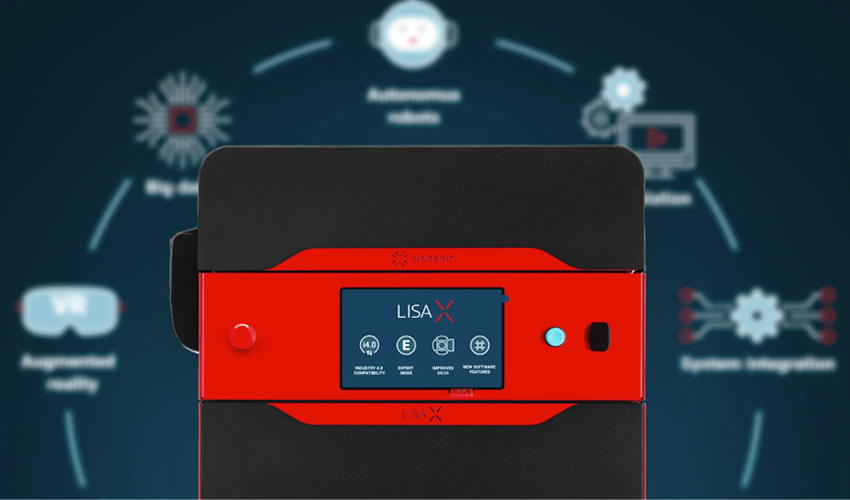
In recent years, there has been a substantial change in the way industries and companies operate. This transformation, known as Industry 4.0 or the Fourth Industrial Revolution, consists of the integration, automation and digitalization of all industrial manufacturing and production processes. In it, we find different technological tools, such as simulation, augmented reality, cybersecurity, big data, and of course, additive manufacturing. 3D printing plays a fundamental role in this shift, offering advanced technologies for different industrial applications. One widespread polymer additive manufacturing process is selective laser sintering (SLS). In this market, one of the first companies born with the aim of offering SLS 3D printers is Sinterit. A specialist in powder technology since its inception, Sinterit has long been strengthening its position in the industry through its Lisa, Lisa X and Lisa Pro 3D printers. The question now is, how are these SLS solutions and technological advances changing the additive manufacturing sector? And what is Sinterit’s role in all this digital transformation?
Headquartered in Krakow, Poland, Sinterit has been in business since 2014, when the first wave of companies offering compact, accessible and affordable SLS 3D printers emerged. Since the launch of its first machine, the Lisa, the company has gradually grown in the industry to position itself as one of the leaders in SLS 3D printing. And while additive manufacturing is now close to the prerogatives of Industry 4.0, there are still many improvements to be made. To dig deeper into this topic, we will delve into how an application programming interface (API) tailored to Sinterit SLS printers can optimize production. Furthermore, we will take a closer look at why a company should consider implementing Industry 4.0 in its additive manufacturing projects. Finally, we will learn of the success stories of users who have already used Sinterit machines as a complement in their production to get closer and closer to this digital transformation.
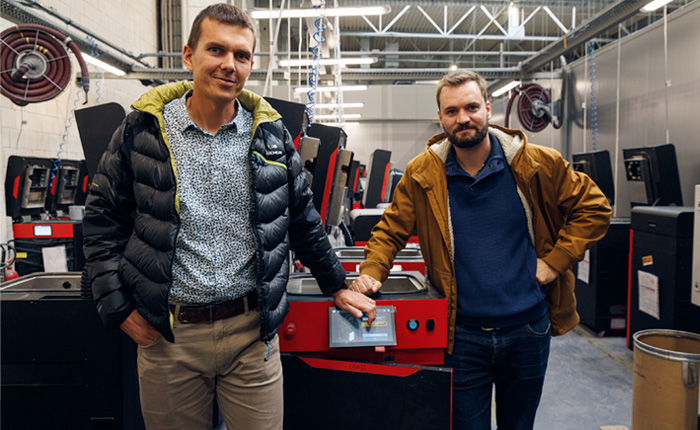
The Lisa X is one of the SLS 3D printers that are ready for Industry 4.0.
Sinterit and Industry 4.0
As we can see, the fourth industrial revolution and additive manufacturing have a close collaborative relationship. This means that, although 3D printing is a key element in this digital transformation, the tools that are part of Industry 4.0 can also be a significant factor in companies’ additive manufacturing projects. So how can both elements be used in a complementary way, and what are the benefits of each? 3D printing makes it possible to create complex final parts with a lower expenditure of materials, with lower costs and in a much shorter time. Industry 4.0, on the other hand, is characterized as a smart, connected manufacturing system that aims to provide information and identify potential mishaps. The reason that should motivate organizations to consider its implementation is the improvement of productivity, optimization of energy resources and workers’ safety, as well as production efficiency.
More from the desk
Six other notes from the rest of the bench.
 News3D Printing to Maintain Cornell’s Eco-Friendly Lake Source Cooling SystemMaintaining sustainability on a large campus can be a complex challenge, as balancing environmental responsibility with efficient operations requires innovative solutions. Last week, Cornell University’s Lake Source Cooling (LSC) system underwent essential maintenance to combat t
 NewsTop 5 Videos: SEAT invests in a 3D printing centerThis week we found the top 5 videos about 3D printing and the way additive manufacturing is changing production. The technology has infiltrated many sectors, from medical to automotive – check our selection of the week to keep up with the innovations! If you enjoy these, you&hell
 NewsIs Artificial Intelligence the Key to Greater Productivity in AM?As a digital manufacturing method, additive manufacturing has already managed to establish itself in a wide variety of industries. Whether in medicine, the automotive sector or the consumer goods industry, there is hardly any sector that does not benefit from…
 NewsFrench Astronaut Thomas Pesquet Brings 3D Printing to the ISSTwo weeks ago, French astronaut Thomas Pesquet flew for the second time to the International Space Station (ISS) for a six-month trip, becoming the ISS’s first French commander. What we found particularly interesting was that 3D printing accompanied him on…
 NewsResearchers Have Created a New Rotational, Multimaterial 3D Printing ProcessA team of researchers from the Harvard John A. Paulson School of Engineering and Applied Sciences and the Wyss Institute for Biologically Inspired Engineering at Harvard University have taken inspiration from nature to develop a rather surprising 3D printing method.…
 NewsIconic Ghost Train Revitalized with Bambu Lab 3D PrintersLuna Park Melbourne, a treasured amusement park in Australia, opened its doors in 1934. It welcomed visitors with the usual roller coasters and games, carousels and carnival treats, but the park had a “dark” side: The Ghost Train. Today, the…