News
Researchers Have Created a New Rotational, Multimaterial 3D Printing Process
A team of researchers from the Harvard John A. Paulson School of Engineering and Applied Sciences and the Wyss Institute for Biologically Inspired Engineering at Harvard University have taken inspiration from nature to develop a rather surprising 3D printing method.…
- 3 min read
- News
- Six more stories
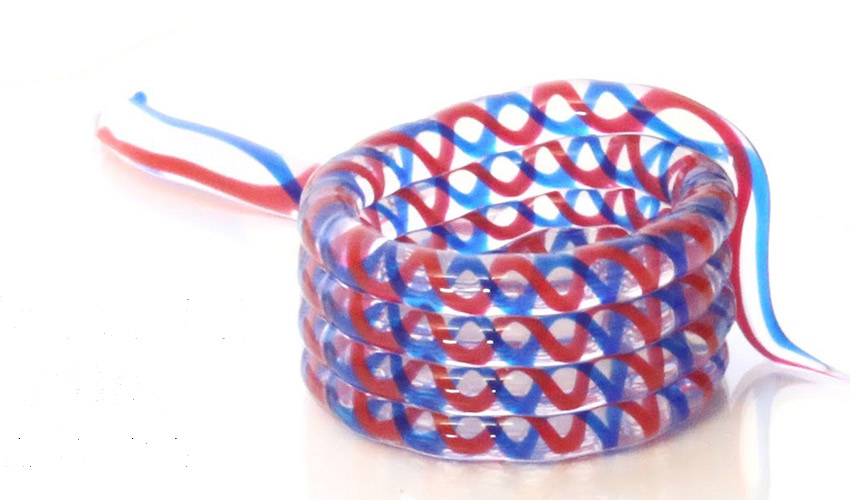
A team of researchers from the Harvard John A. Paulson School of Engineering and Applied Sciences and the Wyss Institute for Biologically Inspired Engineering at Harvard University have taken inspiration from nature to develop a rather surprising 3D printing method. Inspired by the helix-shaped structures found mainly in plants, they have designed a 3D printer that is capable of printing with four different materials wherein a rotating nozzle deposits a helical filament. So far, the team has 3D printed structures of different stiffnesses that could have interesting applications in robotics for example.
This is not the first time that mankind relies on nature’s behavior to innovate: in 3D printing, we often talk about biomimicry and there are many projects imitating the structures that surround us. One example is the lattice structures, like those seen in hives. In this particular project, the idea is to be inspired by the helical shapes found in all biological systems, such as plants and our own muscles. In fact, it is our proteins that assemble themselves and that, by taking this helix shape, trigger their contraction. It would therefore be interesting to be able to design a structure capable of contracting thanks to the properties of the material. This is the track explored by these researchers.
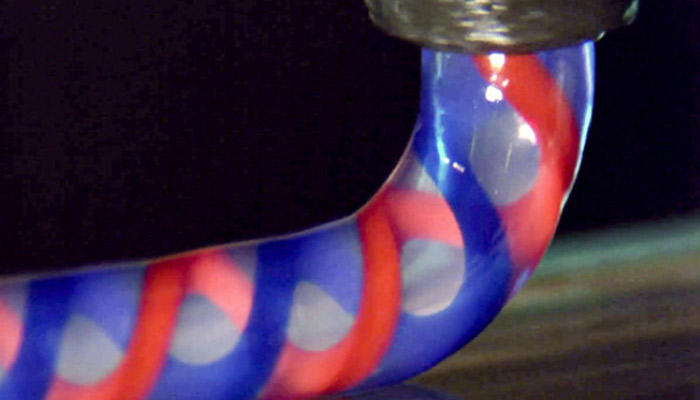
The helical shape is integrated into the deposited filament (photo credits: Harvard John A. Paulson School of Engineering and Applied Sciences)
How Rotational Multimaterial 3D Printing Works
The imagined additive manufacturing solution uses four different ink cartridges – similar to large syringes. They are connected to a complex rotating nozzle that, as it moves, creates a filament with helical properties. Natalie Larson, author of the study, explains, “Rotational multimaterial printing allows us to generate functional helical filaments and structural lattices with precisely controlled architecture and, ultimately, performance.”
More from the desk
Six other notes from the rest of the bench.
 MaterialsGet bowled over by these 3D-printed bowling ballsStart-up Freshmade 3D from Ohio have recently announced that they have created a material strong enough to create 3D-printed bowling balls from. The material, called AMClad, is an “isotropic Engineered Sand Composite (ESC)”, that they say is “ideal for 3D&hellip
 MaterialsHow to Choose a Polymer for Your 3D Printing Application? Experts Give Their Advice!Today, there are a wide variety of materials that are compatible with additive manufacturing technologies, from thermoplastics to metals, ceramics and photosensitive resins. The largest family of these materials is polymers, which can be found in different forms depending on&hell
 PrintersFormlabs debutes two new machines: The FormWash and The FormCureFormlabs, the SLA 3D printer manufacturers who have brought us machines, such as the Form 1+ and 2, have made quite an announcement this morning at the RAPID + TCT conference in Pittsburgh, Pennsylvania; announcing two new machines that will…
 News#3DExpress: Lore Introduces the World’s Highest-Performing 3D Printed Cycling ShoeOnce again, we’d like to take a look at some of the latest news from the additive manufacturing market. Starting with new 3D printed cycling shoes from Lore! The shoes are produced from a scan, finished in under 10 minutes,…
 ApplicationsUSS Essex Becomes First American Ship With a Metal 3D Printer OnboardYou may remember last year when the Naval Postgraduate School announced a partnership with Xerox to use the ElemX 3D printer to explore the capabilities of 3D printers for the Navy and Marine Corps. Well it seems that it has…
 Guides#3DStartup: Cubicure and Hot Lithography ProcessIn 2015, Cubicure was founded by Prof. Dr. Jürgen Stampfl and Dr. Robert Gmeiner. That same year they won the S2B award of the Rudolf Sallinger fonds and came in second in the “Call Pro Industry” funding program, all indicating a…