News
Is Artificial Intelligence the Key to Greater Productivity in AM?
As a digital manufacturing method, additive manufacturing has already managed to establish itself in a wide variety of industries. Whether in medicine, the automotive sector or the consumer goods industry, there is hardly any sector that does not benefit from…
- 3 min read
- News
- Six more stories

As a digital manufacturing method, additive manufacturing has already managed to establish itself in a wide variety of industries. Whether in medicine, the automotive sector or the consumer goods industry, there is hardly any sector that does not benefit from the strengths of 3D printing. Among other things, the technology innovates production processes by making components both more flexible and more sustainable. Nevertheless, 3D printing has not yet been able to realize its full potential in terms of productivity. Could artificial intelligence be the key? A German-Canadian consortium is now addressing this question by developing new process control software for laser material deposition. Ultimately, it is intended to optimize production and increase productivity.
It is well known that 3D printing is a leading technology that is considered part of Industry 4.0. This era is defined by the increasing digitization and adaptation of artificial intelligence in all areas. The fact that additive manufacturing methods can benefit from automation seems unsurprising, especially with regard to process optimization. For this reason, a German-Canadian consortium has now been established in the project “Artificial Intelligence Enhancement of Process Sensing for Adaptive Laser Additive Manufacturing AI-SLAM” The German partners include the Fraunhofer Institute for Laser Technology ILT in Aachen and the software developer BCT from Dortmund. On the Canadian side, the project is coordinated by the National Research Council NRC and supported by a team of researchers from McGill University (Montreal). Apollo Machine and Welding Ltd in Alberta is also participating in the project. The aim is to develop software for equipment manufacturers so that LMD processes can run automatically.
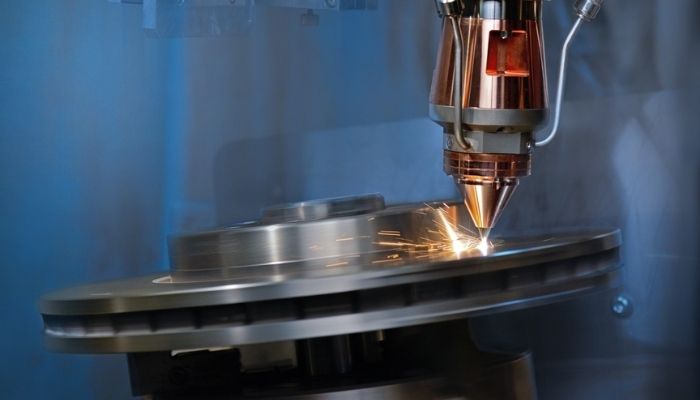
Photo Credits: Fraunhofer ILT, Aachen
AI to Make the LMD Process More Efficient
Laser material deposition (LMD) is a hybrid manufacturing method wherein material with a layer thickness of 0.01 mm to 2 mm can be applied with high precision to almost any metallic base material in a very short time. Users of laser buildup welding know that to ensure component quality, the thickness of the layer must be measured after each coating or at least after every 10th layer and the process control adjusted. In the future, thanks to AI, the system could automatically recognize precisely this necessity. Therefore, the software would ultimately be able to identify deviations from the specified contour and automatically control process parameters such as the feed rate. In addition, the software should learn independently on the basis of a database and optimize the process iteratively.
More from the desk
Six other notes from the rest of the bench.
 NewsTCT 3sixty 2021: A Round-Up of the News from the EventSlowly but surely, additive manufacturing events are starting to start back up after more than a year of inactivity due to the health crisis. Last week yet another popular event took place in person, on the heels of its sibling…
 NewsWEBINAR: Proven on the Production Floor: Why the Raplas PR 700 Works in a Real Manufacturing EnvironmentFor manufacturers considering an investment in industrial 3D printing, the transition from laboratory testing to high-stakes manufacturing can be a significant hurdle. While prototypes may perform well in controlled environments, scaling production often brings new challenges, su
 MaterialsThe Top Hybrid Materials to Replace Classic Filaments for your 3D PrinterThe process of 3D printing by extrusion, also known as deposition of molten material, is one of the most popular and commonly used methods in the additive manufacturing market. This is due to its ability to offer a wide range…
 NewsCan bio-printing tumour cells, become a treatment against cancer?A student from the University of Waikato in New Zealand, Shalini Guleria, is now seeking to identify the best treatment for all breast cancer patients. She turned to bio-printing to 3D print tumour cells. It would be possible to collect cells in a…
 NewsWEBINAR: Overcoming AM Design Challenges in Critical SectorsDesigning custom 3D-printable parts – like jigs, fixtures, or product-specific tooling – often requires manual modeling by experienced CAD users. This is a time-consuming process and is difficult to scale, so it often becomes a bottleneck in additive manufacturing workflows.&hell
 ApplicationsBentley Blends Heritage and 3D Tech in EXP 15 Concept CarBentley Motors has unveiled its EXP 15 concept, a digital project that captures both the spirit of the brand’s Grand Tourer roots while also pushing towards a future defined by sustainability, additive manufacturing, and electrification. The company recently revealed the…