Materials
Researchers Unveil Breakthrough 3D Bioprinting Method Using Plant Cells
3D printing has proven to be a versatile technology, expanding its applications across various fields, from manufacturing to medicine. It has become an indispensable tool in many sectors due to its ability to customize products and create complex, unique structures…
- 3 min read
- Materials
- Six more stories
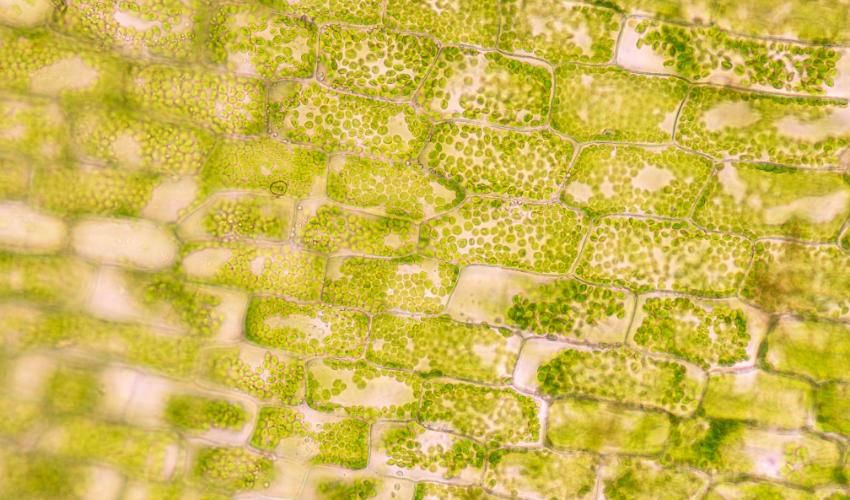
3D printing has proven to be a versatile technology, expanding its applications across various fields, from manufacturing to medicine. It has become an indispensable tool in many sectors due to its ability to customize products and create complex, unique structures from a wide range of materials. Researchers worldwide have leveraged these benefits to develop innovative methods like bioprinting, which are transforming their respective fields. Recently, a team of researchers published a paper in the American Chemical Society, unveiling a new bioprinting method using inks containing genetically modified plant cells to produce living materials.
Until recently, developing living materials from plant cells was hampered by the simplicity of their structures, which limited their functionality. While researchers had already created living materials from bacterial and fungal cells, their ambitions extended further. The study we discuss today marks a breakthrough in overcoming these limitations. Led by scientists Ziyi Yu and Zhengao Di, the team developed Engineered Plant Living Materials containing modified plant cells with customizable behaviors and capabilities. This advancement has been made possible through the facilitation of 3D printing technology.
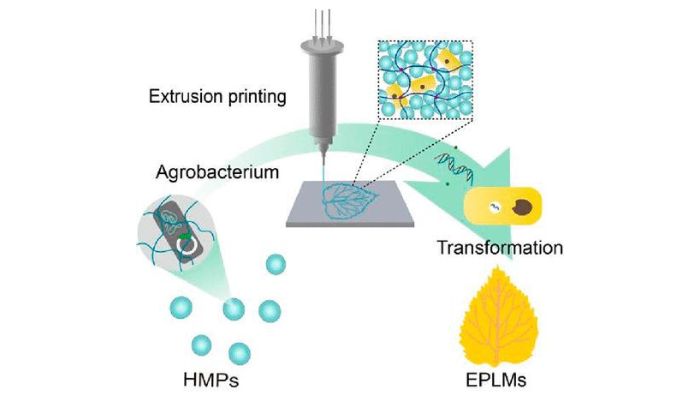
To achieve this, the researchers developed a bioink containing plant cells and bacteria. Specifically, the ink was composed of tobacco plant cells, gelatin, and hydrogel microparticles, which contained Agrobacterium tumefaciens, a bacterium that facilitates the transfer of DNA segments to plant genomes. This bioink was used to 3D print various shapes, such as grids, snowflakes, leaves, and spirals, for analysis. The printing was done using a three-axis 3D bioprinter with extrusion technology, and the shapes were cured with blue light to strengthen their structure. After 48 hours, the bacteria in the engineered living materials had transferred DNA to the growing tobacco cells. For example, a leaf-shaped print showed colors produced by the modified plant cells after just 24 hours. The researchers also observed that the plant cells continued to grow and replicate within the living materials over a few weeks, producing proteins as directed by the transferred DNA.
More from the desk
Six other notes from the rest of the bench.
 GuidesTPM3D Talks Clean, Efficient SLS 3D Printing and Expanding InternationallyOne of the countries where we are seeing the fastest growth in additive manufacturing is undoubtedly China. And while many associate the Chinese market with desktop solutions, whether extrusion or vat photopolymerization, there are a growing number of manufacturers offering&helli
 NewsTop 5 Videos: 3D printing for e-bikes and moreThis week we found the top 5 videos about 3D printing and the way additive manufacturing is changing production. The technology has infiltrated many sectors, from medical to automotive – check our selection of the week to keep up with the innovations! If you enjoy these, you&hell
 NewsUniversity of Buffalo Uses $2.3 Million NSF Grant to Advance AI in ManufacturingAt the core of 3D printing and other technologies in Industry 4.0 is the idea that we need to improve on traditional manufacturing. Now, a University of Buffalo research team is hoping to do just that thanks to a $2.3…
 GuidesThe Personalities Who Shaped the Additive Manufacturing Market in 2023As we approach the end of the year, it’s time for us to take a look back at the market, and at the personalities who have shaped the 3D printing sector in 2023. Whether they work in major corporations, startups…
 PrintersAre UniZ 3D Printers the Fastest 3D Printers Ever?UniZ are an American additive manufacturing startup from San Diego which opened its doors back in 2014. The starting team was composed of engineers, entrepreneurs, and designers. Since then, UniZ have released their currently available SLASH and SLASH+ UDP 3D…
 ApplicationsNotre Dame Researchers Develop Method for 3D Printing Blood Capillary NetworksResearchers at the University of Notre Dame have successfully 3D printed blood capillary networks using a surprising technique. Before exploring their method, it’s worth understanding why 3D printing blood capillary networks matters in the first place. In the United States&