Materials
A New Tungsten Powder Compatible with Additive Manufacturing
Additive manufacturing with metal is gaining in popularity. This is shown, among other things, by the increasing number of 3D printing companies that specialize in metal manufacturing or offer machines for metal printing. Aluminum, bronze, chrome, stainless steel, iron and&hellip
- 3 min read
- Materials
- Six more stories
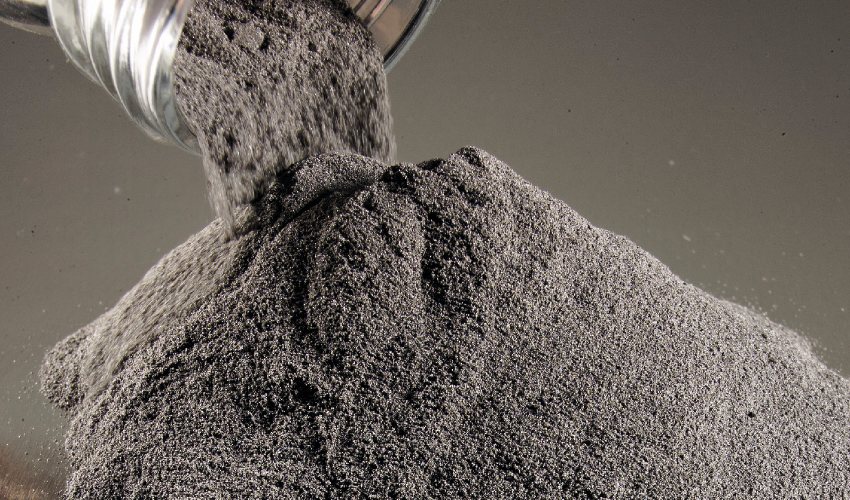
Additive manufacturing with metal is gaining in popularity. This is shown, among other things, by the increasing number of 3D printing companies that specialize in metal manufacturing or offer machines for metal printing. Aluminum, bronze, chrome, stainless steel, iron and copper are just a few examples of the most commonly used metals. Of these, some – often in the form of alloys – are already usable in the additive manufacturing industry, with the elements usually processed by laser powder bed fusion or electron beam melting. One particular metal that shows great potential in the field of additive manufacturing – especially for 3D printing in the automotive and aerospace industries – is tungsten, due to its great mechanical strength, high stiffness and high thermal load capacity.
In fact, tungsten has the highest melting point of all metals at around 6,152°F (3,400°C), which on the one hand makes it perfect for use in energy and lighting technology, but at the same time makes it difficult to manufacture. The biggest challenge with using tungsten in additive manufacturing at the current state is that printed parts are often prone to cracking, which greatly affects quality. This problem is especially prevalent with more complex, precise shapes with curves or holes, which in turn are impossible to model using traditional processes or machining techniques. But now there is a solution: Bayerische Metallwerke GmbH has developed a new manufacturing process for the tungsten alloys WNiFe (tungsten, nickel and iron) and WNiCu (tungsten, nickel and copper), which it patented in early 2021.
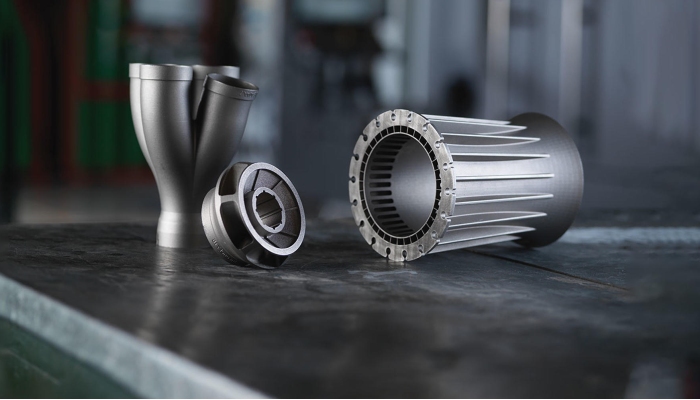
More and more metals can be used in additive manufacturing. (Photo Credits: 3D Systems)
This production method is characterized by the multiphase solid solution alloy, which is obtained in powder form. Dr. Hany Gobran, research and development manager at Bayerische Metallwerke, reports on his new development: “The special feature of our tungsten-nickel-iron alloy is that we obtain it in the form of a pre-alloyed powder that is suitable as a starting product for 3D printing and coating processes.” Previously, only mixed powder was used to make tungsten useful for components with complex geometries. Unlike Mr. Gobran’s new pre-alloyed powder, these blends have different melting points, resulting in much of the added elements (nickel and iron) evaporating uncontrollably during melting. Thanks to the pre-alloying of the new patented process, all three elements are combined as a multiphase material in each individual powder particle, so that their composition and distribution in the final product can be precisely controlled and there is no loss of the binder metals.
More from the desk
Six other notes from the rest of the bench.
 Printers3D Printing on a Budget: What Do You Need to Know?It is no secret that 3D printing is growing in popularity both at home and in industry. That is not to say that there are no obstacles that could prevent someone interested in the topic from taking it up as…
 MaterialsAn Introduction to Post-Processing in 3D PrintingThe value chain of additive manufacturing consists of multiple steps before having a final part. There is, of course, the printing phase, but also the modeling phase, which is start of any project. But once the 3D printer has finished…
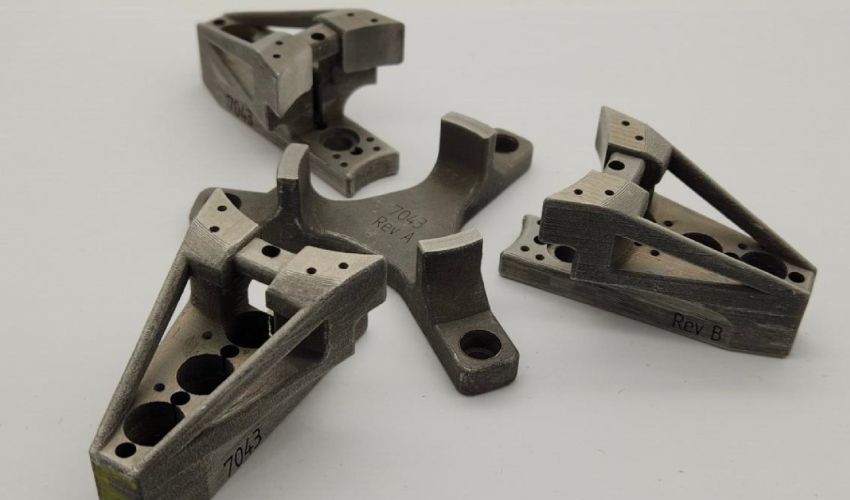 NewsAPG Manufactures Lathe Chuck Jaws with Tritone’s MoldJet TechnologyOne of the best-known advantages of 3D printing, which is appreciated by different industries, is freedom of design. While still having to follow rules with certain limitations depending on the part to be produced, Design for Additive Manufacturing (DfAM) allows…
 MaterialsCovestro Launches New Recycled PET 3D Printing MaterialCovestro has launched a new 3D printing material, Arnite® AM2001 GF (G) rPETm, made from recycled post-consumer PET waste. This is the materials manufacturer’s first additive manufacturing specific product. The material is a glass-fiber filled recycled polyethylene terephthalate
  MaterialsRigid or Elastic? The Plastic Material that Changes Properties Thanks to 3D PrintingIn recent years, many university research projects have been developing multifunctional materials through additive manufacturing. In the medical field, for example, it is important to create fabrics capable of regenerating organs or bone structures and design advanced biomedical
  ApplicationsNASCAR to Implement 3D Printed Parts in Next Gen Racecars3D printing in the automotive industry is no longer a new topic. The sector has rapidly adopted 3D technologies for not just prototyping and R&D, but also the production of end-use parts in everything from electric cars to luxury vehicles.…