Applications
Inside Lincoln Electric’s Mission to 3D Print Components for Nuclear Submarines
The United States Navy faces a formidable challenge: by 2028, it must deliver one Columbia-class ballistic missile submarine and two Virginia-class attack submarines each year, all while maintaining its existing fleet. To meet this ambitious goal, the responsibility falls to&hell
- 3 min read
- Applications
- Six more stories
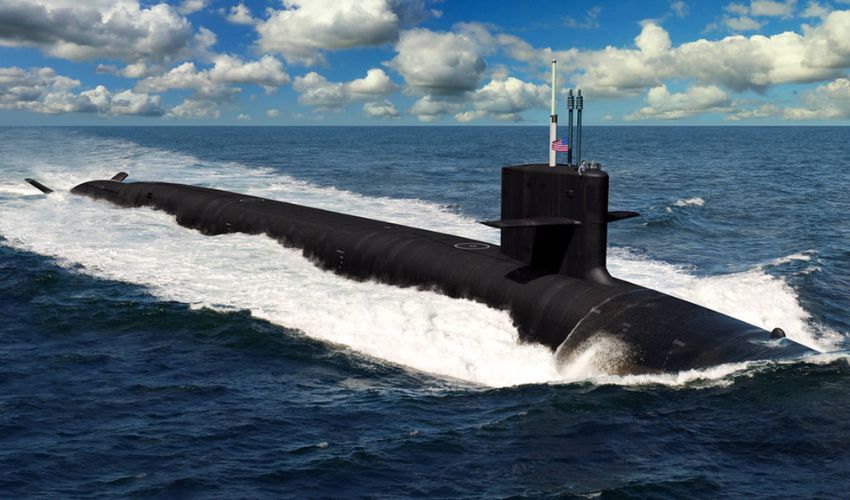
The United States Navy faces a formidable challenge: by 2028, it must deliver one Columbia-class ballistic missile submarine and two Virginia-class attack submarines each year, all while maintaining its existing fleet. To meet this ambitious goal, the responsibility falls to the Maritime Industrial Base (MIB), established in 2024 to spearhead the Navy’s efforts to revitalize America’s shipbuilding and repair capabilities. Achieving these production targets will require innovative solutions to reduce bottlenecks, increase throughput, and strengthen supply chains. As part of this effort, the MIB Program is investing in General Dynamics Electric Boat and Lincoln Electric to integrate additive manufacturing into the construction of nuclear-powered submarines.
With MIB Program funding, General Dynamics Electric Boat will source critical components from Lincoln Electric’s new large-scale metal additive manufacturing facility. Ken Jeanos, vice president of supply chain, materials and logistics for General Dynamics Electric Boat, underscored the challenge of obtaining materials: “Material availability continues to drive construction delays across the submarine enterprise,” he said, adding, “3D-printed parts have the potential to accelerate construction and delivery of submarines to the U.S. Navy by cutting lead times for critical components.”
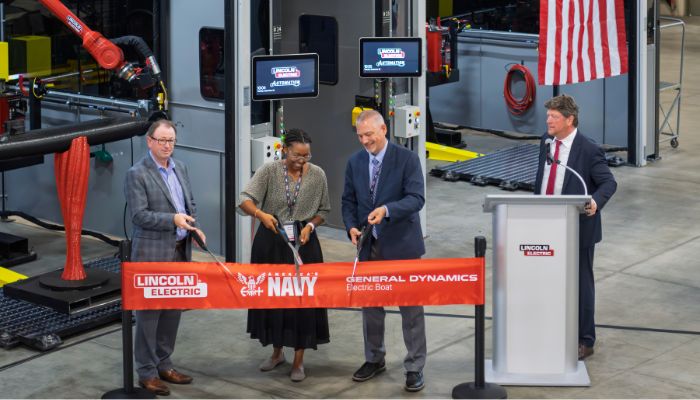
Mr. Mike Whitehead, Lincoln Electric’s President of Americas Welding, Ms. Larissa Smith, Director, Advanced Manufacturing, DRPM, Maritime Industrial Base Program, U.S. Navy, and Mr. Ken Jeanos, VP, Materials and Supply Chain, General Dynamics Electric Boat, lead the ribbon cutting to celebrate the investment of four SculptPrint™ 1500 additive manufacturing cells to support the production of critical submarine components.
How Will The Parts Be 3D Printed?
To meet this demand, Lincoln Electric will produce these using four of its state-of-the-art SculptPrint machines, located at its Additive Solutions facility in Cleveland, Ohio. SculptPrint systems employ wire-arc additive manufacturing (WAAM) or gas metal arc directed energy deposition (GMA-DED), which are designed for large, mission-critical metal components such as those used in submarine construction. The technology delivers high deposition rates, enables large-scale builds, and provides precise process control. This makes it ideal for producing dense, fully fused metal parts with mechanical properties equivalent to or better than those of cast or wrought material.
More from the desk
Six other notes from the rest of the bench.
 GuidesTOP 10 3D Printing & Additive Manufacturing University DegreesAs 3D printing and additive manufacturing become mainstream, an influx of professionals who specialise in this area will be needed. Therefore, a number of universities have already started offering additive manufacturing and 3D printing university degrees. These university degree
 SoftwareOpenSCAD, the Free and Open-Source 3D ModelerOpenSCAD is a free, open-source CAD software aimed at making solid 3D models. This CAD software is suitable for experienced users who are comfortable with programming. One of the critical features of OpenSCAD is that it is a script-only 3D…
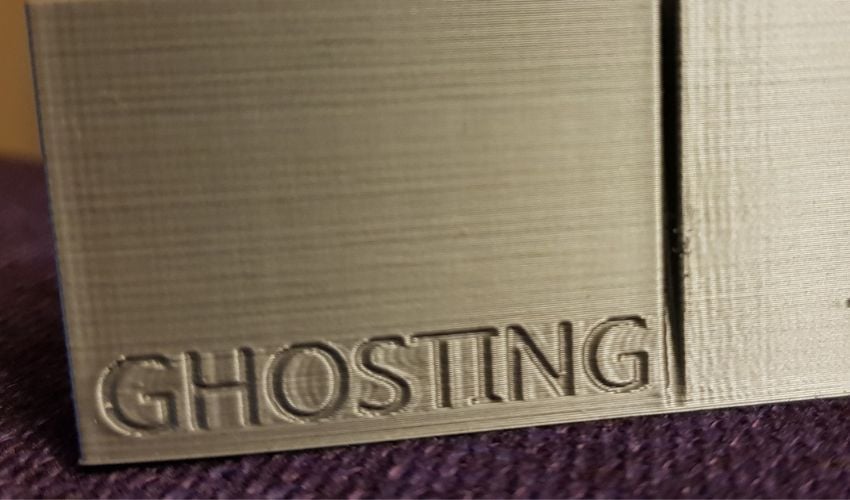 NewsWhy Ghosting Occurs in 3D Printing and How to Avoid It3D printing, like any manufacturing method, does not come without problems. Besides stringing in 3D printing, where unwanted thin filament threads are stretched between non-printed areas, thus creating ‘strings’ of material, there is also ghosting. You may have heard
  NewsAll You Need to Know About Cold Spray Additive ManufacturingThe various additive manufacturing technologies available today can seem endless, though they often fall into one of about seven categories, but not all of them. Take, for example, cold spray additive manufacturing. Cold spray is a technique which involves the…
 NewsHow is the 3D printing community responding to COVID-19?During the last few days, a wide range of initiatives have emerged across the world to face the current health crisis. It’s no secret that global stocks are running low for essential products such as masks or ventilators. Hospitals are…
 NewsFashion breakthroughs thanks to 3D printing collaboration at NYFWAt New York Fashion Week (NYFW) last week, fashion witnessed some breakthroughs thanks to a new technique developed by one of the 3D printing giants, Stratasys. The collaboration between the 3D printer manufacturer and fashion designers threeASFOUR and Travis Fitch…