News
All You Need to Know About Cold Spray Additive Manufacturing
The various additive manufacturing technologies available today can seem endless, though they often fall into one of about seven categories, but not all of them. Take, for example, cold spray additive manufacturing. Cold spray is a technique which involves the…
- 3 min read
- News
- Six more stories

The various additive manufacturing technologies available today can seem endless, though they often fall into one of about seven categories, but not all of them. Take, for example, cold spray additive manufacturing. Cold spray is a technique which involves the use of a high-velocity gas jet – at up to four times the speed of sound – which accelerates powder particles onto a substrate, usually a metal, over a distance of approximately 25mm. This technique can form a coating over the piece, or, in the case of AM, can be used to form an entire part. The cold spray process itself was developed by researchers at the Institute of Theoretical and Applied Mechanics (ITAM) of the Siberian Branch of the Russian Academy of Science, in the 1980s. The group realized that it was possible to coat solid particles with a gas flow at room stagnation temperature.
In terms of cold spray additive manufacturing, this is a technique which uses cold spraying to form entire parts (or to fix broken or damaged parts). It is done with a spray nozzle and robotic arms that either are moving a substrate or the nozzle itself, with different benefits and limitations to each method. But what are the advantages of using this method? What about the applications? We took a closer look.
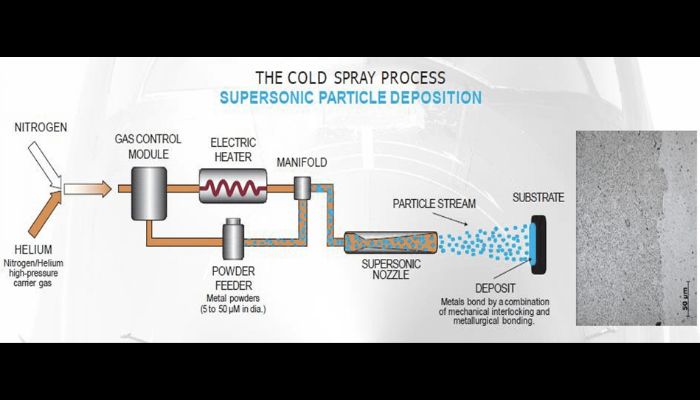
Photo credit: VRC Metal Systems
Benefits and Limitations of Cold Spray Additive Manufacturing
One of the main advantages of cold spray in general over thermal spraying is that, because the temperature does not go above 800 degrees, it can be used for temperature-sensitive materials (including nanostructured) and oxygen sensitive (such as titanium and aluminum, both of which oxidize) as the particles do not melt. Furthermore, the production time is short – shorter than SLM, EBM, and LMD, and the product size list unlimited. Additionally, cold spraying can be undertaken with a number of different metals and their compounds. These include aluminum, nickel, copper, steel and titanium, as well as precious metals – silver, gold, and platinum – and refractory materials. Furthermore, cold spray additive manufacturing has a particular advantage for the repairing of corroded or damaged parts, particularly in the aerospace industry.
More from the desk
Six other notes from the rest of the bench.
 NewsInfraredTags, Invisible Barcodes Embedded in 3D Printed ObjectsAt MIT, a fourth-year doctoral student in the Department of Electrical Engineering and Computer Science has developed a method to “lock” information into a physical object. Using 3D printing and a camera that uses the infrared (IR) range, he can…
 NewsSpaceIL using 3D printing to win $30M prize by landing on MoonIn what promises to be a momentous achievement, an Israeli startup is attempting to use 3D printing to land on the Moon. The startup, SpaceIL, plan to land a vehicle on the moon, including many 3D printing parts. Why? Google…
 GuidesThe Personalities Who Shaped the Additive Manufacturing Market in 2023As we approach the end of the year, it’s time for us to take a look back at the market, and at the personalities who have shaped the 3D printing sector in 2023. Whether they work in major corporations, startups…
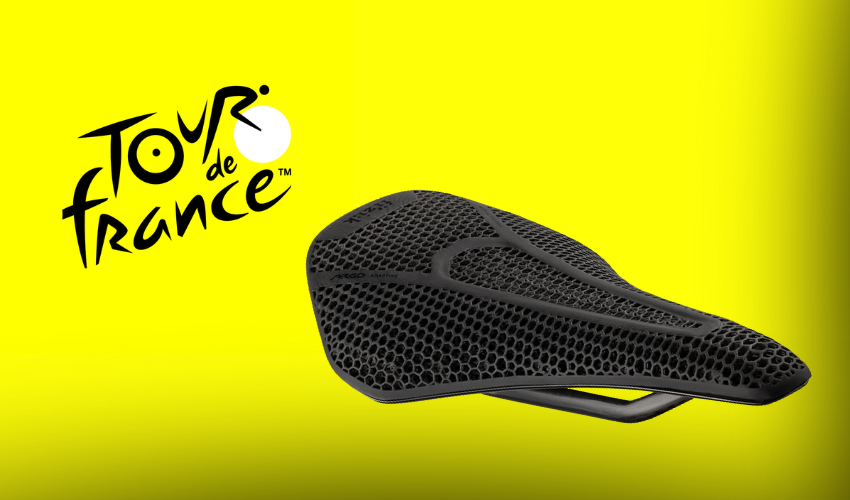 NewsA 3D Printed Saddle Rode to the Finish Line at the Tour de FranceThrough the excitement and fanfare of the last stage of the Tour de France, one of the quiet stars of the competition didn’t even pedal at all. Beneath Slovenian cyclist and Tour de France Winner Tadej Pogačar, a sleek $400…
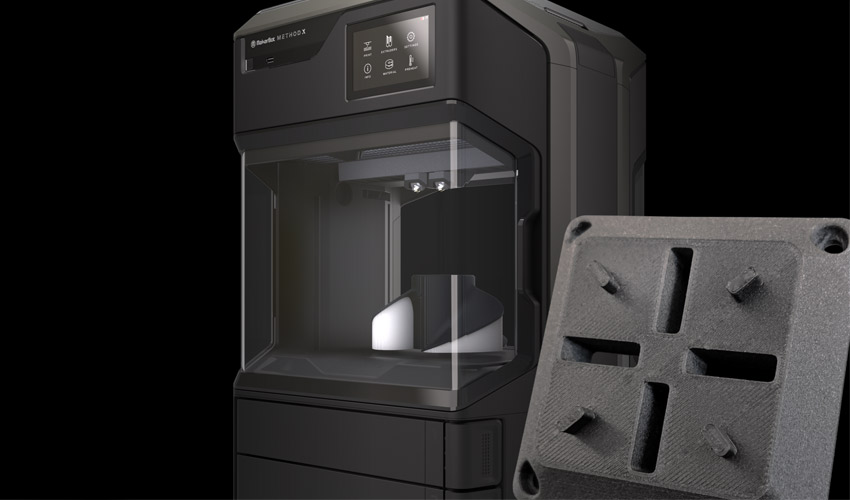 PrintersMETHOD Carbon Fiber Edition, the carbon fiber 3D printer from MakerBotThe manufacturer MakerBot has just launched a new professional machine capable of printing carbon fiber reinforced nylon, also developed by the manufacturer. Named METHOD Carbon Fiber Edition, this solution is based on the METHOD platform developed in December 2018 but…
 NewsFormnext Start-Up Challenge 2023: What Do This Year’s Winners Expect From the Event?The most anticipated event of the year in the Additive Manufacturing industry, Formnext 2023 is just around the corner. Held in Frankfurt, Germany, from November 7 to 10, companies and professionals from all over the world have already secured their…