News
Francisco Bonansea and his use of 3D printing to create guitars at home
Additive manufacturing is impacting all types of sectors, including music! We have witnessed the emergence of 3D printed instruments with the same sound capacity as a conventional musical instruments. This production method is becoming increasingly common among professional music
- 3 min read
- News
- Six more stories
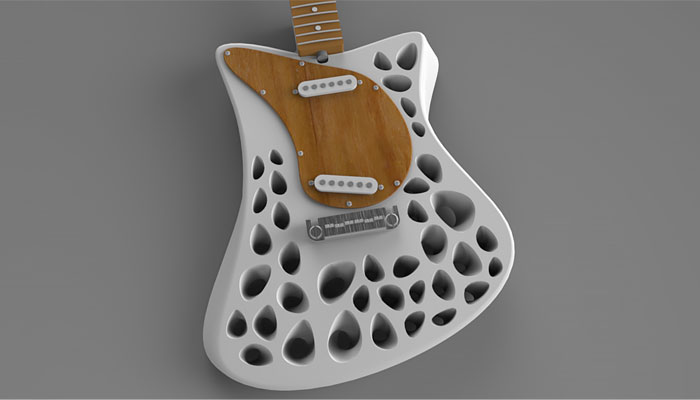
Additive manufacturing is impacting all types of sectors, including music! We have witnessed the emergence of 3D printed instruments with the same sound capacity as a conventional musical instruments. This production method is becoming increasingly common among professional musicians and people from the maker community. For example, a few months ago we were delving into Nik Huber Guitars‘ use of 3D printing: making guitar bridges using amorphous metals, they obtaining the pieces more quickly and easily than with traditional methods. One of the projects that caught our attention comes from the Argentinian industrial designer, Francisco Bonansea, who is also using 3D printing to create his own line of guitars. Under the brand Bonansea, we met Francisco Bonansea to learn more about his activity and his relation with this manufacturing method.
3DN: Can you introduce yourself and tell us how your relationship with 3D printing began?
I am Francisco Bonansea Mazzoni, from Bahía Blanca (Bs As, Argentina). I am an industrial designer graduated from the Universidad Nacional de la Plata. Once I finished my studies, I started to work in a self-employed way, until I formed Fractal Design with a partner, and then I formed other partnerships and worked in different projects. I started to make my first impressions in 2016, in a local entrepreneurs’ club, making prototypes and mock-ups of designs, to then start making final products. Last year I concentrated more on this new facet, making drum accessories, guitar and bass stands.
3DN: What are the technical characteristics of the guitar you have developed?
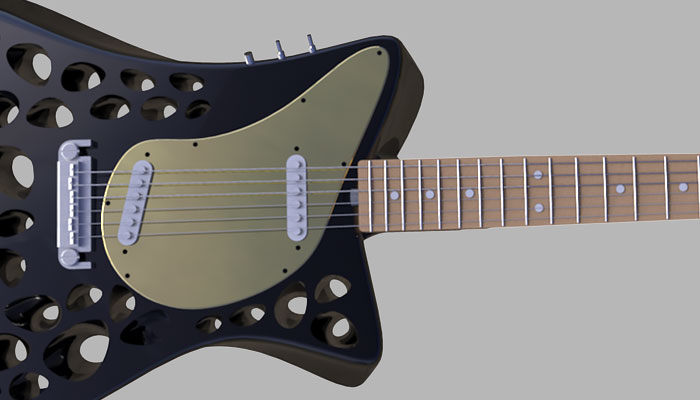
The guitar has a headphone output to listen to yourself, or a speaker with the same 3.5mm audio cable. This allows you to use the guitar anywhere, either outside or inside a house, you can share the space with other people without disturbing them at all, giving the guitarist the flexibility to be able to practice and play in any circumstance. It weighs only 2 and a half kilos (one kilo less than one in the market); an important feature when playing in a show. It also contains a tone control (bass/treble), overdrive graduation, guitar and headphone volume.
More from the desk
Six other notes from the rest of the bench.
 NewsAM Workflow Optimization for Metal 3D Printing with GF Machining SolutionsHow can the AM workflow be optimized for metal additive manufacturing? Dogan Basic, Product Marketing Manager at GF Machining Solutions, explains how the company helps customers integrate metal 3D printing into the process chain. In collaboration with 3D Systems, it…
 NewsGraphene Improves Properties of Copper Powder used in Additive ManufacturingIn Sweden, Uppsala University and the company Graphmatech have worked together to develop a rather unusual copper powder in order to create denser 3D printed parts. Using a laser fusion process, the researchers modified the metal’s surface with graphene. Thanks…
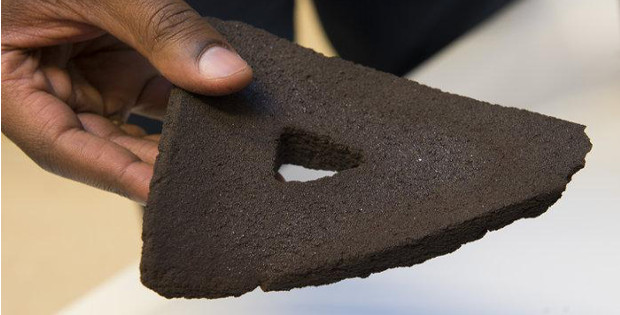 NewsThe European Space Agency’s moon brickThe age of space living may be upon us as the European Space Agency (ESA) has just announced new developments in what looks to be the future of space colonization. Following NASA’s innovations in 3D printed chainmail and their 3D printed…
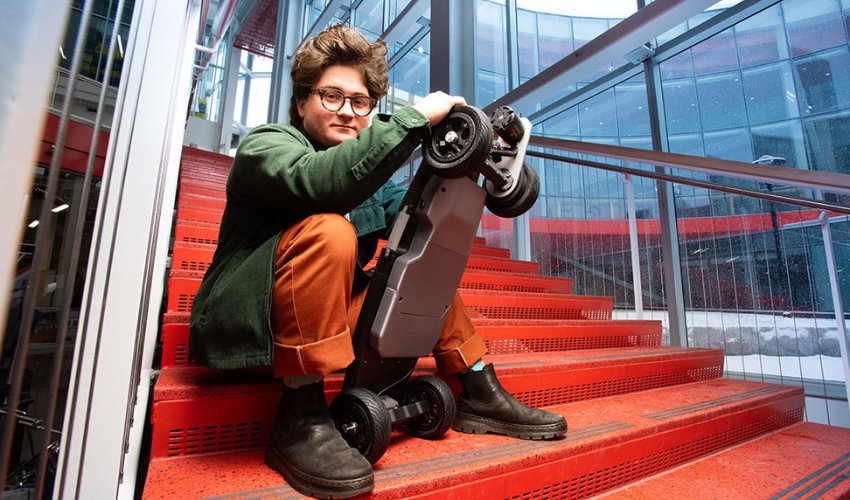 ApplicationsRIT Student 3D Prints Custom-Designed Electric SkateboardThe world of 3D printing has seen a surge in the creation of functional objects, ranging from custom surfboards with optimized wave-riding characteristics to lightweight bicycle components that improve overall performance and comfort. Following this wave of innovation, Mike Elrod
 Applications3D Printed Human Skin Equivalents Help Identify Potential HSV TreatmentsHerpes Simplex Virus (HSV) is estimated to infect 64% of the world’s population, according to the World Health Organization. The virus causes oral and genital herpes, and while it can be asymptomatic, it can also cause painful flare-ups and make…
 NewsAncient Roman Concrete Meets Modern 3D Printing to Save Coral ReefsThe underwater coral reefs of the world are some of our Earth’s most diverse and fascinating, living, breathing ecosystems. Unfortunately due to pollution, climate change and other negative factors, coral reefs are in extreme danger of extinction, with 90% of…