Materials
Could Self-Sensing Materials Be the Future of 3D Printing?
What if 3D printed materials could detect problems before it was too late to solve them? Engineers at the University of Glasgow are working on making that possible by creating a system capable of modeling the physics of self-sensing 3D…
- 3 min read
- Materials
- Six more stories

What if 3D printed materials could detect problems before it was too late to solve them? Engineers at the University of Glasgow are working on making that possible by creating a system capable of modeling the physics of self-sensing 3D printed composites. The materials can detect strain, load, and damage using only a measure of electrical current, and this could allow the status of materials to be monitored in real-time, unlocking the potential for safety and quality assurance features for various applications.
How do these self-sensing materials work? According to the press release from the University of Glasgow, “Weaving fine strands of carbon nanotubes throughout materials can allow them to carry an electrical current, imbuing them with the ability to monitor their own structural integrity through a phenomenon called piezoresistivity.” If the electrical current changes, it can mean that the material has been crushed or stretched, permitting the fault to be addressed.
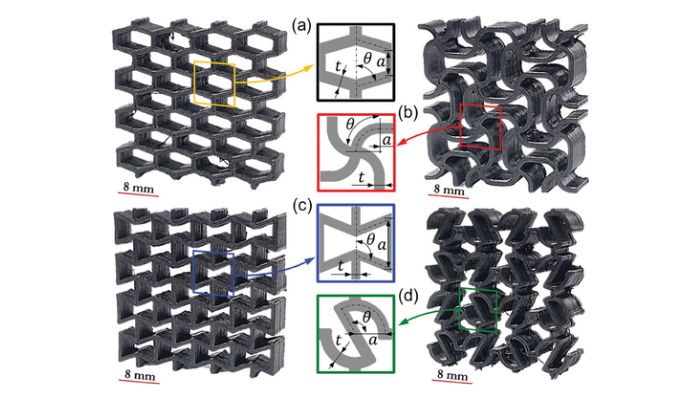
The four different lattices created by the University of Glasgow engineers (Photo credit: University of Glasgow)
Professor Shanmugam Kumar, of the University of Glasgow’s James Watt School of Engineering, led the research. He explained, “Imparting piezoresistive behavior to 3D-printed cellular materials gives them the ability to monitor their own performance without any additional hardware.”
More from the desk
Six other notes from the rest of the bench.
 ApplicationsAML3D ships 3D printed marine propellerThe Australian company, AML3D, has shipped a Stainless Steel grade 316L propeller to 3D Printing Corporation (3DPC), a Japanese based 3D printing consultancy firm. Compared to traditional manufacturing technologies, the promise of additive manufacturing is to deliver components a
 ApplicationsZSFab Announces First U.S. Clinical Use of 3D Printed Impants in Spinal SurgeriesIt seems that every week, there is a new innovative use of 3D printing in the healthcare sector. Whether for implants, bioprinted organs, prostheses & orthoses, dentistry, or any of the innumerable applications for additive manufacturing in the wide medical…
 ApplicationsResearchers Create 3D Printed Surgical TableNorth American University researchers recently announced the successful creation of a 3D-Printed surgical table. The project, a collaboration between the University of Western Ontario (Western) and Michigan Technological University (Michigan Tech), was conducted using open-source
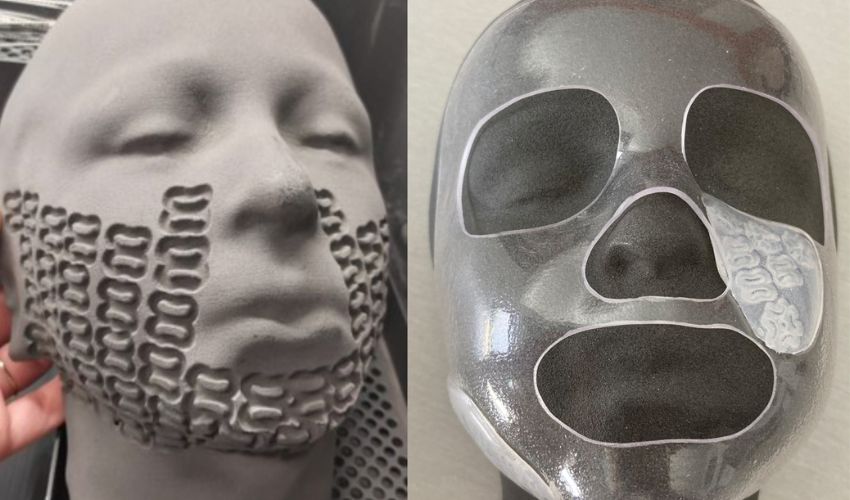 Applications3D Printing is Being Used to Treat Children With Severe Burns3D printing is making more and more progress in the medical field with applications in bioprinting, 3D printed prostheses, digitization of dentistry and much more. Adding to the advances of additive manufacturing in medicine is a recent collaboration between Italy…
 SoftwareTopology Optimization vs. Generative Design: Which Modeling Tool Should You Choose?There is a constant race for even faster production, parts meeting higher demands and to surpass our current accomplishments. To achieve this, the products we manufacture have to be optimized in one way or another, so that they perform even…
 NewsDynamic 3D Printing Method Achieves Unmatched Speed and AccuracyRelying on the speed of light, researchers at Northwestern University have developed a remarkably faster photopolymerization-based 3D printer. The researchers claim to be able to deposit 4,000 layers in just 2 minutes! But that’s not all: this 3D printer, equipped…