News
Cornell Researchers Have 3D Printed a Superconductor
Cornell University researchers recently announced that they have created a new way to 3D print superconductors that deliver record-setting performance. Their method was recently published in the ‘Nature Communications’ journal, and specifically uses a one-step printin
- 3 min read
- News
- Six more stories

Cornell University researchers recently announced that they have created a new way to 3D print superconductors that deliver record-setting performance. Their method was recently published in the ‘Nature Communications’ journal, and specifically uses a one-step printing process that helps simplify fabrication and produces a highly ordered structure. This breakthrough has the potential to advance technologies such as MRI magnets and quantum devices. This shows how additive manufacturing can help streamline the production of materials that once required long and complex processing.
The process used by the researchers relies on a copolymer-nanoparticle ink that organizes itself into nanoscale patterns as it is printed. After receiving a heat treatment, the printed material then becomes a porous crystalline superconductor with properties not achievable through conventional methods. This process helps eliminate multiple preparation steps while allowing for more complex designs. The ability to print directly into functional superconducting forms is what sets this approach apart from previous efforts.
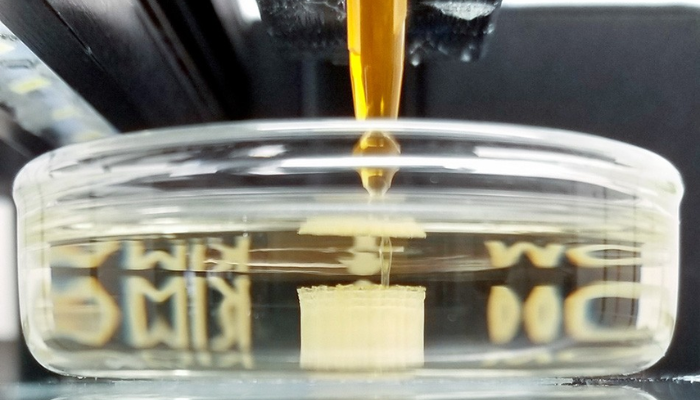
The most striking result came from printing niobium-nitride, a common superconducting material. The 3D-printed version reached an upper critical magnetic field of up to 50 Tesla, which is the highest value ever achieved for this specific compound. Such strength is vital for high-field magnets which are used in the medical and scientific sector. These results confirm that the printed materials are not only faster to produce but also capable of record-breaking performance.
More from the desk
Six other notes from the rest of the bench.
 News10 Reasons to Adopt 3D PrintingToday, many companies in the manufacturing industry still use traditional production methods. That being said, what is known as the fourth industrial revolution is becoming more and more of a reality, leading to the adoption of new methods of creation…
 NewsTop 5 Videos: The Biggest 3D-Printed Office Space in EuropeThis week, we invite you to the largest 3D-printed office space in Europe. This new construction is located in Austria. Construction and architecture companies PERI, STRABAG, and COBOD collaboratively built this massive 3D printing feat. Then, 3Dnatives brings you back…
 NewsTitanium, its alloys and 3D printing with Ti6Al4VTitanium and its alloys, particularly Ti6Al4V, are of great importance in 3D printing. Titanium is a metal found in nature as an oxide, specifically rutile (TiO2) or ilmenite (FeTiO3). The extraction of pure titanium is carried out using the Kroll…
 ApplicationsThe University of Sydney Takes a Leap Towards Functional 3D Printed Human TissuesEmbarking on a journey that seems ripped from the pages of science fiction, a recent breakthrough has brought us one step closer to the future of 3D printing functional human tissues. A collaborative effort between bioengineers and biomedical scientists from…
 MaterialsAll You Need to Know About Polycarbonate (PC) for 3D PrintingPolycarbonate (PC) is a family of thermoplastic polymers defined by the carbonate groups in their molecular structure. Engineering-grade PC is prized for its exceptional impact resistance, and certain grades are optically transparent, combining strength, durability and clarity in
 MaterialsWhy Are Manufacturers Betting on Ceramic FFF 3D Printing?Since its arrival on the additive manufacturing market in 2018, Nanoe has been working to democratize the use of ceramic and metal FFF 3D printing with an accessible and easy-to-implement process. While its filaments have made their way into laboratories…