News
What Are the Major Post-Processing Challenges in 2021?
Post-processing solutions manufacturer PostProcess Technologies has released the third edition of its Annual Additive Post-Printing Survey: Trends Report 2021. This year’s report confirms what was already announced last year, namely the desire to shorten this time-consuming
- 3 min read
- News
- Six more stories
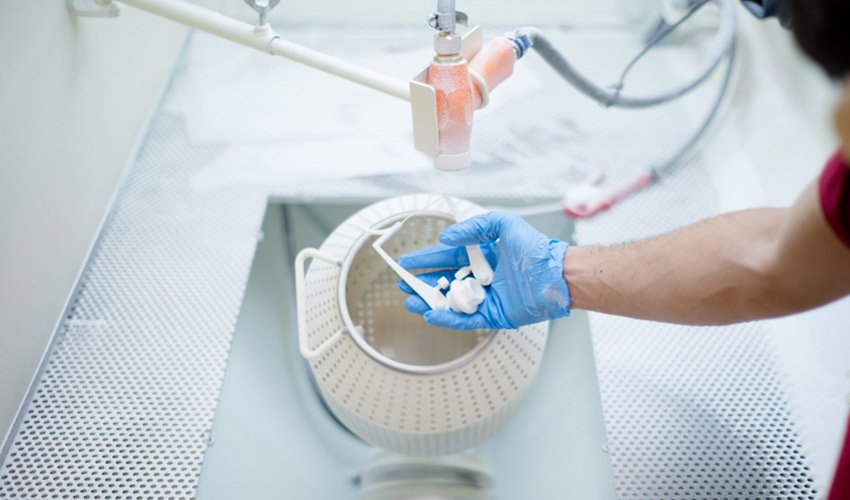
Post-processing solutions manufacturer PostProcess Technologies has released the third edition of its Annual Additive Post-Printing Survey: Trends Report 2021. This year’s report confirms what was already announced last year, namely the desire to shorten this time-consuming step, to improve the quality of finished parts and to allow operators to focus on higher value-added tasks. Overall, users of additive manufacturing want to automate the various post-processing steps as much as possible, especially when it comes to mass production.
This year, the number of participants in the study doubled, demonstrating the growing interest in additive manufacturing among users. Another 50% of respondents are fully aware of the methods used in their companies, a new sign of interest. The PostProcess Technologies study focuses on post-processing trends according to the 3D printing processes chosen by the participating companies; not surprisingly, fused deposition modeling (FDM), photopolymerization and selective laser sintering (SLS) are among the top three, followed by MultiJet Fusion and material jetting. Each process has its own specific constraints, of course – something to keep in mind throughout this study.
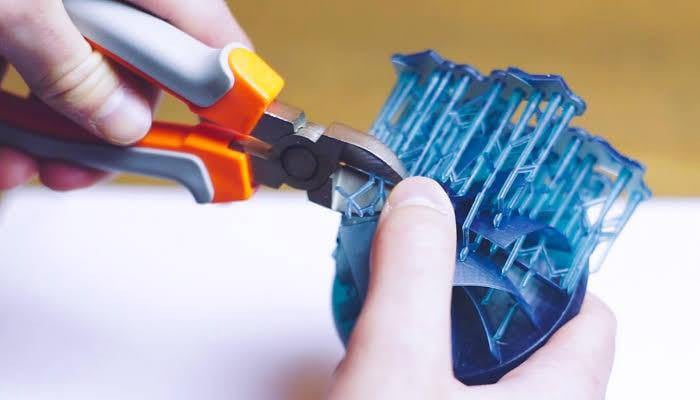
Post-processing techniques depend on the technology used and the final application (photo credits: Nikko Industries)
Current Post-Processing Techniques
As there are many additive manufacturing processes, so too are there post-processing methods: removal of supports, excess materials, surface finishing, polishing, heat treatment, etc. Depending on the final application of the 3D printed part and the process used, the post-processing will be more or less long and complicated. And this year, the most used methods are similar to the previous years: printing support removal for 82% of the participants, surface finishing for 67%, resin removal for 45% and powder removal for 44%. These results are hardly surprising when you consider the 3D printing technologies most commonly used today.
More from the desk
Six other notes from the rest of the bench.
 ApplicationsUrsa Major Propels U.S. Navy Missile Program With 3D PrintingDenver-based rocket innovator Ursa Major, a leading force in propulsion technology, has recently announced the company has secured a landmark contract with the US Navy’s Naval Energetics Systems and Technologies (NEST) Program. The collaboration aims to propel the Navy̵
 Guides#TALK3D: Meet Bradley Rothenberg, the CEO of nTopologynTopology is an engineering software that specializes in developing the next generation of engineering design tools for additive manufacturing. It helps engineers iterate in real time and design new solutions that were previously infeasible. In layman’s terms, the tool incr
 Printers#3DExpress: UltiMaker Launches Announces its New Factor 4 3D PrinterThe additive manufacturing market has been quite active this week! And with good reason, several important announcements were made. First, we couldn’t miss the launch of UltiMaker’s new FDM 3D printer, the Factor 4. This is a solution that aims…
 ApplicationsFord and Red Bull Powertrains Use 3D Printing to Optimize Vehicles for F1In 2023, Ford Motor Company partnered with Red Bull Powertrains to race at Formula 1. It had been more than two decades since Ford has been on racetracks, and now, Ford and Red Bull Powertrains will develop the next-generation hybrid…
 ApplicationsWake Forest Teams Win NASA Challenge with Functional 3D Printed Liver TissuesThe first and second place winners in NASA’s Vascular Tissue Challenge have created 3D printed lab-grown human liver tissues. The two teams of scientists, both from the Wake Forest Institute for Regenerative Medicine (WFIRM) in Winston-Salem, North Carolina were able&hellip
 Guides#Working3D: Six Questions for an Additive Manufacturing Innovation EngineerWe are back with the #Working3D series in which we get to know first-hand the different professions in the 3D printing sector. On this occasion, we will learn about the day-to-day life of an additive manufacturing innovation engineer. Closely related…