Applications
Was the Artemis II Toilet 3D-Printed in Titanium? What We Really Know
The Artemis II mission launched on April 1, carrying four astronauts on the first crewed flight around the Moon in more than half a century. On board was the Universal Waste Management System (UWMS), the first functional toilet to travel…
- 3 min read
- Applications
- Six more stories

The Artemis II mission launched on April 1, carrying four astronauts on the first crewed flight around the Moon in more than half a century. On board was the Universal Waste Management System (UWMS), the first functional toilet to travel on a lunar mission. Since then, it has often been described as a “3D-printed titanium” toilet. But how accurate is that claim?
The UWMS is not a new system. Collins Aerospace began developing it in 2015 under a $30 million NASA contract, and an initial version was delivered to the International Space Station in 2020 for testing. The version flown aboard the Orion capsule on Artemis II is a more compact adaptation of that original design, optimized for deep space missions.
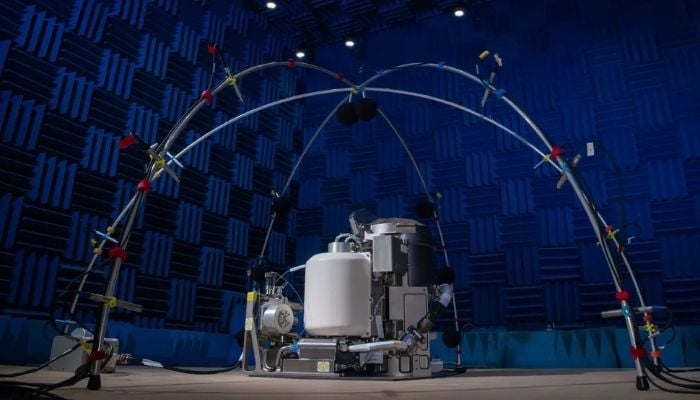
The toilet system installed on the ISS (Photo Credits: NASA).
Where 3D Printing Comes In
In September 2020, just days before the UWMS was sent to the ISS, NASA stated on its official Tumblr that the system included “a 3D-printed titanium cover for its dual fan separator.” This component, known as the Dual Fan Separator (DFS), is the mechanical core of the UWMS. It generates the airflow that, in microgravity, moves waste toward the collection containers. What NASA identified as 3D-printed was the cover of this component, not the entire toilet.
More from the desk
Six other notes from the rest of the bench.
 Materials8 Reasons to Use High-Performance Polymers in Additive ManufacturingHigh-performance polymers (HPP) have been used in industry for several decades, particularly in injection molding and machining. However, in recent years, they have ceased to be materials exclusive to traditional engineering and have made their appearance in additive manufacturin
 GuidesNASA Engineers on the Importance of Metal Additive Manufacturing for PropulsionFor some time now, NASA has been using 3D printing for everything from prototyping to end-use parts. In fact, it’s use has become so widespread, that the organization is becoming one of the leaders in research into the use of…
 ApplicationsConcrete 3D Printing Will Be Used for the UK’s New High Speed Rail Network, HS2In January 2012, it was announced that a national high speed rail network would be built in the United Kingdom, the HS2. Currently, construction is underway on the first phase of the rail, covering 140 miles between London and Birmingham.…
 PrintersUltimaker unveils their new S5 3D printerUltimaker, the Dutch manufacturer of desktop 3D printers, has revealed their new machine, the Ultimaker S5. Presented at the Hannover Fair, the S5 includes a larger build volume, a touch screen, resealable windows, a mobile application and the capability of…
 MaterialsAll You Need to Know About Polycarbonate (PC) for 3D PrintingPolycarbonate (PC) is a family of thermoplastic polymers defined by the carbonate groups in their molecular structure. Engineering-grade PC is prized for its exceptional impact resistance, and certain grades are optically transparent, combining strength, durability and clarity in
 NewsRecovery of 3D printing market driven by China and Desktop 3D Printer ShipmentsThe company CONTEXT recently published its latest market study on the global 3D printing market. It states that the Chinese and Desktop 3D Printer markets are leading the way for a longer U-shaped recovery of the global sector. According to…