Applications
Porsche offers 3D printed customizable seats for its sports cars
A growing number of automotive companies are turning to 3D printing to create parts for their vehicles. Whether it’s for rapid prototyping, tooling applications or creating custom-made parts, the applications are wide-ranging. In fact, the consulting firm specialized in the&helli
- 3 min read
- Applications
- Six more stories

A growing number of automotive companies are turning to 3D printing to create parts for their vehicles. Whether it’s for rapid prototyping, tooling applications or creating custom-made parts, the applications are wide-ranging. In fact, the consulting firm specialized in the 3D printing market, SmarTech Publishings, released a report that predicts that this market will reach $5.3 billion in value by 2023. Going beyond rapid prototyping and tooling, a large stream of revenue should be generated by the production of end use parts.
We have seen many developments in the sector, including the most recent collaboration between 3DGBIRE, Ultimaker and BAC. The three companies partnered to develop over 40 parts for BAC’s Mono R supercar. For luxury and sports cars in particular, 3D printing can create tailor-made parts, well-suited for customers looking for a high level of personalization. This is also what Porsche is offering with its 3D printed bodyform full-bucket seats. In order to offer maximum comfort to drivers, these seats are completely customizable.
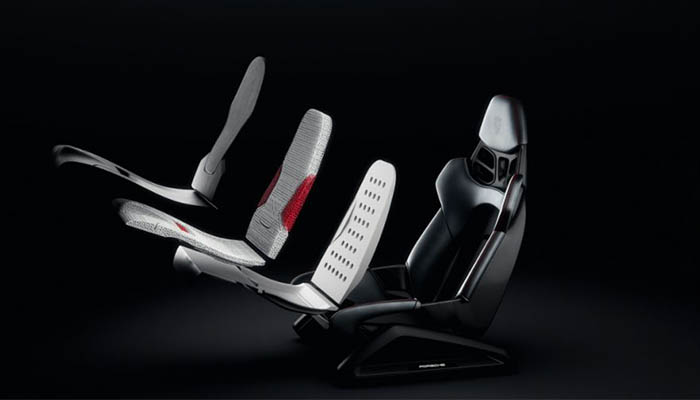
Image via Porsche
For a long time now, professional racing cars have offered customizable seats. So why not bring the concept to luxury and sports cars using 3D printing? Michael Stefner, Member of the Executive Board for R&D at Porsche explains: “The seat is the interface between the human and the vehicle, and is thus important for precise, sporty handling. That’s why personalized seat shells customized for the driver have been standard in race cars for a long time now.”
More from the desk
Six other notes from the rest of the bench.
 NewsWhale-Inspired 3D Printed Shoe Released by Elastium x LaLaLand3D printed shoes have been circulating in the footwear market for years. From high fashion shoes to running sneakers, we’ve seen many brands, including adidas, Dior, and ASICS, use 3D printing to create innovative products. LaLaLand Production and Design, California’s…
 SoftwareTopology Optimization vs. Generative Design: Which Modeling Tool Should You Choose?There is a constant race for even faster production, parts meeting higher demands and to surpass our current accomplishments. To achieve this, the products we manufacture have to be optimized in one way or another, so that they perform even…
 PrintersDesktop Metal launches Fiber 3D printer for continuous fiber 3D printingYou all know Desktop Metal for its metal 3D printers, designed to fit into an office environment with the Studio System and to also enable mass manufacture with the Production System. The U.S. manufacturer has announced the launch of a…
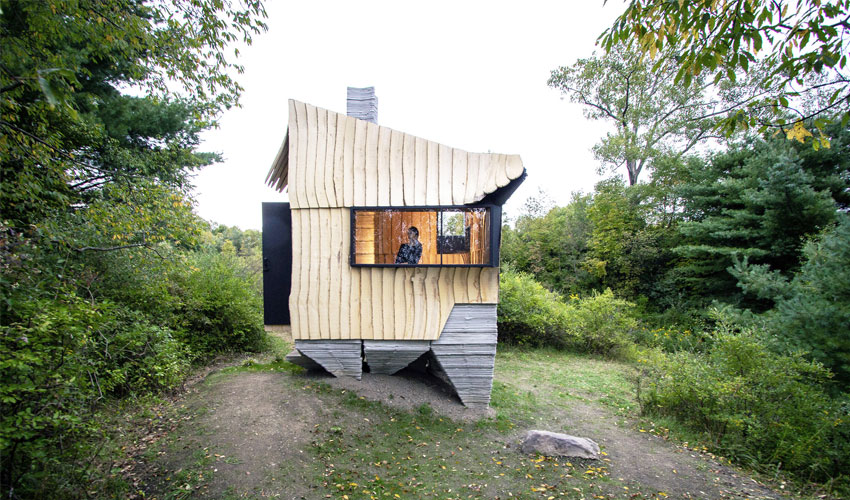 NewsA 3D printed and recycled wood cabinWhat if we reuse wood waste to make small houses and other constructions? That’s the idea behind Ashen Cabin, a cabin imagined by the HANNAH design studio: using emerlad-ash-borer-infested wood (a species of beetle insect), the American company used 3D printing…
 Applications#3DExpress: Facial Implants Made Using 3D PrintingIn this issue of #3DExpress, we once again present five exciting news items from the world of 3D printing that have caused a stir this week. First up: the 3D-printed facial implant that the University Hospital Basel has produced and…
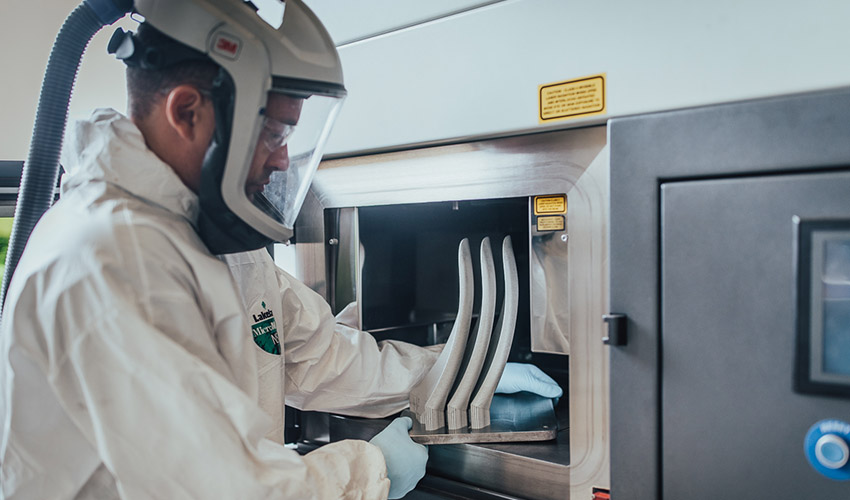 NewsUsing metal additive manufacturing for renewable applicationsRenishaw has collaborated with the Nova Scotia Community College (NSCC) in Canada to produce two ocean turbine parts using additive manufacturing for industrial design firm Biome Renewables. Biome Renewables is a startup specialized in using biomimetic design processes to create&